THE CLASSIC COLLECTION✦A dead man’s diaryCLASSIC FREE BOOKS
A dead man’s diary
Coulson Kernahan
THE CLASSIC COLLECTION · 1909
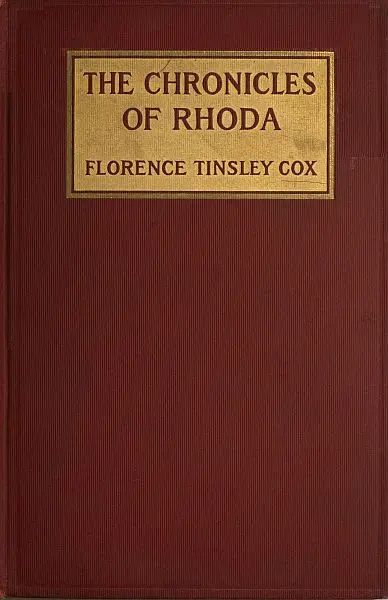
"The Chronicles of Rhoda" by Florence Tinsley Cox is a novel written in the early 20th century. The narrative centers around a young girl named Rhoda Harcourt, exploring her imaginative thoughts, her relationships with her family, and her experiences as she navigates childhood. The book delves into themes of innocence, love, and the complexities of growing up, inviting readers into the whimsical and sometimes tumultuous world of Rhoda. The opening of the novel introduces Rhoda's family life and the special bond she shares with her grandmother. As Rhoda interacts with her family, she showcases her vivid imagination, weaving stories and adventures that reflect her childlike perspective. We see Rhoda grapple with feelings of jealousy upon the arrival of new siblings, the challenge of defining her identity, and her unique friendship with her father, which sets the stage for her emotional journey throughout the book. As her family dynamics shift with the introduction of twins, Rhoda's imaginative lens offers both humor and poignancy as she learns about sibling rivalry, love, and the complexities of family life.
Introduction adapted from the source catalogue; source summaries may be automatically generated.
Free to read · English · 38,282 words · No account needed
MAKE TIME FOR A GOOD BOOK
On by default. Untick to stop anonymous reading totals. Each page counts after 10 seconds in view. How this works.
Anonymous counting is on unless you have switched it off.
For the first and only time in the course of our acquaintance she laughed. She laughed as if she would die, while I sat on my sofa pillow and watched her. During the rest of the lesson she was remarkably friendly.
My mother was much pleased with the progress that I made. She often spoke of Madame Tomaso's method, and of how brilliantly her little pupils played. My mother had never heard of raps. All the family were encouraging in their comments, and they, also, set me a shining example. My mother rubbed up her musical knowledge, and even my grandmother would steal into the parlor in the early twilight, and play some Old World melody which held within its tune the hurry of dancing feet. All these I was to learn some day, when my fingers had grown as strong as my desire. I played better and better for the admiring circle, until Madame Tomaso herself would have been astonished if she could have heard me.
"She really does quite well," my father said one night. "It almost sounds like a tune. Is it 'Yankee Doodle,' or 'Old Dog Tray'?"
"Neither!" my mother cried, warmly. "I don't know exactly what it is myself, but it is probably something classic. And she is doing it beautifully!"
"It is 'Yankee Doodle,' mother," I said, in a whisper.
She did not hear me. She was looking at the piano with sad eyes.
"They have taken an awful lot out of it," she said. "It was the first thing that we bought after we were married!"
"Was it?" my father inquired, briskly. "I thought we bought the coffee-pot first. Didn't we fry eggs in the coffee-pot?"
My mother gave him a startled glance.
"We did fry eggs in a coffee-pot," she admitted, reluctantly. "At least you fried them. I did not know how."
"Somehow eggs don't taste as good now-a-days as those did," my father said, musingly. "I wonder if it was the coffee-pot."
Grandmother leant over my shoulder, and examined the piano cover.
"What made that, Rhoda?" she demanded, pointing to a broad streak which
ran through the plush.
"That is where Madame Tomaso beats time," I answered, meekly.
They looked at one another.
"She is such an excellent teacher," my mother said, apologetically, "that I suppose I ought not to complain. It's very good of her to take so much trouble. Just as soon as they are large enough, she shall teach the twins, too."
"Oh, no, mother!" I cried, quickly.
"Why not, Rhoda?"
I evaded the question.
"Couldn't I teach them, mother?" I asked, anxiously.
They all laughed at me as if I had said something foolish.
Your reading position is saved on this browser. Take it to another device with a library code. Reading pages adapt to text, rather than matching a printed edition.
BEHIND THE BOOK
This eBook is for the use of anyone anywhere in the United States and most other parts of the world at no cost and with almost no restrictions whatsoever. You may copy it, give it away or re-use it under the terms of the Project Gutenberg License included with this eBook or online at www.gutenberg.org. If you are not located in the United States, you will have to check the laws of the country where you are located before using this eBook. Read the source licence.
The original source file, including credits and licence, is retained by this library. Request an original-format copy at no charge. Please include the book title and Project Gutenberg identifier #40526.
KEEP YOUR CURIOSITY GOING
Coulson Kernahan

Maurice Baring
Frances Wright
Cécile Tormay

Frederic Jesup Stimson

W. H. P. (William Henry Pope) Jarvis