THE CLASSIC COLLECTION✦A dead man’s diaryCLASSIC FREE BOOKS
A dead man’s diary
Coulson Kernahan
THE CLASSIC COLLECTION · 1909
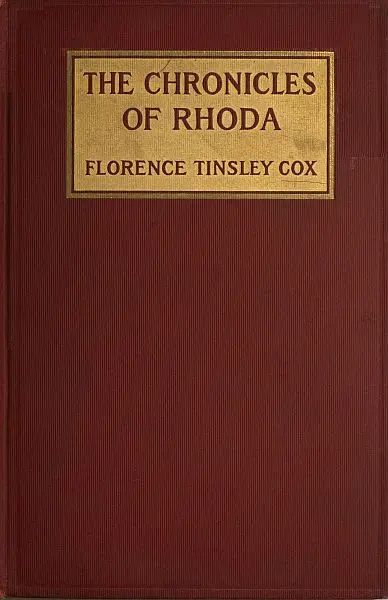
"The Chronicles of Rhoda" by Florence Tinsley Cox is a novel written in the early 20th century. The narrative centers around a young girl named Rhoda Harcourt, exploring her imaginative thoughts, her relationships with her family, and her experiences as she navigates childhood. The book delves into themes of innocence, love, and the complexities of growing up, inviting readers into the whimsical and sometimes tumultuous world of Rhoda. The opening of the novel introduces Rhoda's family life and the special bond she shares with her grandmother. As Rhoda interacts with her family, she showcases her vivid imagination, weaving stories and adventures that reflect her childlike perspective. We see Rhoda grapple with feelings of jealousy upon the arrival of new siblings, the challenge of defining her identity, and her unique friendship with her father, which sets the stage for her emotional journey throughout the book. As her family dynamics shift with the introduction of twins, Rhoda's imaginative lens offers both humor and poignancy as she learns about sibling rivalry, love, and the complexities of family life.
Introduction adapted from the source catalogue; source summaries may be automatically generated.
Free to read · English · 38,282 words · No account needed
MAKE TIME FOR A GOOD BOOK
On by default. Untick to stop anonymous reading totals. Each page counts after 10 seconds in view. How this works.
Anonymous counting is on unless you have switched it off.
"Frank is quite well," she said, "and very busy. Would you like to see
his letter?"
Grandmother hesitated. She almost turned her back upon Evelyn.
"No," she answered, slowly. "No. When he writes a letter to me, I will
read it. Not before."
"Oh, you are hard on Frank," Evelyn protested. "How can he write to you? Didn't you say you would have nothing more to do with him, unless he gave up his profession?"
"Profession! Has an actor a profession?" grandmother cried. "This is the first time I ever heard it called by that name. I said he was to choose between his mother and a child's mad whim, and he made his choice."
She picked up the picture and looked at it with tears in her eyes.
"I could forgive him anything but acting," she said. "Sometimes I think I could even forgive him that. I do so long to see him again."
Evelyn slipped her arm about grandmother.
"He will come back," she cried, consolingly.
"Never," grandmother replied, with a despairing glance at the empty
street. "Don't I know him, Evelyn? Man and boy? He is as stubborn as I
am."
"Would the little boy play with me, grandma, if he came back?" I asked,
excitedly.
They both looked at me, but Evelyn was the only one who smiled.
"Perhaps," she said. "He used to be very fond of you."
After that I was always watching for the little boy. Every morning when I got up I looked out of the window to see if he were not coming in our gate. And the last thing before I went to bed, I looked out carefully again. I thought that I should know him by his hair, and I felt how lovely it would be if he would only come at Christmas time. Christmas was not going to be so nice that year as usual. I did not think that I should get anything. There were lots of presents in the house for other children, even my little brother and sister, but somehow there did not seem to be any for Rhoda!
"Father," I said, one morning, "there's a very pretty book in your top drawer. A child's book. I wonder whose it is?"
He was quite busy reading his paper, but he answered me at once.
"That's for a little friend of mine," he declared. "It's a secret."
"Oh! Is she a good girl, father?"
He glanced at me and laughed.
"Sometimes she's awfully good," he answered.
Your reading position is saved on this browser. Take it to another device with a library code. Reading pages adapt to text, rather than matching a printed edition.
BEHIND THE BOOK
This eBook is for the use of anyone anywhere in the United States and most other parts of the world at no cost and with almost no restrictions whatsoever. You may copy it, give it away or re-use it under the terms of the Project Gutenberg License included with this eBook or online at www.gutenberg.org. If you are not located in the United States, you will have to check the laws of the country where you are located before using this eBook. Read the source licence.
The original source file, including credits and licence, is retained by this library. Request an original-format copy at no charge. Please include the book title and Project Gutenberg identifier #40526.
KEEP YOUR CURIOSITY GOING
Coulson Kernahan

Maurice Baring
Frances Wright
Cécile Tormay

Frederic Jesup Stimson

W. H. P. (William Henry Pope) Jarvis