THE CLASSIC COLLECTION✦A dead man’s diaryCLASSIC FREE BOOKS
A dead man’s diary
Coulson Kernahan
THE CLASSIC COLLECTION · 1893
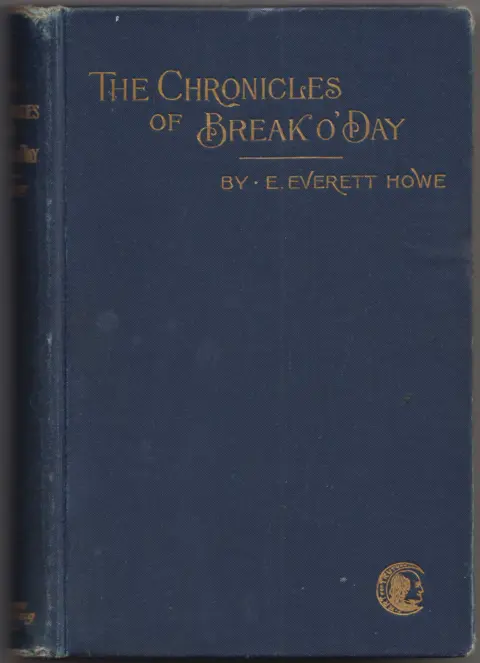
The chronicles of Break o'Day by E. Everett (Edward Everett) Howe. Explore this classic work in a free online edition. Subjects include Farm life -- Fiction; Michigan -- Fiction. Read the locally hosted text below, adjust the reading display, and continue where you left off.
Introduction adapted from the source catalogue; source summaries may be automatically generated.
Free to read · English · 117,492 words · No account needed
MAKE TIME FOR A GOOD BOOK
On by default. Untick to stop anonymous reading totals. Each page counts after 10 seconds in view. How this works.
Anonymous counting is on unless you have switched it off.
Toward morning the major was awakened by loud and repealed shouting. As passers-by had sometimes amused themselves by calling him up and cracking jokes at his expense, he did not at first respond to the summons. But the continuance of the shouting argued the occurrence of something unusual, and, hastily dressing, he went to the dining-room window.
In the road was a band of mounted men, the advance of which only could be seen by Ratke, while the main portion of the body was obscured by the evergreens. Some of the troop carried guns, several bore pitchforks, not more than one or two appeared unarmed, and these probably had revolvers.
"What is the matter?" inquired the major.
"Matter enough!" returned a voice. "Two horses was stole last night, and we're after the thieves."
"We've got some inquiries to make here," said Green, riding through the large gate and within a short distance of the house, where he was followed by the band. "You have men from every part of the country, and nobody knows whether they are honest or not. What we want to know is, where are they?"
"You may search the premises if you like," said Ratke. "All of my men are in the club-house. All but one," he added, "and he is above suspicion. I will call him."
"Trace, Trace," called the major, going to the door of Montcalm's
room with a lamp.
"Come in," said Montcalm, "I thought I heard some one calling."
As soon as Ratke had left him, Montcalm sprang up, scaped together some patches of swamp muck which bad not been noticed by his unobservant employer, and, wrapping them in a paper, threw them hastily into one of his trunks.
Stepping out of doors, he saw the thief-hunters, who were returning
from the club-house.
"Hurrah, boys!" called a young fellow in a white hat; "everybody get
on a horse."
"What is the use of making such a racket?" asked Green. "You let the thieves know you are coming long before we get to them."
"I am my own boss," answered the fellow in the white hat.
Montcalm ran to the horse-barn, unlocked it with the key which he had obtained from Ratke, bridled the steeds and led them out before he was rejoined by his employer. After assisting the major to get on the back of Bill, he too mounted, and they at once sped eastward toward the party, which they presently overtook.
The band halted in front of Takum's.
"We want to see where Phleet is," said Green.
Shout after shout was given, but Philetus did not respond.
Your reading position is saved on this browser. Take it to another device with a library code. Reading pages adapt to text, rather than matching a printed edition.
BEHIND THE BOOK
This eBook is for the use of anyone anywhere in the United States and most other parts of the world at no cost and with almost no restrictions whatsoever. You may copy it, give it away or re-use it under the terms of the Project Gutenberg License included with this eBook or online at www.gutenberg.org. If you are not located in the United States, you will have to check the laws of the country where you are located before using this eBook. Read the source licence.
The original source file, including credits and licence, is retained by this library. Request an original-format copy at no charge. Please include the book title and Project Gutenberg identifier #79241.
KEEP YOUR CURIOSITY GOING
Coulson Kernahan

Maurice Baring
Frances Wright
Cécile Tormay

Frederic Jesup Stimson

W. H. P. (William Henry Pope) Jarvis