THE CLASSIC COLLECTION✦A dead man’s diaryCLASSIC FREE BOOKS
A dead man’s diary
Coulson Kernahan
THE CLASSIC COLLECTION · 1893
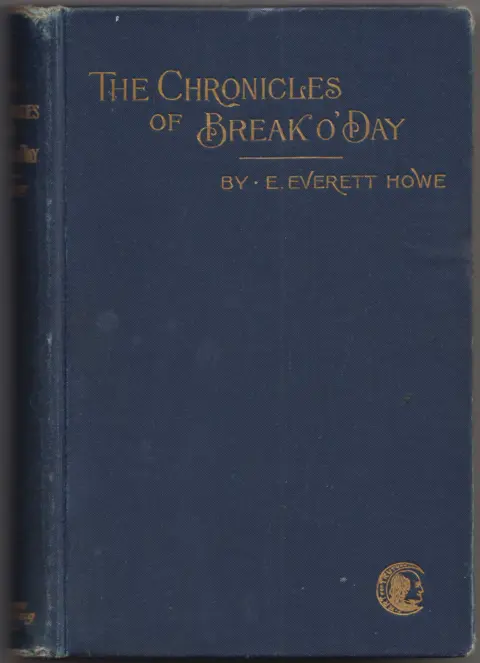
The chronicles of Break o'Day by E. Everett (Edward Everett) Howe. Explore this classic work in a free online edition. Subjects include Farm life -- Fiction; Michigan -- Fiction. Read the locally hosted text below, adjust the reading display, and continue where you left off.
Introduction adapted from the source catalogue; source summaries may be automatically generated.
Free to read · English · 117,492 words · No account needed
MAKE TIME FOR A GOOD BOOK
On by default. Untick to stop anonymous reading totals. Each page counts after 10 seconds in view. How this works.
Anonymous counting is on unless you have switched it off.
Nora's enjoyment of the scene was well-nigh perfect. She clapped her hands, rolled over on the sofa and, but for Archer's monotonous "By-and-By, By-and-By," would certainly have been heard by him.
"Oh, that was splendid, Mr. Archer," she cried, when the hymn was
concluded. "I wish I could sing like that. Now give us a song,
please."
"What kind of a song, Mrs. Warfle?" Archer inquired.
"Something sentimental," answered Nora. "That's what we would all
like to hear."
Thus encouraged, Archer began to sing a narrative, most of which on account of its tedious length must be briefly told in prose.
"Come listen to the awful tale,
That in song I shall bewail,
About a preacher's only son,
And all for love he was undone.
He was but eighteen years of age
When in love he did engage."
When he was twenty years old, after receiving a call to preach, he repeated his proposals of marriage to the young lady.
"But her people, they did object
To him, because he had no prospect."
Her affections blighted, the maiden pined steadily away, and an anxious friend made the following inquiry:
"Madam, what makes you look so pale?
Madam, what makes your colors fail?
Your cheeks was once like roses red,
And now they look as though you was dead.
Your eyes was once as black as sloes.
Now to the grave methinks they goes."
On this solicitation the maiden, telling the story of her love, imparted a warning to those who interfere with affairs of the heart, and at the close of the injunction gave a wail of agony and expired. The parents, stricken with grief at their loss, sent for the minister's son.
"Then to the funeral he did go,
Was dressed in black from top to toe.
This noble young man took his bed,
And in a week more he was dead."
With a voice alternating between a roar and a yell, the singer told the moral to the tragedy in forty lines, four of which are subjoined.
"Now, all you people, far and near,
To stop true love you should ever fear;
For young folks parted sighs do heave.
Sometimes they die and oft do grieve."
"Oh, dear! Oh, my! Oh, my! Oh, dear!" ejaculated Nora, making no attempt to conceal her mirth while the clerk, as he thought, very properly seconded, with less effusiveness, her demonstrations of glee. "Oh! that's awful good, Mr. Archer. That's splendid. Oh! my! Oh, dear! 'Sometimes they die and oft do grieve.' What! You're not going now, are you?"
Your reading position is saved on this browser. Take it to another device with a library code. Reading pages adapt to text, rather than matching a printed edition.
BEHIND THE BOOK
This eBook is for the use of anyone anywhere in the United States and most other parts of the world at no cost and with almost no restrictions whatsoever. You may copy it, give it away or re-use it under the terms of the Project Gutenberg License included with this eBook or online at www.gutenberg.org. If you are not located in the United States, you will have to check the laws of the country where you are located before using this eBook. Read the source licence.
The original source file, including credits and licence, is retained by this library. Request an original-format copy at no charge. Please include the book title and Project Gutenberg identifier #79241.
KEEP YOUR CURIOSITY GOING
Coulson Kernahan

Maurice Baring
Frances Wright
Cécile Tormay

Frederic Jesup Stimson

W. H. P. (William Henry Pope) Jarvis