THE CLASSIC COLLECTION✦A dead man’s diaryCLASSIC FREE BOOKS
A dead man’s diary
Coulson Kernahan
THE CLASSIC COLLECTION · 1893
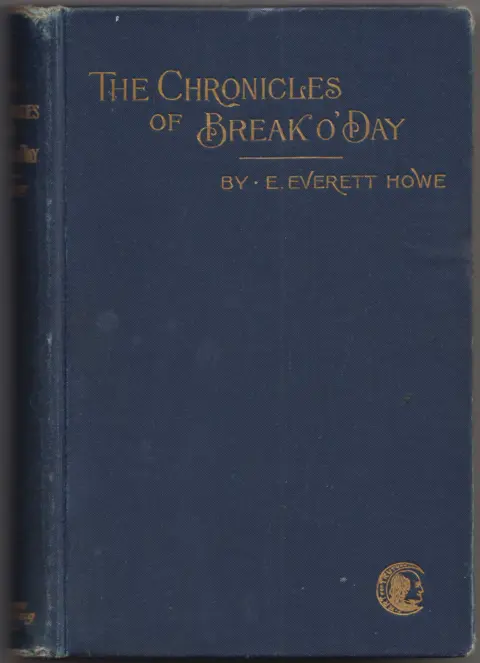
The chronicles of Break o'Day by E. Everett (Edward Everett) Howe. Explore this classic work in a free online edition. Subjects include Farm life -- Fiction; Michigan -- Fiction. Read the locally hosted text below, adjust the reading display, and continue where you left off.
Introduction adapted from the source catalogue; source summaries may be automatically generated.
Free to read · English · 117,492 words · No account needed
MAKE TIME FOR A GOOD BOOK
On by default. Untick to stop anonymous reading totals. Each page counts after 10 seconds in view. How this works.
Anonymous counting is on unless you have switched it off.
Archer supposed that the housekeeper was displeased because she rightly suspected that he was making a deep impression on Nora. Loath to give up the exercise of his fascination, he exchanged sly glances with the young lady, to the great wrath of Mrs. Grippin, who determined to wait until the proper moment, and then, rising in her just indignation, to send Nora to bed. But as Nora caught the gleam of her eye, and Archer abandoned his winking and leering on finding that they were not returned, the Trebian ambush was never sprung. Mrs. Grippin finally returned to her room, saying, as she did so, "Now, Nora, if I hear any more nonsense, you'll start to bed."
"Mr. Archer," said Nora, a few minutes after the departure of her stern relative, "did you ever read history much?"
"Yes," said Archer, "I've read it a good deal."
"Who do you think was the greatest man that ever lived?"
"Well, now, I can't say positive," said Archer with a wise nod, "but I kind o' think George Washington was, don't you?"
"No," said Nora, "I think Tammany Hall was. But they didn't treat him
very well, though."
"That's a fact," said Archer, "they used him miserable."
"Who do you think was to blame?"
"Well, now, it's been a good while since I've read it and a fellow will forget, you know. What do you think?"
"I think Queen Elizabeth was. Let's see. What was it he said when he got on board the steamer that was to take him to Cape Colony? Farewell, O England, thou land of my birth.'"
"Yes, that was it," assented Archer.
"Oh, no. It wasn't either, come to think of it," said
Nora. "Don't you remember?
"'Long have I served thee O, Queen,'
Long hath my love to thee been.
He was a poet, you know."
"That's so," said Archer. "I do remember now."
"What do you think of Moses the Great?"
"I think he was quite a man."
"I guess he was quite a man. He conquered the whole world, you know."
"Yes, I know it," said Archer, bobbing his head.
"Oh, no," exclaimed Nora, "not quite all when we think about it. There was Elisha the Seventh, of Russia, beat him at Waterloo."
"So he did," admitted Archer.
"How Moses the Great did run his horses to get away," pursued Nora, "full-blooded Hambletonians, too. They said they run awful."
"They claim they scratched gravel to beat all," said Archer.
"You can find pictures of all the great men in this history of the world," said Nora, bringing from one of the bookcases a large volume with morocco back and corners.
Your reading position is saved on this browser. Take it to another device with a library code. Reading pages adapt to text, rather than matching a printed edition.
BEHIND THE BOOK
This eBook is for the use of anyone anywhere in the United States and most other parts of the world at no cost and with almost no restrictions whatsoever. You may copy it, give it away or re-use it under the terms of the Project Gutenberg License included with this eBook or online at www.gutenberg.org. If you are not located in the United States, you will have to check the laws of the country where you are located before using this eBook. Read the source licence.
The original source file, including credits and licence, is retained by this library. Request an original-format copy at no charge. Please include the book title and Project Gutenberg identifier #79241.
KEEP YOUR CURIOSITY GOING
Coulson Kernahan

Maurice Baring
Frances Wright
Cécile Tormay

Frederic Jesup Stimson

W. H. P. (William Henry Pope) Jarvis