THE CLASSIC COLLECTION✦A dead man’s diaryCLASSIC FREE BOOKS
A dead man’s diary
Coulson Kernahan
THE CLASSIC COLLECTION · 1893
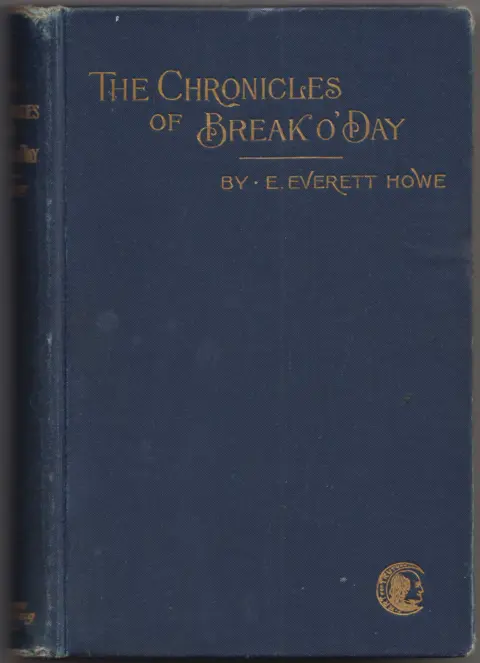
The chronicles of Break o'Day by E. Everett (Edward Everett) Howe. Explore this classic work in a free online edition. Subjects include Farm life -- Fiction; Michigan -- Fiction. Read the locally hosted text below, adjust the reading display, and continue where you left off.
Introduction adapted from the source catalogue; source summaries may be automatically generated.
Free to read · English · 117,492 words · No account needed
MAKE TIME FOR A GOOD BOOK
On by default. Untick to stop anonymous reading totals. Each page counts after 10 seconds in view. How this works.
Anonymous counting is on unless you have switched it off.
"Oh, we can't make a deal to-day," said Mr. Boutwell. "Not under two weeks anyway. I must go to the company and report. If I think it is worth while, we'll take the wagon down to Madgeburg to look at it. Then if we all think it's an improvement, we'll give you a fair price for it."
"Then," said the major sadly, "I must sell the farm. My business is
such that I cannot wait."
The Barton hundred and sixty was a fertile piece of land and had excellent buildings. A grasping farmer was ready to buy it for his son who was soon to be married, but knowing Ratke's circumstances, he would offer but thirty dollars an acre, little more than half its value. The cashier of the Second National Bank handed out a number of bills, which Ratke put into a bag. The bag was light, but the heart of the major was heavy.
The afternoon was well spent when Ratke returned to the Cass House. The New Jerusalem, waxing old as an object of wonder, was nearly deserted by the crowd.
As their acquaintance was prolonged, Mr. Boutwell became more talkative, or rather more agreeable, for he had been at first not unwilling to talk.
"How do you like philosophy?" inquired the major.
"Very well," answered Mr. Boutwell. "I used to have a special liking
for it."
"What author is your favorite?" asked Ratke.
"Oh, I like Comstock," said Mr. Boutwell. "I think he's about as good
as any of them."
"Comstock," said the major in disgust, "he is the author of an
elementary physics."
"There are different tastes about authorities," observed Mr. Boutwell. "Some may not like Comstock. I think he does pretty well."
"How do you like Hobbes?"
"First-rate," ventured Mr. Boutwell, thinking that he now heard the name of the major's favorite, "I like him very much."
"I do not. His theories are the most selfish ever put forth by a philosopher. What do you think of his work, the Leviathan?"
"If I remember rightly," said Boutwell, "it has a fine description of
the whale."
The major concluded that Mr. Boutwell had given his entire energies to business. "I hope you are not a disciple of Hobbes," he remarked. "If you are, you will beat me down as much as you can on the price of my wagon. In that case, I can expect an offer from you of not more than five hundred."
"Oh, no," said Boutwell, "not by any means. What I meant was that he
could write pretty well. Now, am I right? Isn't his work in good
style?"
Your reading position is saved on this browser. Take it to another device with a library code. Reading pages adapt to text, rather than matching a printed edition.
BEHIND THE BOOK
This eBook is for the use of anyone anywhere in the United States and most other parts of the world at no cost and with almost no restrictions whatsoever. You may copy it, give it away or re-use it under the terms of the Project Gutenberg License included with this eBook or online at www.gutenberg.org. If you are not located in the United States, you will have to check the laws of the country where you are located before using this eBook. Read the source licence.
The original source file, including credits and licence, is retained by this library. Request an original-format copy at no charge. Please include the book title and Project Gutenberg identifier #79241.
KEEP YOUR CURIOSITY GOING
Coulson Kernahan

Maurice Baring
Frances Wright
Cécile Tormay

Frederic Jesup Stimson

W. H. P. (William Henry Pope) Jarvis