THE CLASSIC COLLECTION✦A dead man’s diaryCLASSIC FREE BOOKS
A dead man’s diary
Coulson Kernahan
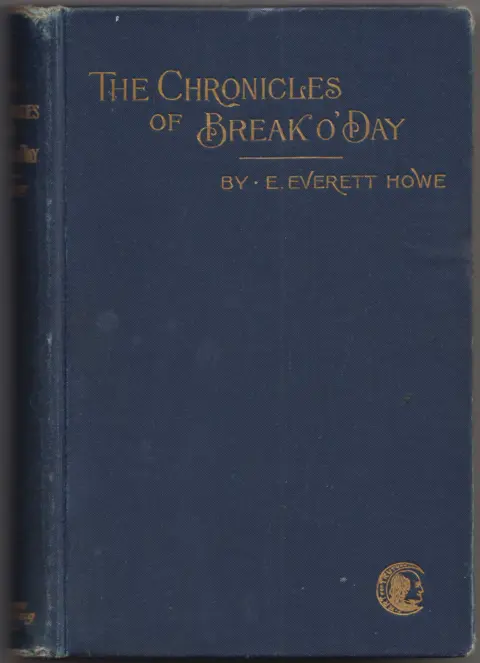
THE CLASSIC COLLECTION · 1893
The chronicles of Break o'Day by E. Everett (Edward Everett) Howe. Explore this classic work in a free online edition. Subjects include Farm life -- Fiction; Michigan -- Fiction. Read the locally hosted text below, adjust the reading display, and continue where you left off.
Introduction adapted from the source catalogue; source summaries may be automatically generated.
Free to read · English · 117,492 words · No account needed
MAKE TIME FOR A GOOD BOOK
On by default. Untick to stop anonymous reading totals. Each page counts after 10 seconds in view. How this works.
Anonymous counting is on unless you have switched it off.
"Thank you," answered John, "I will call at about six."
"Very well," said Manie, "I promised Jennie Holmes to come to her house to-night and I must be going."
John had performed his errand, yet he lingered at the door feeling that he had something still to tell. At last he said, "Good-bye."
"Good-bye," said Manie in surprise, "for how long? Not quite a day."
"I hope not more than that," replied John. "But I have found that my expectations are not to be depended upon. That prospect on which I calculate most is apt to be most completely dissipated."
He tried to keep warmth from his words and tones that they might not betray his longing to indulge in passionate utterance, utterance which, he thought, would warn Manie of the depth of his feeling and banish him from her beyond the possibility of a return. His whole being fought against the restraint. He threw back at her another look and saw a glance which appeared to contain encouragement, but which he could not analyze with certainty. An apprehension seized him that a golden opportunity was passing away, but its place was taken by another that speech would destroy a growing prospect. Their separation promised to be short; and yet, as if he were about to start on a long journey, he felt a desire to bid her a second and different farewell.
Checking himself with the fear that he had already said too much, he left her presence. The next night he would stake his hopes on a revelation to Manie, which, if all circumstances were considered, did not promise a satisfactory result. He was not confident. He shut his eyes to the consequences, while a dread of failure was using its influence to dissuade him from his design.
In the backyard he met Montcalm, who thus addressed him:
"There is a little matter I meant to have spoken to you about before.
Suppose we take a walk."
"I cannot now," responded John, "I have an engagement."
"Accommodate me as soon as you can, then," said Montcalm.
"Any time to-morrow," replied John, hastening to the club-house.
He stayed a few minutes in the chamber and, bringing down his violin, was about to leave the building when Daggett stopped him.
"What, John, you ain't going away?"
"I must," Wrengell replied.
"Oh, pshaw!" ejaculated Daggett, "that's just the way when we need you. Well, go it. I don't blame you."
After Wrengell's departure, Montcalm entered the clubhouse and asked
concerning his whereabouts.
"He's gone," answered Archer, "took his fiddle and gone."
Your reading position is saved on this browser. Take it to another device with a library code. Reading pages adapt to text, rather than matching a printed edition.
BEHIND THE BOOK
This eBook is for the use of anyone anywhere in the United States and most other parts of the world at no cost and with almost no restrictions whatsoever. You may copy it, give it away or re-use it under the terms of the Project Gutenberg License included with this eBook or online at www.gutenberg.org. If you are not located in the United States, you will have to check the laws of the country where you are located before using this eBook. Read the source licence.
The original source file, including credits and licence, is retained by this library. Request an original-format copy at no charge. Please include the book title and Project Gutenberg identifier #79241.
KEEP YOUR CURIOSITY GOING
Coulson Kernahan

Maurice Baring
Frances Wright
Cécile Tormay

Frederic Jesup Stimson

W. H. P. (William Henry Pope) Jarvis