THE CLASSIC COLLECTION✦A dead man’s diaryCLASSIC FREE BOOKS
A dead man’s diary
Coulson Kernahan
THE CLASSIC COLLECTION · 1893
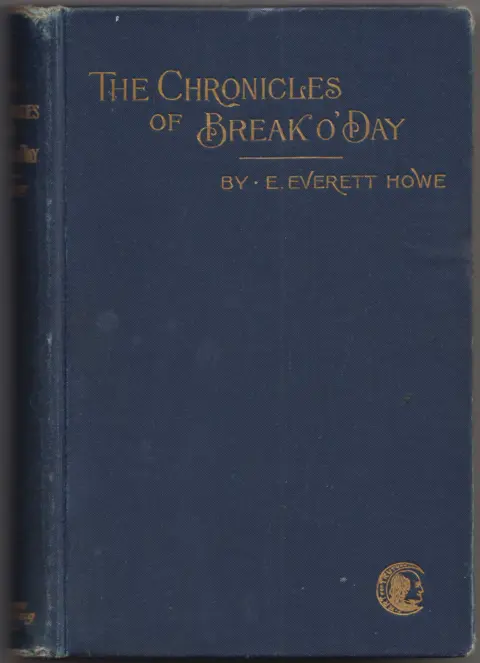
The chronicles of Break o'Day by E. Everett (Edward Everett) Howe. Explore this classic work in a free online edition. Subjects include Farm life -- Fiction; Michigan -- Fiction. Read the locally hosted text below, adjust the reading display, and continue where you left off.
Introduction adapted from the source catalogue; source summaries may be automatically generated.
Free to read · English · 117,492 words · No account needed
MAKE TIME FOR A GOOD BOOK
On by default. Untick to stop anonymous reading totals. Each page counts after 10 seconds in view. How this works.
Anonymous counting is on unless you have switched it off.
"The next witness I shall perceed to call," said the justice, "is William Henry Harrison Hibbard."
Gently pushed forward by several men, William Henry Harrison took the
chair.
Sparks gravely looked down at the law-book and repeated these words: "William Henry Harrison Hibbard, you do solemnly swear that the evidence you shall give to this inquest concernin' the death of the person here lyin' dead shall be the truth, the whole truth and nothin' but the truth."
The half-wit stared stupidly at the justice, but made no reply.
"The court is waitin'," observed Sparks. "We want you to speak up."
Still the witness did not answer.
"We're in a hurry," said Sparks. "Do you swear it, I say?"
"No," replied William Henry Harrison.
"What!" ejaculated Sparks, "you won't tell us? Now I ask you again. Do you swear to tell the truth?"
"No," said William Henry Harrison, "I no swear. Wicked, awful."
"We do not want you to swear or say anything bad," said the major. "We want to know if you will tell the truth."
"Yes," was the response. "I no lie."
"Now, William Henry Harrison Hibbard," Sparks began, "we want you to tell us somethin' about the murder. Some think you know more about it than you care to tell. They kind o' think you know who it was that hit 'im."
William Henry Harrison's terror of the preceding night was revived. He remembered the dark-lantern, the hideous face which had peered into his, the great shadow which had been thrown on the ceiling and the threats which the ferocious intruder had uttered. He drew down his head and shoulders and cast an uneasy glance toward the door which led to the cellar.
"I want to ask you, William Henry Harrison," said Sparks, "what did you do as you did for? What did you want to call Mr. Green up there for when you knowed somebody was a-waitin' to kill 'im? There was nothin' fair about that. It wa'n't as you'd like to be done by. Answer me now. What did you want to do it for?"
Poor William Henry Harrison, incapable of defense, could only stare
in mute appeal.
"If you don't answer me," threatened Sparks, "I shall take legal perceedin's agin you. What did you want to do it for?"
"I dono," responded the half-wit.
"Yes, you do know, too," persisted Sparks. "If you called him up there, you know what you called him for, You orto be ashamed o' yourself, a-doin' like that. There he'd fed you an' kept you an' give you your clothes, an' you had to up an' play that mean trick on 'im,"
Your reading position is saved on this browser. Take it to another device with a library code. Reading pages adapt to text, rather than matching a printed edition.
BEHIND THE BOOK
This eBook is for the use of anyone anywhere in the United States and most other parts of the world at no cost and with almost no restrictions whatsoever. You may copy it, give it away or re-use it under the terms of the Project Gutenberg License included with this eBook or online at www.gutenberg.org. If you are not located in the United States, you will have to check the laws of the country where you are located before using this eBook. Read the source licence.
The original source file, including credits and licence, is retained by this library. Request an original-format copy at no charge. Please include the book title and Project Gutenberg identifier #79241.
KEEP YOUR CURIOSITY GOING
Coulson Kernahan

Maurice Baring
Frances Wright
Cécile Tormay

Frederic Jesup Stimson

W. H. P. (William Henry Pope) Jarvis