
Last letters from the living dead man
David Patterson (Spirit) Hatch
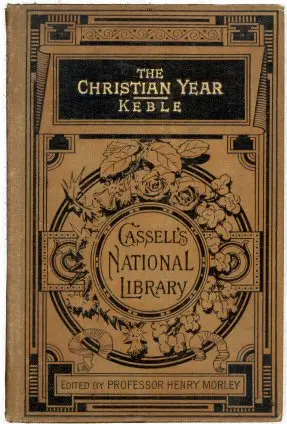
THE CLASSIC COLLECTION · 1827
"The Christian Year" by John Keble is a series of poems written in 1827 for the Sundays and feasts of the Church of England's liturgical calendar. This devotional work became the most popular volume of verse in the nineteenth century, with over 375,000 copies sold by 1873. Several of its poems became beloved hymns. Initially published anonymously, its success led to Keble's appointment as Oxford Professor of Poetry and significantly influenced the Oxford Movement.
Introduction adapted from the source catalogue; source summaries may be automatically generated.
Free to read · English · 48,087 words · No account needed
MAKE TIME FOR A GOOD BOOK
On by default. Untick to stop anonymous reading totals. Each page counts after 10 seconds in view. How this works.
Anonymous counting is on unless you have switched it off.
The blackbird’s song at even-tide,
And hers, who gay ascends,
Filling the heavens far and wide,
Are sweet. But none so blends,
As thine,
With calm decay, and peace divine.
Twenty-Second Sunday after Trinity.
Lord, how oft shall my brother sin against me, and I forgive him?
Matthew xviii. 21.
WHAT liberty so glad and gay,
As where the mountain boy,
Reckless of regions far away,
A prisoner lives in joy?
The dreary sounds of crowded earth,
The cries of camp or town,
Never untuned his lonely mirth,
Nor drew his visions down.
The snow-clad peaks of rosy light
That meet his morning view,
The thwarting cliffs that bound his sight,
They bound his fancy too.
Two ways alone his roving eye
For aye may onward go,
Or in the azure deep on high,
Or darksome mere below.
O blest restraint! more blessèd range!
Too soon the happy child
His nook of homely thought will change
For life’s seducing wild:
Too soon his altered day-dreams show
This earth a boundless space,
With sun-bright pleasures to and fro
Sporting in joyous race:
While of his narrowing heart each year,
Heaven less and less will fill,
Less keenly, thorough his grosser ear,
The tones of mercy thrill.
It must be so: else wherefore falls
The Saviour’s voice unheard,
While from His pard’ning Cross He calls,
“O spare as I have spared?”
By our own niggard rule we try
The hope to suppliants given!
We mete out love, as if our eye
Saw to the end of Heaven.
Yes, ransomed sinner! wouldst thou know
How often to forgive,
How dearly to embrace thy foe,
Look where thou hop’st to live;—
When thou hast told those isles of light,
And fancied all beyond,
Whatever owns, in depth or height,
Creation’s wondrous bond;
Then in their solemn pageant learn
Sweet mercy’s praise to see:
Their Lord resigned them all, to earn
The bliss of pardoning thee.
Twenty-third Sunday after Trinity.
Who shall change our vile body, that it may be fashioned like unto His glorious body, according to the working whereby He is able even to subdue all things onto Himself. Philippians iii. 21.
RED o’er the forest peers the setting sun,
The line of yellow light dies fast away
That crowned the eastern copse: and chill and dun
Falls on the moor the brief November day.
Now the tired hunter winds a parting note,
And Echo hide good-night from every glade;
Yet wait awhile, and see the calm heaves float
Each to his rest beneath their parent shade.
Your reading position is saved on this browser. Take it to another device with a library code. Reading pages adapt to text, rather than matching a printed edition.
BEHIND THE BOOK
This eBook is for the use of anyone anywhere in the United States and most other parts of the world at no cost and with almost no restrictions whatsoever. You may copy it, give it away or re-use it under the terms of the Project Gutenberg License included with this eBook or online at www.gutenberg.org. If you are not located in the United States, you will have to check the laws of the country where you are located before using this eBook. Read the source licence.
The original source file, including credits and licence, is retained by this library. Request an original-format copy at no charge. Please include the book title and Project Gutenberg identifier #4272.
KEEP YOUR CURIOSITY GOING
David Patterson (Spirit) Hatch

David Patterson (Spirit) Hatch

David Patterson (Spirit) Hatch

Edwin Abbott Abbott

Richard Watson
T. G. (Theophilus Gould) Steward