
Last letters from the living dead man
David Patterson (Spirit) Hatch
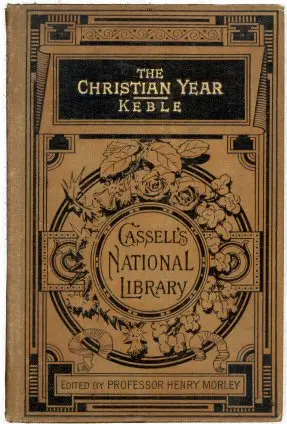
THE CLASSIC COLLECTION · 1827
"The Christian Year" by John Keble is a series of poems written in 1827 for the Sundays and feasts of the Church of England's liturgical calendar. This devotional work became the most popular volume of verse in the nineteenth century, with over 375,000 copies sold by 1873. Several of its poems became beloved hymns. Initially published anonymously, its success led to Keble's appointment as Oxford Professor of Poetry and significantly influenced the Oxford Movement.
Introduction adapted from the source catalogue; source summaries may be automatically generated.
Free to read · English · 48,087 words · No account needed
MAKE TIME FOR A GOOD BOOK
On by default. Untick to stop anonymous reading totals. Each page counts after 10 seconds in view. How this works.
Anonymous counting is on unless you have switched it off.
“Raise thy repining eyes, and take true measure
Of thine eternal treasure;
The Father of thy Lord can grudge thee nought,
The world for thee was bought;
And as this landscape broad—earth, sea, and sky,—
All centres in thine eye,
So all God does, if rightly understood,
Shall work thy final good.”
Twenty-first Sunday after Trinity.
The vision is yet for an appointed time, but at the end it shall speak, and not lie: though it tarry, wait for it, because it will surely come, it will not tarry. Habakkuk ii. 3.
THE morning mist is cleared away,
Yet still the face of Heaven is grey,
Nor yet this autumnal breeze has stirred the grove,
Faded yet full, a paler green
Skirts soberly the tranquil scene,
The red-breast warbles round this leafy cove.
Sweet messenger of “calm decay,”
Saluting sorrow as you may,
As one still bent to find or make the best,
In thee, and in this quiet mead,
The lesson of sweet peace I read,
Rather in all to be resigned than blest.
’Tis a low chant, according well
With the soft solitary knell,
As homeward from some grave beloved we turn,
Or by some holy death-bed dear,
Most welcome to the chastened ear
Of her whom Heaven is teaching how to mourn.
O cheerful tender strain! the heart
That duly bears with you its part,
Singing so thankful to the dreary blast,
Though gone and spent its joyous prime,
And on the world’s autumnal time,
’Mid withered hues and sere, its lot be cast:
That is the heart for thoughtful seer,
Watching, in trance nor dark nor clear,
Th’ appalling Future as it nearer draws:
His spirit calmed the storm to meet,
Feeling the rock beneath his feet,
And tracing through the cloud th’ eternal Cause.
That is the heart for watchman true
Waiting to see what GOD will do,
As o’er the Church the gathering twilight falls
No more he strains his wistful eye,
If chance the golden hours be nigh,
By youthful Hope seen beaming round her walls.
Forced from his shadowy paradise,
His thoughts to Heaven the steadier rise:
There seek his answer when the world reproves:
Contented in his darkling round,
If only he be faithful found,
When from the east the eternal morning moves.
Note: The expression, “calm delay,” is borrowed from a friend, by whose kind permission the following stanzas are here inserted.
Unheard in summer’s flaring ray,
Pour forth thy notes, sweet singer,
Wooing the stillness of the autumn day:
Bid it a moment linger,
Nor fly
Too soon from winter’s scowling eye.
Your reading position is saved on this browser. Take it to another device with a library code. Reading pages adapt to text, rather than matching a printed edition.
BEHIND THE BOOK
This eBook is for the use of anyone anywhere in the United States and most other parts of the world at no cost and with almost no restrictions whatsoever. You may copy it, give it away or re-use it under the terms of the Project Gutenberg License included with this eBook or online at www.gutenberg.org. If you are not located in the United States, you will have to check the laws of the country where you are located before using this eBook. Read the source licence.
The original source file, including credits and licence, is retained by this library. Request an original-format copy at no charge. Please include the book title and Project Gutenberg identifier #4272.
KEEP YOUR CURIOSITY GOING
David Patterson (Spirit) Hatch

David Patterson (Spirit) Hatch

David Patterson (Spirit) Hatch

Edwin Abbott Abbott

Richard Watson
T. G. (Theophilus Gould) Steward