
Last letters from the living dead man
David Patterson (Spirit) Hatch
THE CLASSIC COLLECTION · 1827
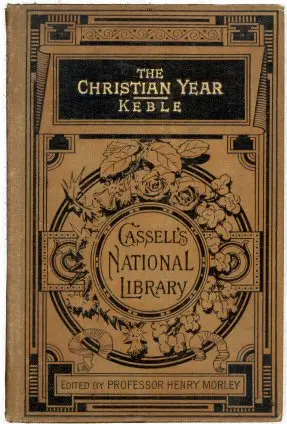
"The Christian Year" by John Keble is a series of poems written in 1827 for the Sundays and feasts of the Church of England's liturgical calendar. This devotional work became the most popular volume of verse in the nineteenth century, with over 375,000 copies sold by 1873. Several of its poems became beloved hymns. Initially published anonymously, its success led to Keble's appointment as Oxford Professor of Poetry and significantly influenced the Oxford Movement.
Introduction adapted from the source catalogue; source summaries may be automatically generated.
Free to read · English · 48,087 words · No account needed
MAKE TIME FOR A GOOD BOOK
On by default. Untick to stop anonymous reading totals. Each page counts after 10 seconds in view. How this works.
Anonymous counting is on unless you have switched it off.
Caught from that blaze by wrath Divine,
Lost branches of the once-loved vine,
Now withered, spent, and sere,
See Israel’s sons, like glowing brands,
Tossed wildly o’er a thousand lands
For twice a thousand year.
God will not quench nor slay them quite,
But lifts them like a beacon-light
The apostate Church to scare;
Or like pale ghosts that darkling roam,
Hovering around their ancient home,
But find no refuge there.
Ye blessèd Angels! if of you
There be, who love the ways to view
Of Kings and Kingdoms here;
(And sure, ’tis worth an Angel’s gaze,
To see, throughout that dreary maze,
God teaching love and fear:)
Oh say, in all the bleak expanse
Is there a spot to win your glance,
So bright, so dark as this?
A hopeless faith, a homeless race,
Yet seeking the most holy place,
And owning the true bliss!
Salted with fire they seem, to show
How spirits lost in endless woe
May undecaying live.
Oh, sickening thought! yet hold it fast
Long as this glittering world shall last,
Or sin at heart survive.
And hark! amid the flashing fire,
Mingling with tones of fear and ire,
Soft Mercy’s undersong—
’Tis Abraham’s God who speaks so loud,
His people’s cries have pierced the cloud,
He sees, He sees their wrong;
He is come down to break their chain;
Though nevermore on Sion’s fane
His visible ensign wave;
’Tis Sion, wheresoe’er they dwell,
Who, with His own true Israel,
Shall own Him strong to save.
He shall redeem them one by one,
Where’er the world-encircling sun
Shall see them meekly kneel:
All that He asks on Israel’s part,
Is only that the captive heart
Its woe and burthen feel.
Gentiles! with fixed yet awful eye
Turn ye this page of mystery,
Nor slight the warning sound:
“Put off thy shoes from off thy feet—
The place where man his God shall meet,
Be sure, is holy ground.”
Palm Sunday.
And He answered and said unto them, I tell you that, if these should hold their peace, the stones would immediately cry out. St. Luke xix. 40.
YE whose hearts are beating high
With the pulse of Poesy,
Heirs of more than royal race,
Framed by Heaven’s peculiar grace,
God’s own work to do on earth,
(If the word be not too bold,)
Giving virtue a new birth,
And a life that ne’er grows old—
Your reading position is saved on this browser. Take it to another device with a library code. Reading pages adapt to text, rather than matching a printed edition.
BEHIND THE BOOK
This eBook is for the use of anyone anywhere in the United States and most other parts of the world at no cost and with almost no restrictions whatsoever. You may copy it, give it away or re-use it under the terms of the Project Gutenberg License included with this eBook or online at www.gutenberg.org. If you are not located in the United States, you will have to check the laws of the country where you are located before using this eBook. Read the source licence.
The original source file, including credits and licence, is retained by this library. Request an original-format copy at no charge. Please include the book title and Project Gutenberg identifier #4272.
KEEP YOUR CURIOSITY GOING
David Patterson (Spirit) Hatch

David Patterson (Spirit) Hatch

David Patterson (Spirit) Hatch

Edwin Abbott Abbott

Richard Watson
T. G. (Theophilus Gould) Steward