
Last letters from the living dead man
David Patterson (Spirit) Hatch
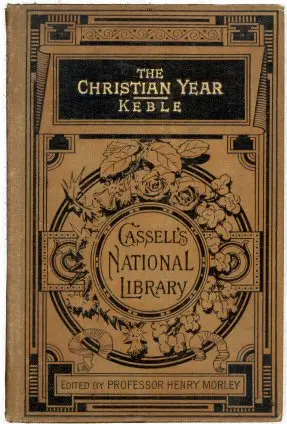
THE CLASSIC COLLECTION · 1827
"The Christian Year" by John Keble is a series of poems written in 1827 for the Sundays and feasts of the Church of England's liturgical calendar. This devotional work became the most popular volume of verse in the nineteenth century, with over 375,000 copies sold by 1873. Several of its poems became beloved hymns. Initially published anonymously, its success led to Keble's appointment as Oxford Professor of Poetry and significantly influenced the Oxford Movement.
Introduction adapted from the source catalogue; source summaries may be automatically generated.
Free to read · English · 48,087 words · No account needed
MAKE TIME FOR A GOOD BOOK
On by default. Untick to stop anonymous reading totals. Each page counts after 10 seconds in view. How this works.
Anonymous counting is on unless you have switched it off.
’Tis Love, the last best gift of Heaven;
Love gentle, holy, pure;
But tenderer than a dove’s soft eye,
The searching sun, the open sky,
She never could endure.
E’en human Love will shrink from sight
Here in the coarse rude earth:
How then should rash intruding glance
Break in upon her sacred trance
Who boasts a heavenly birth?
So still and secret is her growth,
Ever the truest heart,
Where deepest strikes her kindly root
For hope or joy, for flower or fruit,
Least knows its happy part.
God only, and good angels, look
Behind the blissful screen—
As when, triumphant o’er His woes,
The Son of God by moonlight rose,
By all but Heaven unseen:
As when the holy Maid beheld
Her risen Son and Lord:
Thought has not colours half so fair
That she to paint that hour may dare,
In silence best adored.
The gracious Dove, that brought from Heaven
The earnest of our bliss,
Of many a chosen witness telling,
On many a happy vision dwelling,
Sings not a note of this.
So, truest image of the Christ,
Old Israel’s long-lost son,
What time, with sweet forgiving cheer,
He called his conscious brethren near,
Would weep with them alone.
He could not trust his melting soul
But in his Maker’s sight—
Then why should gentle hearts and true
Bare to the rude world’s withering view
Their treasure of delight!
No—let the dainty rose awhile
Her bashful fragrance hide—
Rend not her silken veil too soon,
But leave her, in her own soft noon,
To flourish and abide.
Fifth Sunday in Lent.
And Moses said, I will now turn aside, and see this great sight, why the bush is not burnt. Exodus iii. 3.
THE historic Muse, from age to age,
Through many a waste heart-sickening page
Hath traced the works of Man:
But a celestial call to-day
Stays her, like Moses, on her way,
The works of God to scan.
Far seen across the sandy wild,
Where, like a solitary child,
He thoughtless roamed and free,
One towering thorn was wrapt in flame—
Bright without blaze it went and came:
Who would not turn and see?
Along the mountain ledges green
The scattered sheep at will may glean
The Desert’s spicy stores:
The while, with undivided heart,
The shepherd talks with God apart,
And, as he talks, adores.
Ye too, who tend Christ’s wildering flock,
Well may ye gather round the rock
That once was Sion’s hill:
To watch the fire upon the mount
Still blazing, like the solar fount,
Yet unconsuming still.
Your reading position is saved on this browser. Take it to another device with a library code. Reading pages adapt to text, rather than matching a printed edition.
BEHIND THE BOOK
This eBook is for the use of anyone anywhere in the United States and most other parts of the world at no cost and with almost no restrictions whatsoever. You may copy it, give it away or re-use it under the terms of the Project Gutenberg License included with this eBook or online at www.gutenberg.org. If you are not located in the United States, you will have to check the laws of the country where you are located before using this eBook. Read the source licence.
The original source file, including credits and licence, is retained by this library. Request an original-format copy at no charge. Please include the book title and Project Gutenberg identifier #4272.
KEEP YOUR CURIOSITY GOING
David Patterson (Spirit) Hatch

David Patterson (Spirit) Hatch

David Patterson (Spirit) Hatch

Edwin Abbott Abbott

Richard Watson
T. G. (Theophilus Gould) Steward