
Lucia in London
E. F. (Edward Frederic) Benson
THE CLASSIC COLLECTION · 1904
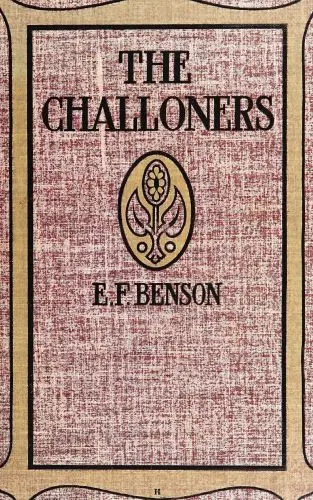
"The Challoners" by E. F. Benson is a novel written in the early 20th century. The story revolves around the Challoner family, focusing particularly on the experiences and perspectives of Helen and her brother Martin as they navigate their lives entangled with familial expectations, societal norms, and their own desires. The narrative hints at greater themes of duty, love, the conflict between individual aspirations and family obligations, as well as the delicate balance between artistic inclinations and moral responsibilities. The opening of the book introduces readers to Helen Challoner, who is enjoying a serene moment in the garden while reading "The Mill on the Floss," a choice that reflects her more liberal views compared to those of her strict father, the Reverend Sidney Challoner. This scene sets the foundation for the dynamic between the siblings, particularly highlighting Helen's frustration with her restricted life in a vicarage characterized by stringent moral expectations. As they discuss literature and their conflicting aspirations, their playful exchanges reveal deeper tensions within the family, particularly between Martin's artistic inclinations and their father's stern principles. The interaction also elicits hints about the father's struggle to balance discipline with love in a changing world, making it clear that this relationship will unfold as a pivotal element of the story.
Introduction adapted from the source catalogue; source summaries may be automatically generated.
Free to read · English · 96,939 words · No account needed
MAKE TIME FOR A GOOD BOOK
On by default. Untick to stop anonymous reading totals. Each page counts after 10 seconds in view. How this works.
Anonymous counting is on unless you have switched it off.
He brought the boat up to the bank in Byron’s pool, where they were to
disembark.
“Yes, there is,” he said. “At least, there may be. There is no use in my telling you now. If it happens, if I am sure it is going to happen, I will tell you beforehand. I promise you that. And now I think we won’t talk any more about it.”
But a sudden uneasiness seized the girl.
“Promise me one thing,” she said. “Promise me it is nothing
disgraceful.”
Martin looked rather injured.
“No; I have not been stealing hens,” he said. “And it is compatible with the highest character.”
Helen looked at him a moment in silence.
“Then I’m not afraid,” she said. “And I will try not to guess at it until you tell me.”
The afternoon was intensely hot, and having arrived here, they settled that a boat under trees was far more to the point than walking under the blaze of the sun, and Helen merely reclined more recumbently on a pile of cushions.
“I think we will go for a walk to-morrow, Martin,” she said, “instead of
to-day.”
“That may be. By the way, I met last week that nice girl who was down at Chartries on the Sunday when I got into so many rows. What was her name?”
“I haven’t the slightest idea,” said Helen.
“Yes, you have. Oh, I know--Miss Pl---- Oh, yes,--Stella Plympton.”
Helen did not answer for a moment.
“Well, I shall go to sleep,” she said. “Martin!”
“Well?”
“You did that remarkably badly,” she said; “a cow could give you points in dissimulation. You remembered her name perfectly.”
Dr. Arne, at whose house on the Trumpington Road Helen was staying, was probably as nearly happy as is possible to the sons of men, who have so marked a genius for discontent. Whether his happiness was worth much and what it all came to is another question; but happy he was,--an affair of immense importance not only to himself, but to all on whom his imperturbable serenity shone. For Providence had endowed him with an apparently insatiable curiosity about the chorus-metres in Greek plays, and also with an intuitive perception as regards this extremely difficult and no doubt fascinating branch of knowledge, which had proved itself capable of being trained into something approaching the perfection of acumen. His intellectual ambitions were thus completely satisfied, and being without any passion but this, which the fact that he was tutor of his college enabled him to gratify without stint, there was really no possible chink at which the bitter wind of discontent could enter and make draughts. The same good fortune had attended his marriage, for he had wooed and won a woman of good birth and breeding, whose only desire, as far as he was aware, was to make her husband not happy,--he was that already,--but comfortable. Extremely edible meals were offered to his notice at hours of his choosing, no sacrilegious hand ever disturbed the papers in his study, his wife walked with him after lunch, and, unless they had people dining with them or were themselves bidden to other feasts, played picquet with him after dinner. His mode of progression along roads was naturally a little quicker than hers, his play of the hand at cards a shade less mediocre, and in consequence he lived in an atmosphere of slight domestic superiority. The same atmosphere, though not domestic, surrounded him in his studies, for, to make a rough statement of the matter, he knew rather more about Greek chorus-metres than anybody else had ever done. His bodily health, moreover, if not exuberant,--he would have found exuberance very trying,--was excellent; he appeared, in fact, to be as immune to the frailties and disorders of the flesh as he was to any unsatisfied cravings of the spirit. He was also childless; and though he was not consciously grateful for this, he was aware that he desired neither more distractions, anxieties, or even joys than he possessed in such completeness.
Your reading position is saved on this browser. Take it to another device with a library code. Reading pages adapt to text, rather than matching a printed edition.
E. F. (Edward Frederic) Benson

E. F. (Edward Frederic) Benson

E. F. (Edward Frederic) Benson

E. F. (Edward Frederic) Benson
BEHIND THE BOOK
This eBook is for the use of anyone anywhere in the United States and most other parts of the world at no cost and with almost no restrictions whatsoever. You may copy it, give it away or re-use it under the terms of the Project Gutenberg License included with this eBook or online at www.gutenberg.org. If you are not located in the United States, you will have to check the laws of the country where you are located before using this eBook. Read the source licence.
The original source file, including credits and licence, is retained by this library. Request an original-format copy at no charge. Please include the book title and Project Gutenberg identifier #57002.
KEEP YOUR CURIOSITY GOING
Coulson Kernahan

Maurice Baring
Frances Wright
Cécile Tormay

Frederic Jesup Stimson

W. H. P. (William Henry Pope) Jarvis