
Lucia in London
E. F. (Edward Frederic) Benson
THE CLASSIC COLLECTION · 1904
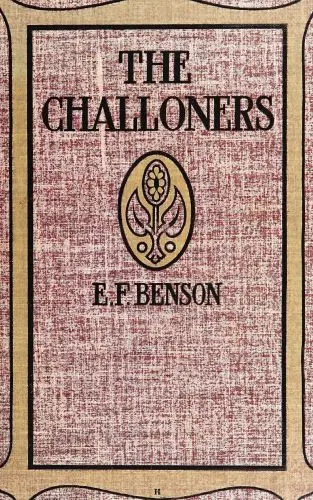
"The Challoners" by E. F. Benson is a novel written in the early 20th century. The story revolves around the Challoner family, focusing particularly on the experiences and perspectives of Helen and her brother Martin as they navigate their lives entangled with familial expectations, societal norms, and their own desires. The narrative hints at greater themes of duty, love, the conflict between individual aspirations and family obligations, as well as the delicate balance between artistic inclinations and moral responsibilities. The opening of the book introduces readers to Helen Challoner, who is enjoying a serene moment in the garden while reading "The Mill on the Floss," a choice that reflects her more liberal views compared to those of her strict father, the Reverend Sidney Challoner. This scene sets the foundation for the dynamic between the siblings, particularly highlighting Helen's frustration with her restricted life in a vicarage characterized by stringent moral expectations. As they discuss literature and their conflicting aspirations, their playful exchanges reveal deeper tensions within the family, particularly between Martin's artistic inclinations and their father's stern principles. The interaction also elicits hints about the father's struggle to balance discipline with love in a changing world, making it clear that this relationship will unfold as a pivotal element of the story.
Introduction adapted from the source catalogue; source summaries may be automatically generated.
Free to read · English · 96,939 words · No account needed
MAKE TIME FOR A GOOD BOOK
On by default. Untick to stop anonymous reading totals. Each page counts after 10 seconds in view. How this works.
Anonymous counting is on unless you have switched it off.
“That is not good manners,” he said, “with you there.”
“Oh, Martin, manners don’t come into it. The truth of father’s beliefs is so overwhelmingly real to him that he can’t think of anything else. That light is so strong that he can see nothing but it. It is soberly the whole world to him.”
“But it isn’t as if Frank was immoral,” said Martin.
“I believe he would mind that less,” said she.
Martin swung the canoe round a half-submerged tree-trunk, where the
water sucked and gurgled.
“But how unreasonable,” he cried. “Frank can’t help his want of belief. But we can all, in some degree, help making brutes of ourselves.”
Helen sat up suddenly, causing the boat to rock.
“I can’t live my life on other people’s lines,” she said, “any more than I expect others to live theirs on my lines. ‘I am I.’ I remember Frank quoting that to me the Sunday he walked back with me from Chartries. That has been like leaven; it has fermented and expanded within me. But, after all, is it only another way of saying ‘I shall be as selfish as I please’?”
“Of course not. That is what people think who haven’t got any individuality of their own. Lots of people haven’t. They are like mirrors slightly cracked, which reflect with certain dimnesses and distortions what is put opposite them. They say individuality is selfishness. What bosh!”
“Aunt Susan hasn’t got any,” remarked Helen, letting the conversation drift away a little. “It is that which makes her so restful. Her mind is like a cushion. It is quite soft, and if you lean on it you make great dents in it.”
Martin remained quite serious, staring at the water with vacant black
eyes.
“Poor father!” he said at length. “Just think; you and me, Helen. He must find us awfully trying.”
“I know; and he continues to love us so. It is that which makes it so dreadful. Oh, Martin, do get through your stupid examination. Do turn out satisfactory, as I’ve been so eminently the reverse.”
Martin transferred his gaze to his sister.
“I really don’t think there’s much chance of it,” he said.
“Of your getting through?”
“I might manage that. But there are other things. The career I propose,
for instance.”
“But he’s reconciled to that,” said Helen. “That’s nothing new.”
Martin paddled on without answering this, and Helen looked at him rather
closely.
“There is something more,” she said. “What is it? Is there not something
more?”
Your reading position is saved on this browser. Take it to another device with a library code. Reading pages adapt to text, rather than matching a printed edition.
E. F. (Edward Frederic) Benson

E. F. (Edward Frederic) Benson

E. F. (Edward Frederic) Benson

E. F. (Edward Frederic) Benson
BEHIND THE BOOK
This eBook is for the use of anyone anywhere in the United States and most other parts of the world at no cost and with almost no restrictions whatsoever. You may copy it, give it away or re-use it under the terms of the Project Gutenberg License included with this eBook or online at www.gutenberg.org. If you are not located in the United States, you will have to check the laws of the country where you are located before using this eBook. Read the source licence.
The original source file, including credits and licence, is retained by this library. Request an original-format copy at no charge. Please include the book title and Project Gutenberg identifier #57002.
KEEP YOUR CURIOSITY GOING
Coulson Kernahan

Maurice Baring
Frances Wright
Cécile Tormay

Frederic Jesup Stimson

W. H. P. (William Henry Pope) Jarvis