THE CLASSIC COLLECTION✦The secret of Father BrownCLASSIC FREE BOOKS
The secret of Father Brown
G. K. (Gilbert Keith) Chesterton
THE CLASSIC COLLECTION · 1926
"The Catholic Church and conversion" by G. K. Chesterton is a religious apologetic treatise written in the early 20th century. It contends that Catholicism appears in the modern world as a fresh, disruptive reality rather than a mere survival, and examines conversion as the Church’s distinctive mark. Chesterton clears away popular anti-Catholic myths, contrasts national loyalties with the Church’s universal claim, and maps the inner journey from curiosity to resistance to assent. The opening of the treatise begins with an editor’s note stressing how converts, coming from every sort of background and by innumerable paths, powerfully witness to the Faith’s reality. Chesterton then argues that Catholicism functions today like a “new religion,” a living force that attracts where other traditions have grown stale; the Church’s true stamp is conversion, not mere tradition. He dismisses stock slanders (about Scripture, priests, and Jesuits), contrasts narrow patriotism with the Church’s prior and wider human solidarity, and identifies the real hurdles as fear of the Faith’s demanding virtues—especially the honesty and responsibility of confession—rather than the vices others allege. He outlines three stages of conversion (defending the Church from injustice, discovering its ideas, then trying to flee the final step) and finally flips the perspective: the Church is not one sect among many but the vast cathedral that contains them, while modern movements are partial exaggerations of Catholic truths; conversion, he insists, enlarges thought and freedom rather than confining them.
Introduction adapted from the source catalogue; source summaries may be automatically generated.
Free to read · English · 25,012 words · No account needed
MAKE TIME FOR A GOOD BOOK
On by default. Untick to stop anonymous reading totals. Each page counts after 10 seconds in view. How this works.
Anonymous counting is on unless you have switched it off.
For this is one of the very queerest of the common delusions about what happens to the convert. In some muddled way people have confused the natural remarks of converts, about having found moral peace, with some idea of their having found mental rest, in the sense of mental inaction. They might as well say that a man who has completely recovered his health, after an attack of palsy or St. Vitus’ dance, signalises his healthy state by sitting absolutely still like a stone. Recovering his health means recovering his power of moving in the right way as distinct from the wrong way; but he will probably move a great deal more than before. To become a Catholic is not to leave off thinking, but to learn how to think. It is so in exactly the same sense in which to recover from palsy is not to leave off moving but to learn how to move. The Catholic convert has for the first time a starting-point for straight and strenuous thinking. He has for the first time a way of testing the truth in any question that he raises. As the world goes, especially at present, it is the other people, the heathen and the heretics, who seem to have every virtue except the power of connected thought. There was indeed a brief period when a small minority did some hard thinking on the heathen or heretical side. It barely lasted from the time of Voltaire to the time of Huxley. It has now entirely disappeared. What is now called free thought is valued, not because it is free thought, but because it is freedom from thought; because it is free thoughtlessness.
Nothing is more amusing to the convert, when his conversion has been complete for some time, than to hear the speculations about when or whether he will repent of the conversion; when he will be sick of it, how long he will stand it, at what stage of his external exasperation he will start up and say he can bear it no more. For all this is founded on that optical illusion about the outside and the inside which I have tried to sketch in this chapter. The outsiders, stand by and see, or think they see, the convert entering with bowed head a sort of small temple which they are convinced is fitted up inside like a prison, if not a torture-chamber. But all they really know about it is that he has passed through a door. They do not know that he has not gone into the inner darkness, but out into the broad daylight. It is he who is, in the beautiful and beatific sense of the word, an outsider. He does not want to go into a larger room, because he does not know of any larger room to go into. He knows of a large number of much smaller rooms, each of which is labelled as being very large; but he is quite sure he would be cramped in any of them. Each of them professes to be a complete cosmos or scheme of all things; but then so does the cosmos of the Clapham Sect or the Clapton Agapemone. Each of them is supposed to be domed with the sky or painted inside with all the stars. But each of these cosmic systems or machines seems to him much smaller and even much simpler than the broad and balanced universe in which he lives. One of them is labelled Agnostic; but he knows by experience that it has not really even the freedom of ignorance. It is a wheel that must always go round without a single jolt of miraculous interruption—a circle that must not be squared by any higher mathematics of mysticism; a machine that must be scoured as clean of all spirits as if it were the avowed machine of materialism. In living in a world with two orders, the supernatural and the natural, the convert feels he is living in a larger world and does not feel any temptation to crawl back into a smaller one. One of them is labelled Theosophical or Buddhistic; but he knows by experience that it is only the same sort of wearisome wheel used for spiritual things instead of material things. Living in a world where he is free to do anything, even to go to the devil, he does not see why he should tie himself to the wheel of a mere destiny. One of them is labelled Humanitarian; but he knows that such humanitarians have really far less experience of humanity. He knows that they are thinking almost entirely of men as they are at this moment in modern cities, and have nothing like the huge human interest of what began by being preached to legionaries in Palestine and is still being preached to peasants in China. So clear is this perception that I have sometimes put it to myself, as something between a melancholy meditation and a joke. “Where should I go now, if I did leave the Catholic Church?” I certainly would not go to any of those little social sects which only express one idea at a time, because that idea happens to be fashionable at the moment. The best I could hope for would be to wander away into the woods and become, not a Pantheist (for that is also a limitation and a bore) but rather a pagan, in the mood to cry out that some particular mountain peak or flowering fruit tree was sacred and a thing to be worshipped. That at least would be beginning all over again; but it would bring me back to the same problem in the end. If it was reasonable to have a sacred tree it was not unreasonable to have a sacred crucifix; and if the god was to be found on one peak he may as reasonably be found under one spire. To find a new religion is sooner or later to have found one; and why should I have been discontented with the one I had found? Especially, as I said in the first words of this essay, when it is the one old religion which seems capable of remaining new.
Your reading position is saved on this browser. Take it to another device with a library code. Reading pages adapt to text, rather than matching a printed edition.
G. K. (Gilbert Keith) Chesterton
G. K. (Gilbert Keith) Chesterton
G. K. (Gilbert Keith) Chesterton
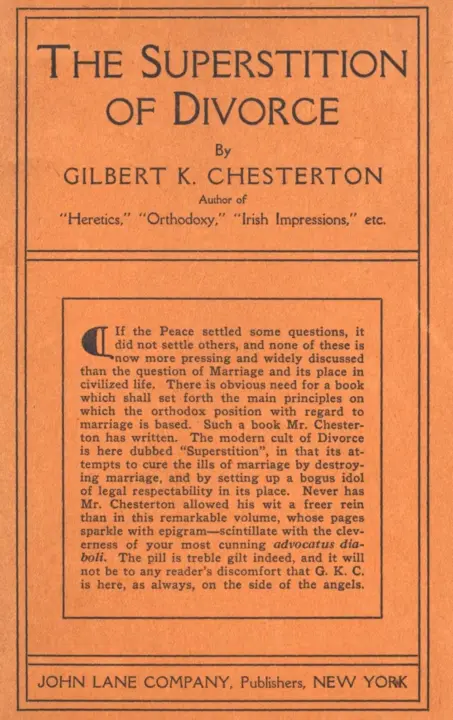
G. K. (Gilbert Keith) Chesterton
BEHIND THE BOOK
This eBook is for the use of anyone anywhere in the United States and most other parts of the world at no cost and with almost no restrictions whatsoever. You may copy it, give it away or re-use it under the terms of the Project Gutenberg License included with this eBook or online at www.gutenberg.org. If you are not located in the United States, you will have to check the laws of the country where you are located before using this eBook. Read the source licence.
The original source file, including credits and licence, is retained by this library. Request an original-format copy at no charge. Please include the book title and Project Gutenberg identifier #76305.
KEEP YOUR CURIOSITY GOING

David Patterson (Spirit) Hatch

David Patterson (Spirit) Hatch

David Patterson (Spirit) Hatch

Ralph Waldo Emerson

Maurice Baring

Oscar Wilde & James McNeill Whistler