THE CLASSIC COLLECTION✦The secret of Father BrownCLASSIC FREE BOOKS
The secret of Father Brown
G. K. (Gilbert Keith) Chesterton
THE CLASSIC COLLECTION · 1926
"The Catholic Church and conversion" by G. K. Chesterton is a religious apologetic treatise written in the early 20th century. It contends that Catholicism appears in the modern world as a fresh, disruptive reality rather than a mere survival, and examines conversion as the Church’s distinctive mark. Chesterton clears away popular anti-Catholic myths, contrasts national loyalties with the Church’s universal claim, and maps the inner journey from curiosity to resistance to assent. The opening of the treatise begins with an editor’s note stressing how converts, coming from every sort of background and by innumerable paths, powerfully witness to the Faith’s reality. Chesterton then argues that Catholicism functions today like a “new religion,” a living force that attracts where other traditions have grown stale; the Church’s true stamp is conversion, not mere tradition. He dismisses stock slanders (about Scripture, priests, and Jesuits), contrasts narrow patriotism with the Church’s prior and wider human solidarity, and identifies the real hurdles as fear of the Faith’s demanding virtues—especially the honesty and responsibility of confession—rather than the vices others allege. He outlines three stages of conversion (defending the Church from injustice, discovering its ideas, then trying to flee the final step) and finally flips the perspective: the Church is not one sect among many but the vast cathedral that contains them, while modern movements are partial exaggerations of Catholic truths; conversion, he insists, enlarges thought and freedom rather than confining them.
Introduction adapted from the source catalogue; source summaries may be automatically generated.
Free to read · English · 25,012 words · No account needed
MAKE TIME FOR A GOOD BOOK
On by default. Untick to stop anonymous reading totals. Each page counts after 10 seconds in view. How this works.
Anonymous counting is on unless you have switched it off.
In short, the story of these sects is not one of straight lines striking outwards and onwards, though if it were they would all be striking in different directions. It is a pattern of curves continually returning into the continent and common life of their and our civilisation; and the summary of that civilisation and central sanity is the philosophy of the Catholic Church. To us, Spiritualists are men studying the existence of spirits, in a brief and blinding oblivion of the existence of evil spirits. They are, as it were, people just educated enough to have heard of ghosts but not educated enough to have heard of witches. If the evil spirits succeed in stopping their education and stunting their minds, they may of course go on for ever repeating silly messages from Plato and doggerel verses from Milton. But if they do go a step or two further, instead of marking time on the borderland, their next step will be to learn what the Church could have taught. To us, Christian Scientists are simply people with one idea, which they have never learnt to balance and combine with all the other ideas. That is why the wealthy business man so often becomes a Christian Scientist. He is not used to ideas and one idea goes to his head, like one glass of wine to a starving man. But the Catholic Church is used to living with ideas and walks among all those very dangerous wild beasts with the poise and the lifted head of a lion-tamer. The Christian Scientist can go on monotonously repeating his one idea and remain a Christian Scientist. But if ever he really goes on to any other ideas, he will be so much the nearer to being a Catholic.
When the convert has once seen the world like that, with one balance of ideas and a number of other ideas that have left it and lost their balance, he does not in fact experience any of the inconveniences that he might reasonably have feared before that silent but stunning revolution. He is not worried by being told that there is something in Spiritualism or something in Christian Science. He knows there is something in everything. But he is moved by the more impressive fact that he finds everything in something. And he is quite sure that if these investigators really are looking for everything, and not merely looking for anything, they will be more and more likely to look for it in the same place. In that sense he is far less worried about them than he was when he thought that one or other of them might be the only person having any sort of communication with the higher mysteries and obviously rather capable of making a mess of it. He is no more likely to be overawed by the fact that Mrs. Eddy achieved spiritual healing or Mr. Home achieved bodily levitation than a fully dressed gentleman in Bond Street would be overawed by the top-hat on the head of a naked savage. A top-hat may be a good hat but it is a bad costume. And a magnetic trick may be a sufficient sensation but it is a very insufficient philosophy. He is no more envious of a Bolshevist for making a revolution than of a beaver for making a dam; for he knows his own civilisation can make things on a pattern not quite so simple or so monotonous. But he believes this of his civilisation and his religion and not merely of himself. There is nothing supercilious about his attitude; because he is well aware that he has only scratched the surface of the spiritual estate that is now open to him. In other words, the convert does not in the least abandon investigation or even adventure. He does not think he knows everything, nor has he lost curiosity about the things he does not know. But experience has taught him that he will find nearly everything somewhere inside that estate and that a very large number of people are finding next to nothing outside it. For the estate is not only a formal garden or an ordered farm; there is plenty of hunting and fishing on it, and, as the phrase goes, very good sport.
Your reading position is saved on this browser. Take it to another device with a library code. Reading pages adapt to text, rather than matching a printed edition.
G. K. (Gilbert Keith) Chesterton
G. K. (Gilbert Keith) Chesterton
G. K. (Gilbert Keith) Chesterton
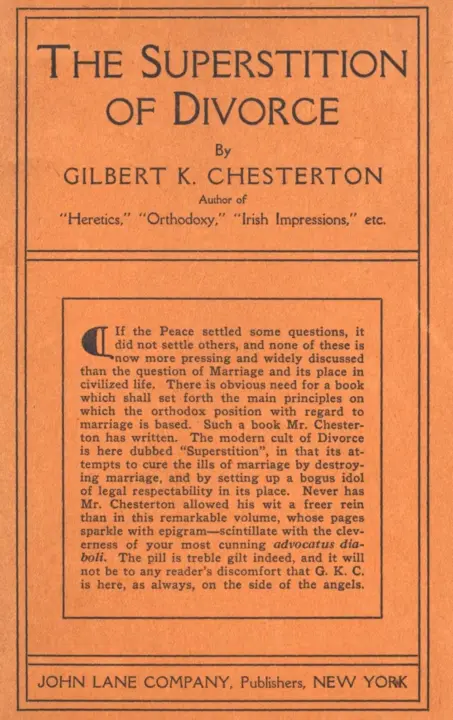
G. K. (Gilbert Keith) Chesterton
BEHIND THE BOOK
This eBook is for the use of anyone anywhere in the United States and most other parts of the world at no cost and with almost no restrictions whatsoever. You may copy it, give it away or re-use it under the terms of the Project Gutenberg License included with this eBook or online at www.gutenberg.org. If you are not located in the United States, you will have to check the laws of the country where you are located before using this eBook. Read the source licence.
The original source file, including credits and licence, is retained by this library. Request an original-format copy at no charge. Please include the book title and Project Gutenberg identifier #76305.
KEEP YOUR CURIOSITY GOING

David Patterson (Spirit) Hatch

David Patterson (Spirit) Hatch

David Patterson (Spirit) Hatch

Ralph Waldo Emerson

Maurice Baring

Oscar Wilde & James McNeill Whistler