THE CLASSIC COLLECTION✦The Ross-shire BuffsCLASSIC FREE BOOKS
The Ross-shire Buffs
James Grant
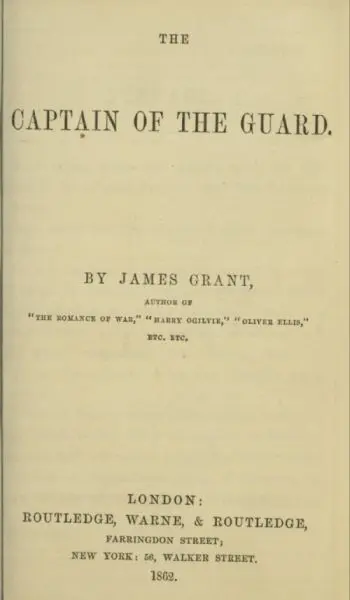
THE CLASSIC COLLECTION · 1862
"The Captain of the Guard" by James Grant is a historical novel written in the mid-19th century. Set in 15th century Scotland, the story centers around the young Earl of Douglas, his noble family, and the political intrigue that envelops them. The novel explores themes of loyalty, ambition, and betrayal against the backdrop of a tumultuous Scottish court, offering glimpses into the lives of key characters such as Sir Patrick Gray, Captain of the King's Guard, and the enchanting Murielle Douglas. At the start of the narrative, the scene is set on the eve of a significant event in November 1440, when the formidable Earl of Douglas is summoned to the court of a young King James II. Characters such as Sir William Crichton, the Lord Chancellor, and Sir Alexander Livingstone, the Regent, are introduced as they prepare to launch a deadly plot against the Douglas family. Meanwhile, the young earl's prideful demeanor and the tensions within his household hint at impending chaos. The opening vividly describes the atmosphere of anticipation and danger, with the ominous appearance of four coffins in a secluded chamber symbolizing the deadly fate awaiting the Douglases. With rich historical detail and compelling character dynamics, the beginning of this novel sets a thrilling stage for the unfolding drama.
Introduction adapted from the source catalogue; source summaries may be automatically generated.
Free to read · English · 113,419 words · No account needed
MAKE TIME FOR A GOOD BOOK
On by default. Untick to stop anonymous reading totals. Each page counts after 10 seconds in view. How this works.
Anonymous counting is on unless you have switched it off.
On first hearing these names, the hitherto listless Murielle started, and turned to Maud Douglas; but feared to ask the question that seemed to burn her tongue.
"Is aught wrong, sister, that you start thus?" asked Margaret, half
contemptuously.
"No--why do you ask?" said Murielle timidly.
"I thought a gnat had stung you."
"Oh, it was Andrew Gray, of Balgarno, who was wounded," said Maud good-naturedly, as she turned in haste to Murielle, whose anxiety she wished to relieve.
"Was your father sure of this?" asked the countess.
"The Provost of Dumfries had the surest tidings."
Margaret smiled bitterly at her pale sister.
"Alas!" thought the latter, in her heart, "he is not spoken of. Oh, can he be dead, that others have led where he was wont to lead?"
After a pause,
"Murielle," said the countess, with some asperity, "if you will not work with us, take your harp, and sing. Occupation will at times divert the mind, even from its most bitter thoughts. Please to give us the ballad of 'Sir Hugh le Blonde.'"
The ladies urged her to do so, but she replied briefly and wearily,--
"Under favour, I cannot sing."
"You cannot sing?" reiterated the countess, pausing in her work, and gazing at Murielle with her full black eyes, above which hung the wavy fringe of her absurdly lofty horned head-dress.
"I cannot sing that ballad--at least, just now."
"And wherefore?"
"I have forgotten it," said she, turning to the window.
"Do you remember when last you sang it?" asked Maud Douglas kindly, in
a low voice.
"Oh yes, dear Maud," said Murielle, as her soft eyes filled with tears at the recollection of that night in the house of the abbot at Edinburgh, where--outwardly, at least--they all seemed so happy, and where her lover hung over her, as she played and sang for him, and him only.
The impetuous young countess, a little despot in her own household, grew weary of her sister's silence and reserve, for Murielle's attachment was no secret to the family; she tossed aside the tapestry, and desired Mariota, the Caillean Rua, to summon her pages and a musician, that they might dance and practise the pavan, which was a slow and stately measure then in fashion, and which took its name from the peacock, because it was danced by knights in their mantles and ladies in their trains; but Murielle said gently, but firmly, as she withdrew to a corbelled stone balcony, upon which the windows of the bower-chamber opened,--
"Excuse me, dear Maggie, I pray you; but I am not in the mood either to
dance or sing."
Your reading position is saved on this browser. Take it to another device with a library code. Reading pages adapt to text, rather than matching a printed edition.
James Grant
James Grant
James Grant
James Grant
BEHIND THE BOOK
This eBook is for the use of anyone anywhere in the United States and most other parts of the world at no cost and with almost no restrictions whatsoever. You may copy it, give it away or re-use it under the terms of the Project Gutenberg License included with this eBook or online at www.gutenberg.org. If you are not located in the United States, you will have to check the laws of the country where you are located before using this eBook. Read the source licence.
The original source file, including credits and licence, is retained by this library. Request an original-format copy at no charge. Please include the book title and Project Gutenberg identifier #52078.
KEEP YOUR CURIOSITY GOING
Cécile Tormay

Moritz Busch
Coulson Kernahan
John L. Ransom

Maurice Baring
Frances Wright