THE CLASSIC COLLECTION✦The Ross-shire BuffsCLASSIC FREE BOOKS
The Ross-shire Buffs
James Grant
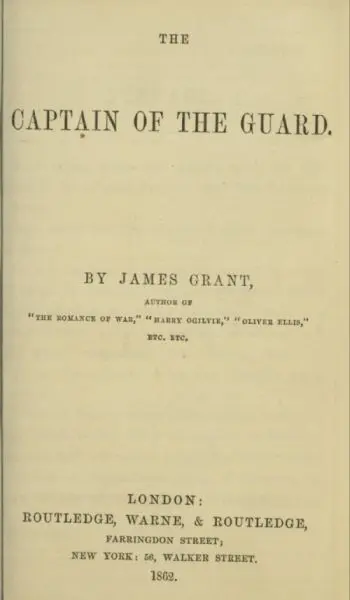
THE CLASSIC COLLECTION · 1862
"The Captain of the Guard" by James Grant is a historical novel written in the mid-19th century. Set in 15th century Scotland, the story centers around the young Earl of Douglas, his noble family, and the political intrigue that envelops them. The novel explores themes of loyalty, ambition, and betrayal against the backdrop of a tumultuous Scottish court, offering glimpses into the lives of key characters such as Sir Patrick Gray, Captain of the King's Guard, and the enchanting Murielle Douglas. At the start of the narrative, the scene is set on the eve of a significant event in November 1440, when the formidable Earl of Douglas is summoned to the court of a young King James II. Characters such as Sir William Crichton, the Lord Chancellor, and Sir Alexander Livingstone, the Regent, are introduced as they prepare to launch a deadly plot against the Douglas family. Meanwhile, the young earl's prideful demeanor and the tensions within his household hint at impending chaos. The opening vividly describes the atmosphere of anticipation and danger, with the ominous appearance of four coffins in a secluded chamber symbolizing the deadly fate awaiting the Douglases. With rich historical detail and compelling character dynamics, the beginning of this novel sets a thrilling stage for the unfolding drama.
Introduction adapted from the source catalogue; source summaries may be automatically generated.
Free to read · English · 113,419 words · No account needed
MAKE TIME FOR A GOOD BOOK
On by default. Untick to stop anonymous reading totals. Each page counts after 10 seconds in view. How this works.
Anonymous counting is on unless you have switched it off.
'Twas thus these cozening villains laid their scheme
Against his life, his youth, and comeliness:
Woe worth the end!--OLD PLAY.
Three miles from the southern gate of Bommel, on the road which led to Ameldroyen, there stood a solitary auberge, or wayside tavern. It was named The Forester, from the circumstance that on a signboard it had a hideous representation of a hunter sounding a horn, and this passed for a likeness of Liderick du Bucq, the first forester of Flanders.
The signboard, moreover, informed the passers, in tolerably-spelt Flemish, that there was entertainment for man and horse, with good German beer within; while a green bush, which hung over the door in the more ancient fashion, announced that there also could be had the good wines of Alicant and Burgundy, with perhaps the strong waters of Anjou and Languedoc, i.e., brandy.
The country in its vicinity was lonely, and thinly populated. Save a wind-mill or two, and a gibbet on an eminence, with a man hanging thereon between the spectator and the sky, there was little to be seen but the dense forest, which then spread for miles along the banks of the river Waal, and away towards Bois-le-duc and Ravenstein.
This auberge, a rickety old house, the roof and walls of which some masses of ivy and woodbine alone seemed to hold together, was kept by Carl Langfanger, an old Brabancione, or disbanded soldier; and it was, in fact, one of the many secret rendezvous of Count Ludwig's military outlaws.
On the day after the night just described, three horsemen arrived at the auberge about noon, and within ten minutes of each other. They placed their horses in a shed behind the edifice, where a Brabancione, named Gustaf Vlierbeke, a very "ragged robin" indeed, acted as groom. They then met in an upper room, on the bare and dirty table of which wine, unasked for and unordered, was placed; and, we may mention, that their swords and daggers were not required by the slipshod tapster, though such was the custom in those days in all well-ordered taverns throughout Christendom.
These three personages were the exiled duke of Albany, the outlawed count of Endhoven, and that "Scottish worthy," Master James Achanna.
Their greetings were more brief than courteous, and after imbibing each a long horn of wine, they drew their chairs close to the table, as if to confer confidentially.
"More wine now, that we may not be interrupted hereafter," said Albany,
as a preliminary.
"Have we not had enough?" asked Achanna, warily.
"Bah! I am not a hermit, and have no need of endeavouring to resemble
old Anthony of Padua."
Your reading position is saved on this browser. Take it to another device with a library code. Reading pages adapt to text, rather than matching a printed edition.
James Grant
James Grant
James Grant
James Grant
BEHIND THE BOOK
This eBook is for the use of anyone anywhere in the United States and most other parts of the world at no cost and with almost no restrictions whatsoever. You may copy it, give it away or re-use it under the terms of the Project Gutenberg License included with this eBook or online at www.gutenberg.org. If you are not located in the United States, you will have to check the laws of the country where you are located before using this eBook. Read the source licence.
The original source file, including credits and licence, is retained by this library. Request an original-format copy at no charge. Please include the book title and Project Gutenberg identifier #52078.
KEEP YOUR CURIOSITY GOING
Cécile Tormay

Moritz Busch
Coulson Kernahan
John L. Ransom

Maurice Baring
Frances Wright