THE CLASSIC COLLECTION✦The Ross-shire BuffsCLASSIC FREE BOOKS
The Ross-shire Buffs
James Grant
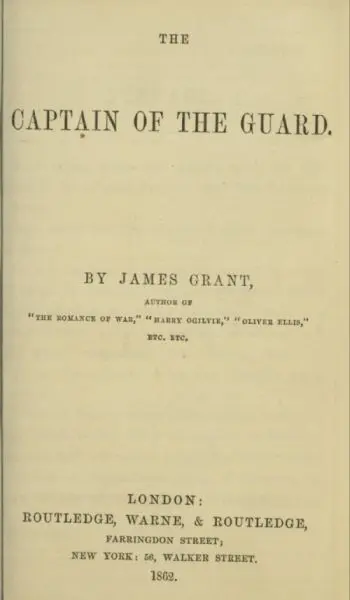
THE CLASSIC COLLECTION · 1862
"The Captain of the Guard" by James Grant is a historical novel written in the mid-19th century. Set in 15th century Scotland, the story centers around the young Earl of Douglas, his noble family, and the political intrigue that envelops them. The novel explores themes of loyalty, ambition, and betrayal against the backdrop of a tumultuous Scottish court, offering glimpses into the lives of key characters such as Sir Patrick Gray, Captain of the King's Guard, and the enchanting Murielle Douglas. At the start of the narrative, the scene is set on the eve of a significant event in November 1440, when the formidable Earl of Douglas is summoned to the court of a young King James II. Characters such as Sir William Crichton, the Lord Chancellor, and Sir Alexander Livingstone, the Regent, are introduced as they prepare to launch a deadly plot against the Douglas family. Meanwhile, the young earl's prideful demeanor and the tensions within his household hint at impending chaos. The opening vividly describes the atmosphere of anticipation and danger, with the ominous appearance of four coffins in a secluded chamber symbolizing the deadly fate awaiting the Douglases. With rich historical detail and compelling character dynamics, the beginning of this novel sets a thrilling stage for the unfolding drama.
Introduction adapted from the source catalogue; source summaries may be automatically generated.
Free to read · English · 113,419 words · No account needed
MAKE TIME FOR A GOOD BOOK
On by default. Untick to stop anonymous reading totals. Each page counts after 10 seconds in view. How this works.
Anonymous counting is on unless you have switched it off.
After each declining to precede the other, the wily chancellor, while making a sign previously agreed upon and understood by James Achanna and Romanno of that ilk, constable of the garrison, gave a hand to each of the brothers, and led them within the gate.
There was an immediate rush among their rough and tumultuary followers to press in after them, but the king's guard and the chancellor's vassals, with levelled pikes, bore back alike the excited multitude of citizens and the wild Scots of Galloway, bare-kneed and bare-armed, with their habergeons of jangling iron rings, and the strong barrier-gate was closed with haste and difficulty. Lord Ormond, Sir Malcolm Fleming, Sir Alan Lauder, and a few others, in virtue of their rank, being alone permitted to enter.
This coup was the more easily effected, as at the moment of the earl's entrance Douglas of Pompherston, his purse-bearer, cried "largesse! largesse!" and to add to the incidental popularity of his lord, scattered several handfuls of silver coin among the people, who scrambled in pursuit of them, and rolled over each other in heaps, while the reckless young earl and his brother laughed and threw more, to increase the uproar and merriment.
Then the portcullis, a massive iron grille, was lowered slowly down in its stony grooves, and when its iron spikes reached the causeway, James Achanna, the double tool of Abercorn and the chancellor, exchanged with the latter one of those deep and rapid smiles by which courtly villains can read each other's hearts and convey a volume of subtle thoughts.
Unheeding, or unobservant of all these circumstances, the earl and his brother accompanied the chancellor into the fortress, and as they slowly proceeded up the steep steps and winding path, which led in a north-westerly direction, to the summit of the rock, Crichton expatiated on the joy this meeting occasioned him, as being the precursor of domestic peace, of good will and unity, between his master the king and the great house of Douglas; but while speaking he could perceive the haughty young peer exchanging secret smiles with his brother; so, nothing daunted, the chancellor continued to flatter, and secretly smiled in his turn.
"Great as the house of Douglas has been----"
"Is, my lord," interrupted the earl, haughtily.
"Pardon me," stammered Crichton, reddening with anger to find himself thus addressed by a boy; "I was about to say, that in ages past, its chief glory was ever in its obedience to the crown, from whence its greatness and its honours sprung."
"Well?" observed the boy-noble impatiently.
"Enemies have accused you of treason----"
"Yourself, for instance, Sir William."
Your reading position is saved on this browser. Take it to another device with a library code. Reading pages adapt to text, rather than matching a printed edition.
James Grant
James Grant
James Grant
James Grant
BEHIND THE BOOK
This eBook is for the use of anyone anywhere in the United States and most other parts of the world at no cost and with almost no restrictions whatsoever. You may copy it, give it away or re-use it under the terms of the Project Gutenberg License included with this eBook or online at www.gutenberg.org. If you are not located in the United States, you will have to check the laws of the country where you are located before using this eBook. Read the source licence.
The original source file, including credits and licence, is retained by this library. Request an original-format copy at no charge. Please include the book title and Project Gutenberg identifier #52078.
KEEP YOUR CURIOSITY GOING
Cécile Tormay

Moritz Busch
Coulson Kernahan
John L. Ransom

Maurice Baring
Frances Wright