THE CLASSIC COLLECTION✦The Ross-shire BuffsCLASSIC FREE BOOKS
The Ross-shire Buffs
James Grant
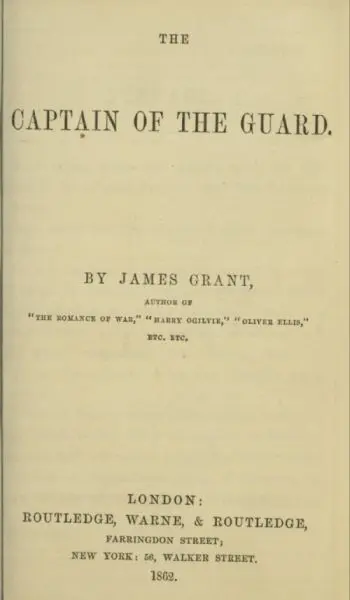
THE CLASSIC COLLECTION · 1862
"The Captain of the Guard" by James Grant is a historical novel written in the mid-19th century. Set in 15th century Scotland, the story centers around the young Earl of Douglas, his noble family, and the political intrigue that envelops them. The novel explores themes of loyalty, ambition, and betrayal against the backdrop of a tumultuous Scottish court, offering glimpses into the lives of key characters such as Sir Patrick Gray, Captain of the King's Guard, and the enchanting Murielle Douglas. At the start of the narrative, the scene is set on the eve of a significant event in November 1440, when the formidable Earl of Douglas is summoned to the court of a young King James II. Characters such as Sir William Crichton, the Lord Chancellor, and Sir Alexander Livingstone, the Regent, are introduced as they prepare to launch a deadly plot against the Douglas family. Meanwhile, the young earl's prideful demeanor and the tensions within his household hint at impending chaos. The opening vividly describes the atmosphere of anticipation and danger, with the ominous appearance of four coffins in a secluded chamber symbolizing the deadly fate awaiting the Douglases. With rich historical detail and compelling character dynamics, the beginning of this novel sets a thrilling stage for the unfolding drama.
Introduction adapted from the source catalogue; source summaries may be automatically generated.
Free to read · English · 113,419 words · No account needed
MAKE TIME FOR A GOOD BOOK
On by default. Untick to stop anonymous reading totals. Each page counts after 10 seconds in view. How this works.
Anonymous counting is on unless you have switched it off.
On the earl's train disappearing among the wooded hollows which lay between the city and the furzy slope of Braid and Liberton, the captain of the guard and his kinsman the lieutenant, with their esquires, pages, and lacqueys passed forth from the castle, to swell the retinue of the chief magistrate of the city, Sir Thomas Cranston of that ilk, baron of Denholm and Stobs, warden of the marches, and one of the conservators of peace upon the borders, for the steel-gloved provosts of those stirring times were men of a different metal from the men of words, who "twaddle" in the same place in this age of steam and electricity.
As they passed out, the king's master butcher entered the gateway of the fortress, accompanied by a peddie or foot-boy, bearing a covered bundle upon a trencher.
This covered bundle contained a black bull's head.
"See you that, Sir Alexander?" said the Chancellor, twitching the furred sleeve of his compatriot.
"The black bull's head!" said the other, with an irrepressible shudder.
"Yes; for the banquet to-morrow."
"Holy Dame!"
"It is the fatal signal, to be placed on the table the moment the king
rises."
"The king! Oh, Chancellor," said the Regent, in a voice that turned almost to a groan, "after all I have urged, mean you that he, poor boy, shall share the odium of our act--a deed at which one half of Scotland, and perhaps all France, may cry aloud?"
"Let them cry; the end shall sanctify the means. With Douglas in his grave, the great seal will be firmer in my hands, the sceptre lighter in yours, and the crown shall shine the brighter on the head of him whose father was wronged and slain by such as Douglas in the Black Friary at Perth."
"I pray God all may end as you predict," said the Regent, doubtfully; "but yet I shudder when contemplating this lure--this snare; the mock banquet, the mock tribunal, and the bloody lykewake of the morrow."
That night, after dusk, four coffins were secretly conveyed up the rock, and through the west postern of the castle, by James Achanna and other "muffled" or masked men, and these were concealed in the chancellor's private closet, the door of which opened off the great hall of David's tower.
These coffins were covered with crimson velvet and had nails, handles, and plates of gold, or at least of richly gilt work.
The first had the name of the most potent prince William, sixth earl of Douglas, third duke of Touraine, lord of Longoville, Galloway, Annandale, and Liddesdale, qui obit 23rd Nov., 1440, in his seventeenth year.
Your reading position is saved on this browser. Take it to another device with a library code. Reading pages adapt to text, rather than matching a printed edition.
James Grant
James Grant
James Grant
James Grant
BEHIND THE BOOK
This eBook is for the use of anyone anywhere in the United States and most other parts of the world at no cost and with almost no restrictions whatsoever. You may copy it, give it away or re-use it under the terms of the Project Gutenberg License included with this eBook or online at www.gutenberg.org. If you are not located in the United States, you will have to check the laws of the country where you are located before using this eBook. Read the source licence.
The original source file, including credits and licence, is retained by this library. Request an original-format copy at no charge. Please include the book title and Project Gutenberg identifier #52078.
KEEP YOUR CURIOSITY GOING
Cécile Tormay

Moritz Busch
Coulson Kernahan
John L. Ransom

Maurice Baring
Frances Wright