THE CLASSIC COLLECTION✦The Ross-shire BuffsCLASSIC FREE BOOKS
The Ross-shire Buffs
James Grant
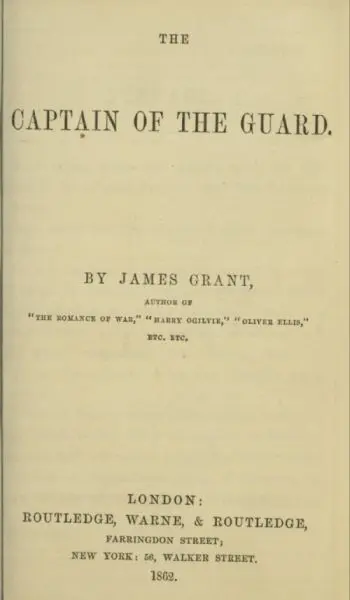
THE CLASSIC COLLECTION · 1862
"The Captain of the Guard" by James Grant is a historical novel written in the mid-19th century. Set in 15th century Scotland, the story centers around the young Earl of Douglas, his noble family, and the political intrigue that envelops them. The novel explores themes of loyalty, ambition, and betrayal against the backdrop of a tumultuous Scottish court, offering glimpses into the lives of key characters such as Sir Patrick Gray, Captain of the King's Guard, and the enchanting Murielle Douglas. At the start of the narrative, the scene is set on the eve of a significant event in November 1440, when the formidable Earl of Douglas is summoned to the court of a young King James II. Characters such as Sir William Crichton, the Lord Chancellor, and Sir Alexander Livingstone, the Regent, are introduced as they prepare to launch a deadly plot against the Douglas family. Meanwhile, the young earl's prideful demeanor and the tensions within his household hint at impending chaos. The opening vividly describes the atmosphere of anticipation and danger, with the ominous appearance of four coffins in a secluded chamber symbolizing the deadly fate awaiting the Douglases. With rich historical detail and compelling character dynamics, the beginning of this novel sets a thrilling stage for the unfolding drama.
Introduction adapted from the source catalogue; source summaries may be automatically generated.
Free to read · English · 113,419 words · No account needed
MAKE TIME FOR A GOOD BOOK
On by default. Untick to stop anonymous reading totals. Each page counts after 10 seconds in view. How this works.
Anonymous counting is on unless you have switched it off.
In the centre of the street are wooden booths, where the country folks, in their canvas gaberdines and hoods of hodden grey, or the burgesses in their pourpoints of good Flemish cloth, may "cheapen" ale at sixteenpence per gallon; otherwise, the brewster or tapster shall have a hole punched in their measures at the market-cross, where now the women of the adjacent villages and farms are arranging their baskets of butter and poultry for sale; and see! there, at this moment, come the town officers, with their halberts and helmets, and the common headsman, in the provost's livery, with a cresset full of blazing coals. Now a crowd gathers: the halberts flash as they are swayed to and fro by the pressure of the people. Then a shriek rises!
They are publicly branding on the cheek a poor woman, a leper, who has rashly ventured within the burgh; though yesterday, by sound of trumpet, at this same old market-cross, the people of the city, and the villages called Leith and Broughton, were forbidden to attend the fairs of Anster and St. Monance, under pain of pit and gallows, as the plague called the het-sickness,--the same disease of which Archibald earl of Douglas died at Restalrig,--rages in Fife.
If the reader, in fancy, can realize all this, he will see the quaint old Edinburgh of 1440 clustering on the steep ridge,--
"Piled deep and massy, close and high;"
the same city over which the haggard eyes of Crichton wandered, and through which, preceded by trumpet and banner, the haughty young lord of Douglas and Touraine was passing to his--doom!
Edinburgh, a village then in size and opulence, was, nevertheless, a capital city. Now, when in aspect and magnitude it is one of the most magnificent in Europe, by a strange anomaly it is, in reality, when its narrowness of spirit, in religion, politics, and patriotism are considered, the most provincial village in her Majesty's dominions, perhaps in the world.
By the time the trumpets were heard, the sun was at its zenith, and Crichton, with a shirt of mail under his velvet pourpoint, came forth to meet the regent in the court-yard.
Livingstone had assumed a similar steel shirt under his shortcoat, which was of red damask, laced with silver, and over which he wore a long flowing gown with open sleeves, revealing those of his ringed defence, which, being a man of more open character than his compatriot, he cared not to conceal, especially in these perilous times.
These two statesmen met, sternly and gravely, without a smile or bow.
"Is all prepared?" asked Livingstone of the chancellor, in a low voice.
Your reading position is saved on this browser. Take it to another device with a library code. Reading pages adapt to text, rather than matching a printed edition.
James Grant
James Grant
James Grant
James Grant
BEHIND THE BOOK
This eBook is for the use of anyone anywhere in the United States and most other parts of the world at no cost and with almost no restrictions whatsoever. You may copy it, give it away or re-use it under the terms of the Project Gutenberg License included with this eBook or online at www.gutenberg.org. If you are not located in the United States, you will have to check the laws of the country where you are located before using this eBook. Read the source licence.
The original source file, including credits and licence, is retained by this library. Request an original-format copy at no charge. Please include the book title and Project Gutenberg identifier #52078.
KEEP YOUR CURIOSITY GOING
Cécile Tormay

Moritz Busch
Coulson Kernahan
John L. Ransom

Maurice Baring
Frances Wright