THE CLASSIC COLLECTION✦The Ross-shire BuffsCLASSIC FREE BOOKS
The Ross-shire Buffs
James Grant
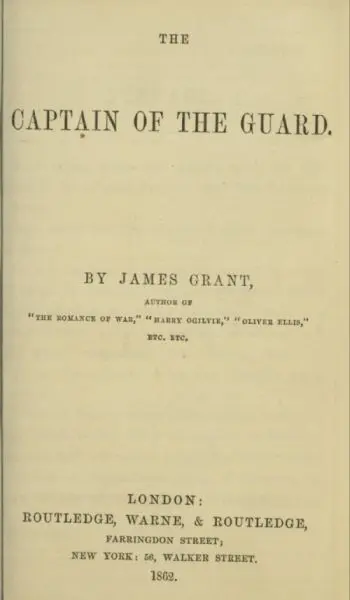
THE CLASSIC COLLECTION · 1862
"The Captain of the Guard" by James Grant is a historical novel written in the mid-19th century. Set in 15th century Scotland, the story centers around the young Earl of Douglas, his noble family, and the political intrigue that envelops them. The novel explores themes of loyalty, ambition, and betrayal against the backdrop of a tumultuous Scottish court, offering glimpses into the lives of key characters such as Sir Patrick Gray, Captain of the King's Guard, and the enchanting Murielle Douglas. At the start of the narrative, the scene is set on the eve of a significant event in November 1440, when the formidable Earl of Douglas is summoned to the court of a young King James II. Characters such as Sir William Crichton, the Lord Chancellor, and Sir Alexander Livingstone, the Regent, are introduced as they prepare to launch a deadly plot against the Douglas family. Meanwhile, the young earl's prideful demeanor and the tensions within his household hint at impending chaos. The opening vividly describes the atmosphere of anticipation and danger, with the ominous appearance of four coffins in a secluded chamber symbolizing the deadly fate awaiting the Douglases. With rich historical detail and compelling character dynamics, the beginning of this novel sets a thrilling stage for the unfolding drama.
Introduction adapted from the source catalogue; source summaries may be automatically generated.
Free to read · English · 113,419 words · No account needed
MAKE TIME FOR A GOOD BOOK
On by default. Untick to stop anonymous reading totals. Each page counts after 10 seconds in view. How this works.
Anonymous counting is on unless you have switched it off.
"Your sister is fortunate, lady, in the best gifts of heaven," continued the abbot, "and must have been born--"
"Under a fortunate star, you would say?"
"Yes, countess, if such things exist."
"Nay," said Murielle, laughing, "I had a kind fairy for a godmother, like the good princesses of the old romance."
Then in the chaunting cadence adopted by the singers of those days, she sang the four-and-thirty verses of the old ballad of "Sir Hugh le Blonde," a knight of the Mearns--but with these we will not inflict the reader.
It told of how the subtile Rodinghame made love to a fair coquette, who was queen of Scotland; and how, when she repelled him, in revenge he put a leper man in her bower chamber. Then came the proud and jealous king, who, on finding him in such a place, ordered the queen to be burned at a stake, unless she could find a champion to do battle with Rodinghame, her traducer, but such was the terror of his prowess that none appeared; the day of doom came; the hapless queen was bound to a stake, and the torch was about to be applied, when Sir Hugh le Blonde, in his armour, sprang forward, and lifted the gage of Rodinghame.
They fought long and desperately, but Sir Hugh slew the accuser, after forcing him to confess his treachery. Thus the queen was restored once more to favour and honour, to the joy of her husband and all his court.
In gratitude to her preserver,
Then said the queen unto the king,
"Arbuthnot's near the sea;
Oh yield it to the northern knight
Who fought this day for me!"
"Yes," said our king, "and thou, Sir Knight,
Come, quaff this cann of wine;
Arbuthnot's but a baronie,
We'll to it Fordoun join."
Thus the descendants of Sir Hugh became lords of Arbuthnot and Fordoun; the sword with which he defended the queen was long preserved by the viscounts of his family, and his helmet was hung in the church of Garvoch, which, in 1282, he bestowed upon the monks of Arbroath for the safety of his soul, and in memory of his victory.
"How like you the song?" asked Abercorn of the countess.
"Well," she replied, with a dark smile; "because it acts as bird-lime."
"Bird-lime," said he, with a perplexed smile; "how?"
"For the king's popinjay," replied the countess, waving her fan towards Sir Patrick Gray; but the ballad was suited to the fashion and spirit of the age, and as Murielle's voice was soft and low, it mingled sweetly with the rippling notes of her little harp.
Your reading position is saved on this browser. Take it to another device with a library code. Reading pages adapt to text, rather than matching a printed edition.
James Grant
James Grant
James Grant
James Grant
BEHIND THE BOOK
This eBook is for the use of anyone anywhere in the United States and most other parts of the world at no cost and with almost no restrictions whatsoever. You may copy it, give it away or re-use it under the terms of the Project Gutenberg License included with this eBook or online at www.gutenberg.org. If you are not located in the United States, you will have to check the laws of the country where you are located before using this eBook. Read the source licence.
The original source file, including credits and licence, is retained by this library. Request an original-format copy at no charge. Please include the book title and Project Gutenberg identifier #52078.
KEEP YOUR CURIOSITY GOING
Cécile Tormay

Moritz Busch
Coulson Kernahan
John L. Ransom

Maurice Baring
Frances Wright