THE CLASSIC COLLECTION✦The Ross-shire BuffsCLASSIC FREE BOOKS
The Ross-shire Buffs
James Grant
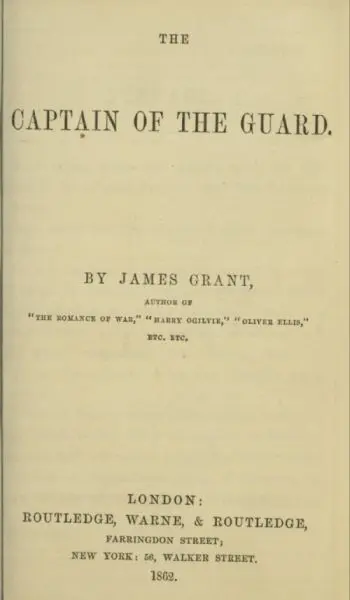
THE CLASSIC COLLECTION · 1862
"The Captain of the Guard" by James Grant is a historical novel written in the mid-19th century. Set in 15th century Scotland, the story centers around the young Earl of Douglas, his noble family, and the political intrigue that envelops them. The novel explores themes of loyalty, ambition, and betrayal against the backdrop of a tumultuous Scottish court, offering glimpses into the lives of key characters such as Sir Patrick Gray, Captain of the King's Guard, and the enchanting Murielle Douglas. At the start of the narrative, the scene is set on the eve of a significant event in November 1440, when the formidable Earl of Douglas is summoned to the court of a young King James II. Characters such as Sir William Crichton, the Lord Chancellor, and Sir Alexander Livingstone, the Regent, are introduced as they prepare to launch a deadly plot against the Douglas family. Meanwhile, the young earl's prideful demeanor and the tensions within his household hint at impending chaos. The opening vividly describes the atmosphere of anticipation and danger, with the ominous appearance of four coffins in a secluded chamber symbolizing the deadly fate awaiting the Douglases. With rich historical detail and compelling character dynamics, the beginning of this novel sets a thrilling stage for the unfolding drama.
Introduction adapted from the source catalogue; source summaries may be automatically generated.
Free to read · English · 113,419 words · No account needed
MAKE TIME FOR A GOOD BOOK
On by default. Untick to stop anonymous reading totals. Each page counts after 10 seconds in view. How this works.
Anonymous counting is on unless you have switched it off.
However, six hundred nobles, barons, and gentlemen, of the house of Douglas, mustered in full array, with all their vassals, within the town of Stirling, on the 25th day of March--the feast of St. Benedict--and dragged through mud and mire the king's safe conduct, which they nailed on a wooden truncheon, and tied to the tail of a sorry old jaded cart-horse. They then burned it publicly at the Market Cross, where after four hundred horns and twenty brass trumpets had proclaimed defiance, they stigmatized "the king, the lord Crichton, Sir Alexander Livingstone, Sir Patrick Gray, and all who adhered to them, as false and perjured traitors!"
They bade formal defiance to the royal garrison. Then, after completely pillaging the town, they set it on fire in every quarter, and, leaving it in flames and ashes, retired through the adjacent country, which they filled with tumult and outrage. Having thus expended their fury on all that came in their way, they retired each to his own fortress, to prepare for what might follow.
Not long after this, the new earl, with his brothers, friends, and kinsmen, daringly fixed on the doors of the parish churches a document, in which they solemnly renounced their allegiance to the king "as a perjured traitor, a violator of the laws of hospitality, and an ungodly thirster after innocent blood."
The parliament now resolved to aid their justly-incensed monarch in punishing these contumacious nobles, and in a short time he found himself at the head of thirty thousand carefully-selected men, who assembled on Pentland Muir, and with them he resolved to advance against the Douglases. Sir Patrick Gray and the royal guard, of course, accompanied him on this expedition.
The king had with him, William, the lord high constable, whom he had just created earl of Errol, and leader of feudal cavalry; Lord Crichton's son, whom he had created earl of Caithness and lord high admiral of the kingdom; the lords Hailes, Fleming, Boyd, and many other loyal nobles, with all their followers.
He had a fine train of artillery (as artillery was viewed in those days), under Romanno of that ilk, the principal cannon being the Lion, a great gun cast in Flanders and shipped at Bruges, for Scotland, by order of his father, James I., in 1430. It was of polished brass, covered by beautiful carvings and ornaments, and bore the following inscription:--
"Illustri Iacobo Scottorum, principe digno,
Regi magnifico, dum fulmine castra reduco,
Factus sum sub eo, nuncuper ergo Leo."
Your reading position is saved on this browser. Take it to another device with a library code. Reading pages adapt to text, rather than matching a printed edition.
James Grant
James Grant
James Grant
James Grant
BEHIND THE BOOK
This eBook is for the use of anyone anywhere in the United States and most other parts of the world at no cost and with almost no restrictions whatsoever. You may copy it, give it away or re-use it under the terms of the Project Gutenberg License included with this eBook or online at www.gutenberg.org. If you are not located in the United States, you will have to check the laws of the country where you are located before using this eBook. Read the source licence.
The original source file, including credits and licence, is retained by this library. Request an original-format copy at no charge. Please include the book title and Project Gutenberg identifier #52078.
KEEP YOUR CURIOSITY GOING
Cécile Tormay

Moritz Busch
Coulson Kernahan
John L. Ransom

Maurice Baring
Frances Wright