THE CLASSIC COLLECTION✦The Ross-shire BuffsCLASSIC FREE BOOKS
The Ross-shire Buffs
James Grant
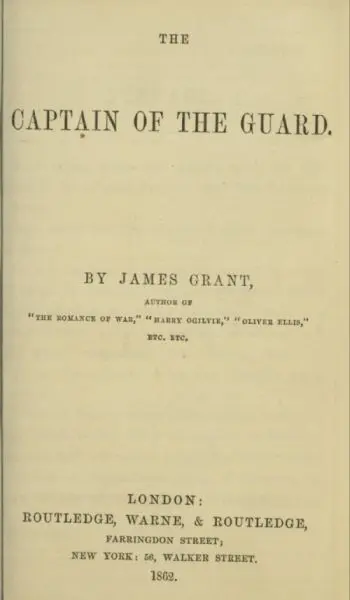
THE CLASSIC COLLECTION · 1862
"The Captain of the Guard" by James Grant is a historical novel written in the mid-19th century. Set in 15th century Scotland, the story centers around the young Earl of Douglas, his noble family, and the political intrigue that envelops them. The novel explores themes of loyalty, ambition, and betrayal against the backdrop of a tumultuous Scottish court, offering glimpses into the lives of key characters such as Sir Patrick Gray, Captain of the King's Guard, and the enchanting Murielle Douglas. At the start of the narrative, the scene is set on the eve of a significant event in November 1440, when the formidable Earl of Douglas is summoned to the court of a young King James II. Characters such as Sir William Crichton, the Lord Chancellor, and Sir Alexander Livingstone, the Regent, are introduced as they prepare to launch a deadly plot against the Douglas family. Meanwhile, the young earl's prideful demeanor and the tensions within his household hint at impending chaos. The opening vividly describes the atmosphere of anticipation and danger, with the ominous appearance of four coffins in a secluded chamber symbolizing the deadly fate awaiting the Douglases. With rich historical detail and compelling character dynamics, the beginning of this novel sets a thrilling stage for the unfolding drama.
Introduction adapted from the source catalogue; source summaries may be automatically generated.
Free to read · English · 113,419 words · No account needed
MAKE TIME FOR A GOOD BOOK
On by default. Untick to stop anonymous reading totals. Each page counts after 10 seconds in view. How this works.
Anonymous counting is on unless you have switched it off.
Its walls were then covered with gilded Spanish leather; a fire of perfumed wood burned cheerfully on the hearth; but the poker and tongs, though each surmounted by an imperial crown, were chained to the jambs, as if in the house of a simple citizen.
After trimming the lights, the pages, on a sign from the king, withdrew backwards, bowing at every step, and he was left with the earl, who found himself alone, or unattended, and in the closet were the Lords Crichton, Glammis, Sir Patrick Gray, a gentleman of the bedchamber, named Sir Simon Glendinning, and one or two others, who were the chosen friends of James.
Aware that their sovereign was about to take the earl calmly but severely to task, they all drew somewhat apart, and Gray, with soldier-like instinct, leaned in silence on his partizan near the door. On perceiving these little movements, a smile of disdain crossed the earl's swarthy face, and he played significantly with his jewelled dagger.
James resumed the subject of his general conduct, and if Master David Hume of Godscroft, the historian of the house of Douglas, can be credited, the earl answered submissively enough, and craved the royal pardon, often alleging that the slaughter of Sir Herbert Herries of Teregles, Sir Thomas MacLellan of Bombie, and others, were not acts against the crown, but lawful raids against his own personal enemies.
"But how came you to slay the Gudeman of my mills at Carluke?" asked the king."----Carluke--ha! ha!"
"The death of a good man is no laughing matter," said James, with a
frown on his handsome face.
"He was accused of having weeds on his land."
"Weeds!" was the perplexed rejoinder.
"Yes, your highness--weeds. It was statute and ordained by Alexander II., that he who poisoneth the king's lands with weeds, especially the corn marigold, was a traitor."
"By my faith! that should make clean garden-work in the realm of Scotland," said the old chancellor, bitterly; "but the law says, that he who hath a plant of this kind found on his lands may be fined a sheep, or the value thereof, at the goul-court of the baron; whereas the miller died, or was found murdered--hewn to pieces by Jethart axes, within the Holy Gyrth of Lesmahago--a crime against the Church as well as State."
"I came not here to talk of peasant carles and their modes of dying," said Douglas, with a terrible frown at Crichton, his hatred for whom he cared not to conceal; "and since when, my lord chancellor, has a slaughter, committed in the form of Raid, been termed a murder in Scotland?"
Your reading position is saved on this browser. Take it to another device with a library code. Reading pages adapt to text, rather than matching a printed edition.
James Grant
James Grant
James Grant
James Grant
BEHIND THE BOOK
This eBook is for the use of anyone anywhere in the United States and most other parts of the world at no cost and with almost no restrictions whatsoever. You may copy it, give it away or re-use it under the terms of the Project Gutenberg License included with this eBook or online at www.gutenberg.org. If you are not located in the United States, you will have to check the laws of the country where you are located before using this eBook. Read the source licence.
The original source file, including credits and licence, is retained by this library. Request an original-format copy at no charge. Please include the book title and Project Gutenberg identifier #52078.
KEEP YOUR CURIOSITY GOING
Cécile Tormay

Moritz Busch
Coulson Kernahan
John L. Ransom

Maurice Baring
Frances Wright