THE CLASSIC COLLECTION✦The Ross-shire BuffsCLASSIC FREE BOOKS
The Ross-shire Buffs
James Grant
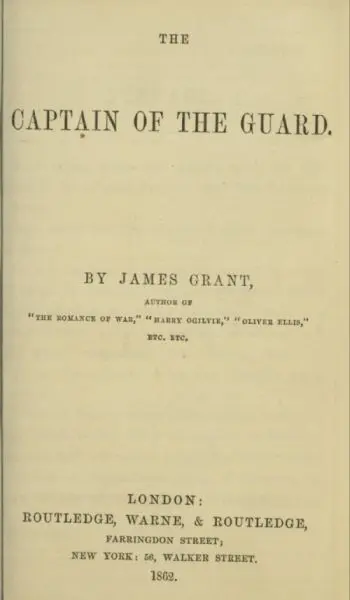
THE CLASSIC COLLECTION · 1862
"The Captain of the Guard" by James Grant is a historical novel written in the mid-19th century. Set in 15th century Scotland, the story centers around the young Earl of Douglas, his noble family, and the political intrigue that envelops them. The novel explores themes of loyalty, ambition, and betrayal against the backdrop of a tumultuous Scottish court, offering glimpses into the lives of key characters such as Sir Patrick Gray, Captain of the King's Guard, and the enchanting Murielle Douglas. At the start of the narrative, the scene is set on the eve of a significant event in November 1440, when the formidable Earl of Douglas is summoned to the court of a young King James II. Characters such as Sir William Crichton, the Lord Chancellor, and Sir Alexander Livingstone, the Regent, are introduced as they prepare to launch a deadly plot against the Douglas family. Meanwhile, the young earl's prideful demeanor and the tensions within his household hint at impending chaos. The opening vividly describes the atmosphere of anticipation and danger, with the ominous appearance of four coffins in a secluded chamber symbolizing the deadly fate awaiting the Douglases. With rich historical detail and compelling character dynamics, the beginning of this novel sets a thrilling stage for the unfolding drama.
Introduction adapted from the source catalogue; source summaries may be automatically generated.
Free to read · English · 113,419 words · No account needed
MAKE TIME FOR A GOOD BOOK
On by default. Untick to stop anonymous reading totals. Each page counts after 10 seconds in view. How this works.
Anonymous counting is on unless you have switched it off.
He was aware that Earl James of Abercorn, Earl Hugh of Ormond, Sir Malcolm Fleming, Sir Alan Lauder, and other kinsmen of the Douglases viewed him with undisguised aversion; and while he continued to play with the balls of thread, and utter pleasant commonplaces to the ladies near, those four personages were standing aloof in a corner, leaning on their swords, which were somewhere about five feet long, "nursing their wrath to keep it warm," and wishing they had the captain of the king's guard on a solitary hill-side, or even in the street without.
"And this Livingstone--I beg pardon, Sir Alexander Livingstone, Laird of Callender--a mere baron," he heard the earl of Douglas say to the abbot; "by what warrant or right is such a man as he regent of the realm?"
"I have heard your noble father ask the same question often, with the same tone--ay, and with the same sombre gloom in his eye, my lord," replied the abbot evasively.
"Well--know you by what right?" reiterated the young noble bitterly, giving vent to the hatred his dead father had carefully and unceasingly inspired and fostered.
"Is it hereditary?" asked the abbot gently.
"Assuredly not."
"Then how came Livingstone to have the regency?"
"'Twas given by parliament and the nation."
"Hence his right," said the abbot, smiling at obtaining the very reply he wished; but the petulant young earl rasped the rowels of his gold spurs furiously on the hearth, for these quiet answers from the "keeper of his conscience" galled and fretted him.
"Well, the time is come for the nobles, the barons, and others to reconsider that too-hastily given right," said the countess; "for what is he, or what is this Lord Chancellor, that earls and chiefs are to veil their bonnets in their presence?"
The abbot, who dreaded the violence of the young countess more than the temper of her husband (who was not exactly a lamb), was prudently silent; but she was determined to force an answer from him, and said bluntly, "Speak, abbot, you are silent!"
"Pardon me, lady, I was thinking of Plutarch. Know you what he said?"
"How should I know, Lord Abbot," said Margaret, while her black eyes sparkled with annoyance; "was he a heretic like Paul Crawer, or a magician like Michael Scott, with an urchin or prickly hedgehog for a familiar?"
"Why ask you all this?" "Because the name sounds cabalistic to a Scottish ear," said Margaret, crossing and fanning herself.
"He was a scholar--and yet an unfortunate pagan, for he knew not of St. Nicholas, the patron of scholars."
"But what said he?"
Your reading position is saved on this browser. Take it to another device with a library code. Reading pages adapt to text, rather than matching a printed edition.
James Grant
James Grant
James Grant
James Grant
BEHIND THE BOOK
This eBook is for the use of anyone anywhere in the United States and most other parts of the world at no cost and with almost no restrictions whatsoever. You may copy it, give it away or re-use it under the terms of the Project Gutenberg License included with this eBook or online at www.gutenberg.org. If you are not located in the United States, you will have to check the laws of the country where you are located before using this eBook. Read the source licence.
The original source file, including credits and licence, is retained by this library. Request an original-format copy at no charge. Please include the book title and Project Gutenberg identifier #52078.
KEEP YOUR CURIOSITY GOING
Cécile Tormay

Moritz Busch
Coulson Kernahan
John L. Ransom

Maurice Baring
Frances Wright