THE CLASSIC COLLECTION✦The Ross-shire BuffsCLASSIC FREE BOOKS
The Ross-shire Buffs
James Grant
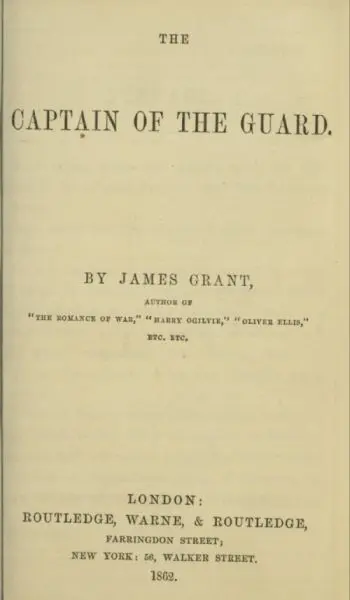
THE CLASSIC COLLECTION · 1862
"The Captain of the Guard" by James Grant is a historical novel written in the mid-19th century. Set in 15th century Scotland, the story centers around the young Earl of Douglas, his noble family, and the political intrigue that envelops them. The novel explores themes of loyalty, ambition, and betrayal against the backdrop of a tumultuous Scottish court, offering glimpses into the lives of key characters such as Sir Patrick Gray, Captain of the King's Guard, and the enchanting Murielle Douglas. At the start of the narrative, the scene is set on the eve of a significant event in November 1440, when the formidable Earl of Douglas is summoned to the court of a young King James II. Characters such as Sir William Crichton, the Lord Chancellor, and Sir Alexander Livingstone, the Regent, are introduced as they prepare to launch a deadly plot against the Douglas family. Meanwhile, the young earl's prideful demeanor and the tensions within his household hint at impending chaos. The opening vividly describes the atmosphere of anticipation and danger, with the ominous appearance of four coffins in a secluded chamber symbolizing the deadly fate awaiting the Douglases. With rich historical detail and compelling character dynamics, the beginning of this novel sets a thrilling stage for the unfolding drama.
Introduction adapted from the source catalogue; source summaries may be automatically generated.
Free to read · English · 113,419 words · No account needed
MAKE TIME FOR A GOOD BOOK
On by default. Untick to stop anonymous reading totals. Each page counts after 10 seconds in view. How this works.
Anonymous counting is on unless you have switched it off.
Within an hour after this, Sir Patrick Gray found himself a free man, and surrounded by his countrymen and friends, all loyal gentlemen of the court, who knew him well. He was cordially embraced by the old chancellor, who presented him to the young Queen Mary, and placed him by her side, as the captain of her husband's Royal Guard.
Messire Jacques de Lalain, on perceiving the turn matters took with his prisoner, began to fear that in the zealous execution of his office he had made a mistake. He offered innumerable apologies to Gray, and as he was not ungenerous, he presented him with a rich suit of Flemish armour, a fine Toledo, a Spanish gennet, and a catella or chain, having fifty links of fine gold, as an amende for all he had endured.
Of all who accompanied the chancellor, he inquired about the Douglases; but could only learn that they were at Rome, and probably would not return until after the great jubilee, which took place then every fiftieth year, in honour of the foundation of Christianity.
The young queen's train embarked at Sluys, in Scottish ships, and crossed the German sea in safety.
On the 1st of April, 1448, she landed at Leith, and as an illustration of "how dull and common-place fiction is when compared with truth," the Dyck Graf of Bommel, and Sir Patrick Gray, who had been so long and so hopelessly his prisoner, rode side by side, as she proceeded towards Edinburgh, and they bore over her head a canopy of cloth of gold upon the points of their lances.
Gray's noble horse and gorgeous armour were now as conspicuous as his soldierly bearing and manly beauty; for both had now returned, and in his five years of captivity the scars inflicted by the ghisarma of Douglas had disappeared, or nearly so.
Patrick Cockburn, of Newbigging, now provost of Edinburgh and governor of the castle, received the queen at the head of the magistrates and all the men of the city, in armour--"boden in effeir of weir," as it was then termed.
Mary was accompanied by the lord chancellor Crichton, John Raulston, bishop of Dunkeld, who was lord privy seal, and Nicholas Otterburn, a canon of Glasgow. The prince of Ravenstein, the marquis of Berg, and Englebert, count of Nassau, hereditary Burg Graf of Antwerp, who were each followed by a brilliant train of attendants, wore the collars and mantles of the Golden Fleece. The prince bore the banner of the bride's uncle, Philip III., surnamed the Good, duke of Burgundy.
Then came the bishops of Liege and Cambrai, riding upon white mules,
with long footcloths.
Your reading position is saved on this browser. Take it to another device with a library code. Reading pages adapt to text, rather than matching a printed edition.
James Grant
James Grant
James Grant
James Grant
BEHIND THE BOOK
This eBook is for the use of anyone anywhere in the United States and most other parts of the world at no cost and with almost no restrictions whatsoever. You may copy it, give it away or re-use it under the terms of the Project Gutenberg License included with this eBook or online at www.gutenberg.org. If you are not located in the United States, you will have to check the laws of the country where you are located before using this eBook. Read the source licence.
The original source file, including credits and licence, is retained by this library. Request an original-format copy at no charge. Please include the book title and Project Gutenberg identifier #52078.
KEEP YOUR CURIOSITY GOING
Cécile Tormay

Moritz Busch
Coulson Kernahan
John L. Ransom

Maurice Baring
Frances Wright