THE CLASSIC COLLECTION✦The Ross-shire BuffsCLASSIC FREE BOOKS
The Ross-shire Buffs
James Grant
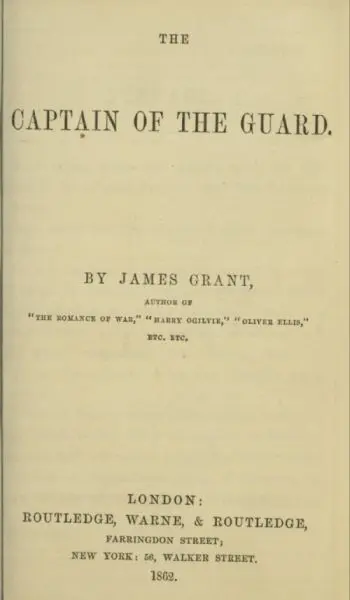
THE CLASSIC COLLECTION · 1862
"The Captain of the Guard" by James Grant is a historical novel written in the mid-19th century. Set in 15th century Scotland, the story centers around the young Earl of Douglas, his noble family, and the political intrigue that envelops them. The novel explores themes of loyalty, ambition, and betrayal against the backdrop of a tumultuous Scottish court, offering glimpses into the lives of key characters such as Sir Patrick Gray, Captain of the King's Guard, and the enchanting Murielle Douglas. At the start of the narrative, the scene is set on the eve of a significant event in November 1440, when the formidable Earl of Douglas is summoned to the court of a young King James II. Characters such as Sir William Crichton, the Lord Chancellor, and Sir Alexander Livingstone, the Regent, are introduced as they prepare to launch a deadly plot against the Douglas family. Meanwhile, the young earl's prideful demeanor and the tensions within his household hint at impending chaos. The opening vividly describes the atmosphere of anticipation and danger, with the ominous appearance of four coffins in a secluded chamber symbolizing the deadly fate awaiting the Douglases. With rich historical detail and compelling character dynamics, the beginning of this novel sets a thrilling stage for the unfolding drama.
Introduction adapted from the source catalogue; source summaries may be automatically generated.
Free to read · English · 113,419 words · No account needed
MAKE TIME FOR A GOOD BOOK
On by default. Untick to stop anonymous reading totals. Each page counts after 10 seconds in view. How this works.
Anonymous counting is on unless you have switched it off.
They were talking of the proceedings of the great ecclesiastical council, which was then sitting in the Swiss archbishopric of Basle, and of the laws it was framing for the extirpation of heresy--topics upon which all men were beginning to question, or rather to sound each other, as such questions, in those days of the stake and faggot, were fraught with danger. They conversed in French; but finding that Gray sat resolutely silent, one turned and said to him abruptly, "Pray, sir, what think you of Procopius?"
"Of--who?" said Gray, with hesitation.
"Procopius, the Shaved."
"The leader of the Hussites?"
"Yes--the protesting heretics."
"I think him a bold Bohemian captain," was the cautious reply.
"What think you of his disputation at the holy council of Basle?"
continued the other.
"I am not capable of judging."
"Peste! Did he not bear hard on the monks?" persisted the querist.
"I am not aware," replied Gray, with increasing reserve, "as I have not heard; but what said he?"
"At the head of two hundred gentlemen of his party, the valiant Procopius came before the council, and stoutly maintained that monkery was an invention of the devil.
"'Can you prove this?' asked Cardinal St. Julien, while his face
flushed red as his stockings.
"'Yes!' replied the Bohemian, stoutly.
"'How?' thundered the cardinal, knitting his brows.
"'Thus; will you deny that the Saviour did not institute it?'
"'We do not.'
"'Then,' quoth Procopius, ''tis plainly an invention of the devil,' whereat Ænies Sylvius Piccolomini----"
"He who was in Scotland?"
"Yes; burst into a fit of laughter, which however did not prevent him from committing several poor devils to the flames in the course of the evening, where they spluttered and burned bravely for the amusement of all good Catholics."
"We have had some such work at home, where John Resby and Paul Crawar have perished at the stake, for preaching doctrines which some term false and others simply new."
"How do you term them?" asked the second traveller.
"Sir," replied Gray, "I am a soldier, and, being neither priest nor clerk may not know the difference."
"So you are of Scotland?" said the first stranger, suddenly relinquishing his French for the old dialect then spoken by the upper classes of the northern kingdom; "we bid you welcome, as countrymen. Pray join us--and harkee, tapster, let us have lights and more wine--we too, sir, are of Scotland."
More Burgundy was promptly brought, and on four torch-like candles of yellow wax being lighted in four great brass sconces, Gray was enabled to observe the aspect and bearing of his fellow travellers, or rather sojourners at the hostelry.
Your reading position is saved on this browser. Take it to another device with a library code. Reading pages adapt to text, rather than matching a printed edition.
James Grant
James Grant
James Grant
James Grant
BEHIND THE BOOK
This eBook is for the use of anyone anywhere in the United States and most other parts of the world at no cost and with almost no restrictions whatsoever. You may copy it, give it away or re-use it under the terms of the Project Gutenberg License included with this eBook or online at www.gutenberg.org. If you are not located in the United States, you will have to check the laws of the country where you are located before using this eBook. Read the source licence.
The original source file, including credits and licence, is retained by this library. Request an original-format copy at no charge. Please include the book title and Project Gutenberg identifier #52078.
KEEP YOUR CURIOSITY GOING
Cécile Tormay

Moritz Busch
Coulson Kernahan
John L. Ransom

Maurice Baring
Frances Wright