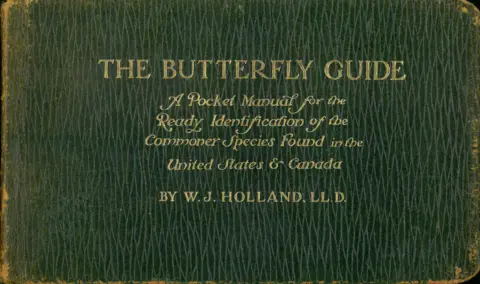
The butterfly guide
W. J. (William Jacob) Holland
THE CLASSIC COLLECTION · 1898
"The Butterfly Book" by W. J. Holland is a scientific publication written in the late 19th century. This work serves as a popular guide aimed at educating readers on the butterflies of North America, providing insight into their life cycles, capture, and preservation. The book promises to appeal to both amateur collectors and scholars, featuring detailed illustrations and information on the various species found on the continent. The opening of this guide introduces readers to the concept of collecting, particularly among young naturalists, and emphasizes the beauty and fascination of butterflies as collectible insects. Holland addresses the gap in accessible literature by noting that while European collectors benefit from well-illustrated manuals, North American enthusiasts have lacked similar resources. He outlines the purpose of the book: to fill this void, offering practical guidance not only on butterfly identification but also on preservation techniques, aiming to inspire a greater appreciation for the insect world while diverting attention from the more threatened bird species.
Introduction adapted from the source catalogue; source summaries may be automatically generated.
Free to read · English · 134,103 words · No account needed
MAKE TIME FOR A GOOD BOOK
On by default. Untick to stop anonymous reading totals. Each page counts after 10 seconds in view. How this works.
Anonymous counting is on unless you have switched it off.
Butterfly.--Very much like aphrodite, from which it may be most easily distinguished by the fact that the hind wings are uniformly dark cinnamon-brown, without any band of buff on the outer margin. Expanse, 2.50-3.00 inches. The insect flies from late June to the end of August.
Egg.--Greenish, conoidal, with about eighteen vertical ribs.
Caterpillar.--Head black, yellowish behind. The body velvety-black, ornamented with black spines which are yellowish at their basal ends. The caterpillar feeds on violets.
Chrysalis.--Reddish-brown or gray, irregularly mottled and striped with black, the abdominal segments slaty-gray, marked with black on the edges where the short angular projections are located.
This butterfly is found in the Western States, extending from the prairie lands of northwestern Ohio to Montana. It largely replaces aphrodite in these regions.
(10) =Argynnis nausicaä=, Edwards, Plate XI, Fig. 9, ♂ (The Arizona
Silver-spot).
Butterfly.--The species is related to the foregoing, but is rather smaller in size. The upper side of the wings is dusky reddish-brown, with the characteristic markings of the genus. On the under side the fore wings are pink, laved with buff at the tip. The hind wings on this side are deep cinnamon-brown, mottled with buff on the inner two thirds; a narrow but clearly defined submarginal band of bright yellowish-buff surrounds them. The silvery spots are clearly marked. The female has the black markings broader and more conspicuous than the male. Expanse, 2.25-2.50 inches.
This insect is quite common in the mountain valleys of Arizona, at an elevation of from six to seven thousand feet above the level of the sea, and flies in July and August. We have no knowledge of the early stages, but it probably does not differ greatly in its larval state from the allied species of the genus.
(11)=Argynnis atlantis=, Edwards, Plate X, Fig. 9, ♂; Plate V, Fig. 6, chrysalis (The Mountain Silver-spot).
Butterfly.--This insect, which resembles aphrodite, is distinguished from that species by its smaller size, its somewhat narrower wings, the deeper brown color of the base of the wings on the upper side, and their darker color on the under side. The submarginal band is pale yellow, narrow, but distinct and always present. Expanse, 2.50 inches.
+--------------------------------------------------------------+ | | | EXPLANATION OF PLATE XI | | | | | | 1. Argynnis callippe, Boisduval, ♂. | | 2. Argynnis callippe, Boisduval, ♀. | | 3. Argynnis callippe, Boisduval, ♂, | | under side. | | 4. Argynnis edwardsi, Reakirt, ♂. | | 5. Argynnis edwardsi, Reakirt, ♀. | | 6. Argynnis rhodope, Edwards, ♀, | | under side. | | 7. Argynnis bischoffi, Edwards, ♂. | | 8. Argynnis cornelia, Edwards, ♂. | | 9. Argynnis nausicaä, Edwards, ♂. | | 10. Argynnis coronis, Behr, ♂. | | 11. Argynnis coronis, Behr, ♀. | | | | | | [Illustration PLATE XI.] | +--------------------------------------------------------------+
Egg.--Conoidal, with twelve to fourteen ribs, honey-yellow. The caterpillars are hatched in the fall, and hibernate without feeding until the following spring.
Your reading position is saved on this browser. Take it to another device with a library code. Reading pages adapt to text, rather than matching a printed edition.
W. J. (William Jacob) Holland
W. J. (William Jacob) Holland
William T. (William Temple) Hornaday & W. J. (William Jacob) Holland
BEHIND THE BOOK
This eBook is for the use of anyone anywhere in the United States and most other parts of the world at no cost and with almost no restrictions whatsoever. You may copy it, give it away or re-use it under the terms of the Project Gutenberg License included with this eBook or online at www.gutenberg.org. If you are not located in the United States, you will have to check the laws of the country where you are located before using this eBook. Read the source licence.
The original source file, including credits and licence, is retained by this library. Request an original-format copy at no charge. Please include the book title and Project Gutenberg identifier #41279.
KEEP YOUR CURIOSITY GOING

John Muir

Asa Gray
Asa Gray

Florence Nightingale
Elizabeth Robins Pennell
Denison Olmsted