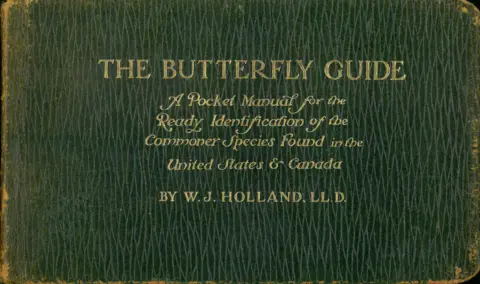
The butterfly guide
W. J. (William Jacob) Holland
THE CLASSIC COLLECTION · 1898
"The Butterfly Book" by W. J. Holland is a scientific publication written in the late 19th century. This work serves as a popular guide aimed at educating readers on the butterflies of North America, providing insight into their life cycles, capture, and preservation. The book promises to appeal to both amateur collectors and scholars, featuring detailed illustrations and information on the various species found on the continent. The opening of this guide introduces readers to the concept of collecting, particularly among young naturalists, and emphasizes the beauty and fascination of butterflies as collectible insects. Holland addresses the gap in accessible literature by noting that while European collectors benefit from well-illustrated manuals, North American enthusiasts have lacked similar resources. He outlines the purpose of the book: to fill this void, offering practical guidance not only on butterfly identification but also on preservation techniques, aiming to inspire a greater appreciation for the insect world while diverting attention from the more threatened bird species.
Introduction adapted from the source catalogue; source summaries may be automatically generated.
Free to read · English · 134,103 words · No account needed
MAKE TIME FOR A GOOD BOOK
On by default. Untick to stop anonymous reading totals. Each page counts after 10 seconds in view. How this works.
Anonymous counting is on unless you have switched it off.
9. Diptera.
Suborders:
Orthorhapha (Hessian Flies, Buffalo-gnats, Mosquitos,
Crane-flies, Horse-flies).
Cyclorhapha (Syrphus, Bot-flies, Tsetse, House-flies, etc.).
10. Lepidoptera.
Suborders:
Rhopalocera (Butterflies).
Heterocera (Moths).
11. Hymenoptera.
Suborders:
Terebrantia (Saw-flies, Gall-wasps, Ichneumon-flies, etc.).
Aculeata (Ants, Cuckoo-flies, Digger-wasps, True Wasps, Bees).
It will be seen by glancing at the foregoing table that the butterflies and moths are included as suborders in the tenth group of the list, to which is applied the name Lepidoptera. This word, like most other scientific words, is derived from the Greek, and is compounded of the noun (λεπις), which signifies a scale, and the noun (πτερον), which signifies a wing. The butterflies and moths together constitute the order of scale-winged insects. The appropriateness of this name will no doubt be at once recognized by every reader, who, having perhaps unintentionally rubbed off some of the minute scales which clothe the wings of a butterfly, has taken the trouble to examine them under a microscope, or who has attentively read what has been said upon this subject in the first chapter of this book. By referring again to the classification which has been given, it will be noted that the last four orders in the list agree in that the creatures included within them undergo for the most part what is known as a complete metamorphosis; that is to say, they pass through four successive stages of development, existing first as eggs, then as worm-like larvæ, or caterpillars, then as pupæ, and finally as perfect, fully developed insects, gifted for the most part with the power of flight, and capable of reproducing their kind. All of this has been to some extent already elucidated in the first chapter of the present volume, but it may be well to remind the reader of these facts at this point.
[Illustration FIG. 76.--Antennæ of butterflies.]
A question which is frequently asked by those who are not familiar with the subject relates to the manner in which it is possible to distinguish between moths and butterflies. A partial answer can be made in the light of the habits of the two classes of lepidoptera. Butterflies are diurnal in their habits, flying between sunrise and dusk, and very rarely taking the wing at night. This habit is so universal that these insects are frequently called by entomologists "the diurnal lepidoptera," or are simply spoken of as "diurnals." It is, however, true that many species of moths are also diurnal in their habits, though the great majority of them are nocturnal, or crepuscular, that is, flying at the dusk of the evening, or in the twilight of the early morning. Upon the basis of mere habit, then, we are able only to obtain a partial clue to the distinction between the two suborders. A more definite distinction is based upon structure, and specifically upon the structure of the antennæ. Butterflies have long, thread-like antennæ, provided with a swelling at the extremity, giving them a somewhat club-shaped appearance (Fig. 76). This form of antennæ is very unusual among the moths, and only occurs in a few rare genera, found in tropical countries, which seem to represent connecting-links between the butterflies and the moths. All the true moths which are found within the limits of the United States and Canada have antennæ which are not club-shaped, but are of various other forms. Some moths have thread-like antennæ tapering to a fine point; others have feather-shaped antennæ; others still have antennæ which are prismatic in form, and provided with a little hook, or spur, at the end; and there are many modifications and variations of these forms. The club-shaped form of the antennæ of butterflies has led naturalists to call them Rhopalocera, as has been already explained in speaking of this subject on page 17. Moths are called Heterocera. The word Heterocera is compounded of the Greek word (πτερον), meaning other, and the Greek word (κερας), meaning a horn. They are lepidoptera which have antennæ which are other than club-shaped. Besides the distinctions which exist in the matter of the form of the antennæ, there are distinctions in the veins of the wings, and in the manner of carrying them when at rest or in flight, which are quite characteristic of the two groups; but all of these things the attentive student will quickly learn for himself by observation.
Your reading position is saved on this browser. Take it to another device with a library code. Reading pages adapt to text, rather than matching a printed edition.
W. J. (William Jacob) Holland
W. J. (William Jacob) Holland
William T. (William Temple) Hornaday & W. J. (William Jacob) Holland
BEHIND THE BOOK
This eBook is for the use of anyone anywhere in the United States and most other parts of the world at no cost and with almost no restrictions whatsoever. You may copy it, give it away or re-use it under the terms of the Project Gutenberg License included with this eBook or online at www.gutenberg.org. If you are not located in the United States, you will have to check the laws of the country where you are located before using this eBook. Read the source licence.
The original source file, including credits and licence, is retained by this library. Request an original-format copy at no charge. Please include the book title and Project Gutenberg identifier #41279.
KEEP YOUR CURIOSITY GOING

John Muir

Asa Gray
Asa Gray

Florence Nightingale
Elizabeth Robins Pennell
Denison Olmsted