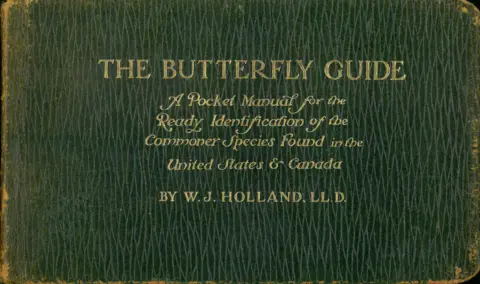
The butterfly guide
W. J. (William Jacob) Holland
THE CLASSIC COLLECTION · 1898
"The Butterfly Book" by W. J. Holland is a scientific publication written in the late 19th century. This work serves as a popular guide aimed at educating readers on the butterflies of North America, providing insight into their life cycles, capture, and preservation. The book promises to appeal to both amateur collectors and scholars, featuring detailed illustrations and information on the various species found on the continent. The opening of this guide introduces readers to the concept of collecting, particularly among young naturalists, and emphasizes the beauty and fascination of butterflies as collectible insects. Holland addresses the gap in accessible literature by noting that while European collectors benefit from well-illustrated manuals, North American enthusiasts have lacked similar resources. He outlines the purpose of the book: to fill this void, offering practical guidance not only on butterfly identification but also on preservation techniques, aiming to inspire a greater appreciation for the insect world while diverting attention from the more threatened bird species.
Introduction adapted from the source catalogue; source summaries may be automatically generated.
Free to read · English · 134,103 words · No account needed
MAKE TIME FOR A GOOD BOOK
On by default. Untick to stop anonymous reading totals. Each page counts after 10 seconds in view. How this works.
Anonymous counting is on unless you have switched it off.
Butterfly.--The antennæ are short, not half the length of the costa. The head is broad, and the antennæ are inserted widely apart. The club is moderate, terminating in a fine point which is bent back at right angles, forming a distinct crook. The abdomen is long and slender, but does not project beyond the hind margin of the secondaries. The fore wings are pointed at the apex and are relatively longer and narrower than in the preceding genus. The neuration is illustrated in the cut.
Early Stages.--These have not yet been studied.
[Illustration FIG. 171.--Neuration of the genus Prenes, enlarged.]
(1) =Prenes ocola=, Edwards, Plate XLVI, Fig. 34, ♂ (The Ocola Skipper).
Butterfly.--Accurately depicted in the plate. The under side is like the upper side, but a shade paler. The under side of the abdomen is whitish. Expanse, 1.45-1.60 inch.
Early Stages.--Unknown.
This is a Southern species, found commonly in the Gulf States, and ranging northward to Pennsylvania, southern Ohio, and Indiana.
Genus CALPODES, Hübner
[Illustration FIG. 172.--Neuration of the genus Calpodes, enlarged.]
Butterfly.--Rather large, stout; head broad; antennæ as in the preceding genus, but stouter. The neuration, considerably enlarged, is accurately delineated in the cut.
Egg.--Hemispherical, ornamented with irregular, more or less
pentagonal cells.
Caterpillar.--Cylindrical, slender, tapering forward and backward from the ninth segment, rapidly diminishing in size posteriorly; the head relatively small, the neck not much strangulated; spiracles surrounded by radiating blackish bristles.
Chrysalis.--The chrysalis is relatively slender, gently convex both on the ventral and dorsal aspects, with a curved delicate frontal tubercle. The tongue-case is long and projects for a considerable distance beyond the somewhat short cremaster.
(1) =Calpodes ethlius=, Cramer, Plate XLV, Fig. 3, ♀; Plate VI, Fig. 48, chrysalis (The Brazilian Skipper).
Butterfly.--There can be no mistaking this robust and thick-bodied species. The wings on the under side are dull olive, blackish at the base of the primaries, with all the spots of the upper side repeated. Expanse, 2.00-2.15 inches.
Early Stages.--The caterpillar feeds on the leaves of the canna.
It is common in the Gulf States, and ranges north to South Carolina. A stray specimen was once taken at West Farms, New York. Southward it ranges everywhere through the Antilles to Argentina, in South America.
Genus LERODEA, Scudder
Butterfly.--The antennæ are about half as long as the costa; the club is robust, slightly elongated, with a distinct crook at the extremity; the palpi have the third joint erect, minute, and bluntly conical. The neuration is represented in the cut.
Early Stages.--These are not known.
[Illustration FIG. 173.--Neuration of the genus Lerodea, enlarged.]
(1) =Lerodea eufala=, Edwards, Plate XLVI, Fig. 33, ♀ (Eufala).
Your reading position is saved on this browser. Take it to another device with a library code. Reading pages adapt to text, rather than matching a printed edition.
W. J. (William Jacob) Holland
W. J. (William Jacob) Holland
William T. (William Temple) Hornaday & W. J. (William Jacob) Holland
BEHIND THE BOOK
This eBook is for the use of anyone anywhere in the United States and most other parts of the world at no cost and with almost no restrictions whatsoever. You may copy it, give it away or re-use it under the terms of the Project Gutenberg License included with this eBook or online at www.gutenberg.org. If you are not located in the United States, you will have to check the laws of the country where you are located before using this eBook. Read the source licence.
The original source file, including credits and licence, is retained by this library. Request an original-format copy at no charge. Please include the book title and Project Gutenberg identifier #41279.
KEEP YOUR CURIOSITY GOING

John Muir

Asa Gray
Asa Gray

Florence Nightingale
Elizabeth Robins Pennell
Denison Olmsted