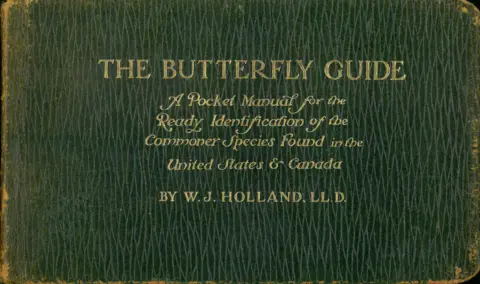
The butterfly guide
W. J. (William Jacob) Holland
THE CLASSIC COLLECTION · 1898
"The Butterfly Book" by W. J. Holland is a scientific publication written in the late 19th century. This work serves as a popular guide aimed at educating readers on the butterflies of North America, providing insight into their life cycles, capture, and preservation. The book promises to appeal to both amateur collectors and scholars, featuring detailed illustrations and information on the various species found on the continent. The opening of this guide introduces readers to the concept of collecting, particularly among young naturalists, and emphasizes the beauty and fascination of butterflies as collectible insects. Holland addresses the gap in accessible literature by noting that while European collectors benefit from well-illustrated manuals, North American enthusiasts have lacked similar resources. He outlines the purpose of the book: to fill this void, offering practical guidance not only on butterfly identification but also on preservation techniques, aiming to inspire a greater appreciation for the insect world while diverting attention from the more threatened bird species.
Introduction adapted from the source catalogue; source summaries may be automatically generated.
Free to read · English · 134,103 words · No account needed
MAKE TIME FOR A GOOD BOOK
On by default. Untick to stop anonymous reading totals. Each page counts after 10 seconds in view. How this works.
Anonymous counting is on unless you have switched it off.
+--------------------------------------------------------------+ | | | EXPLANATION OF PLATE XLVI | | | | 1. Systasea zampa, Edwards, ♂. | | 2. Erynnis manitoba, Scudder, ♂. | | 3. Erynnis manitoba, Scudder, ♀. | | 4. Atalopedes huron, Edwards, ♂. | | 5. Atalopedes huron, Edwards, ♀. | | 6. Atrytone vitellius, Smith and Abbot, ♂. | | 7. Atrytone melane, Edwards, ♂. | | 8. Atrytone melane, Edwards, ♀. | | 9. Lerema hianna, Scudder, ♂. | | 10. Lerema hianna, Scudder, ♀. | | 11. Erynnis ottoë, Edwards, ♂. | | 12. Erynnis ottoë, Edwards, ♀. | | 13. Erynnis sassacus, Harris, ♂. | | 14. Phycanassa viator, Edwards, ♂. | | 15. Phycanassa viator, Edwards, ♀. | | 16. Limochores pontiac, Edwards, ♂. | | 17. Limochores pontiac, Edwards, ♀. | | 18. Hylephila phylæus, Drury, ♂. | | 19. Hylephila phylæus, Drury, ♀. | | 20. Atrytone byssus, Edwards, ♀. | | 21. Limochores palatka, Edwards, ♂. | | 22. Thymelicus mystic, Scudder, ♂. | | 23. Thymelicus mystic, Scudder, ♀. | | 24. Atrytone delaware, Edwards, ♂. | | 25. Atrytone delaware, Edwards, ♀. | | 26. Erynnis morrisoni, Edwards, ♂. | | 27. Erynnis morrisoni, Edwards, ♀. | | 28. Thymelicus ætna, Boisduval, ♂. | | 29. Thymelicus ætna, Boisduval, ♀. | | 30. Limochores manataaqua, Scudder, ♀. | | 31. Euphyes metacomet, Harris, ♂. | | 32. Euphyes verna, Edwards, ♂. | | 33. Lerodea eufala, Edwards, ♀. | | 34. Prenes ocola, Edwards, ♂. | | 35. Oligoria maculata, Edwards, ♂. | | 36. Lerema carolina, Skinner, ♂. | | 37. Phycanassa aaroni, Skinner, ♂. | | 38. Phycanassa howardi, Skinner, ♂. | | 39. Thorybes æmilia, Skinner, ♂. | | 40. Limochores yehl, Skinner, ♂. | | | | [Illustration PLATE XLVI.] | +--------------------------------------------------------------+
"Into the sunshine,
Full of light,
Leaping and flashing
From morn till night."
The Pamphilinæ found in our fauna fall into two groups.
Group A.--The antennæ are not greatly hooked and generally sharply pointed; the palpi have the third joint short and inconspicuous; the cell of the fore wing is always less than two thirds the length of the costa; the lower radial is somewhat nearer to the third median nervule than to the upper radial. The hind wing is often lobed. The lower radial in the hind wing is generally lacking. The male never has a costal fold on the fore wings, and but rarely is provided with a discal stigma.
But three genera belonging to this section of this subfamily are found in our fauna, namely, the genera Amblyscirtes, Pamphila, and Oarisma.
Group B.--The antennæ are sometimes curved, but never hooked, the palpi having the third joint minute, sometimes horizontally porrected. The cell of the fore wing is less than two thirds the length of the costa. The lower radial arises much nearer to the third median nervule than to the upper radial. The hind wing is elongated, but never tailed. The male is never provided on the fore wing with a costal fold, but is in many genera furnished with a discal stigma on the fore wing. When in a state of rest the majority of the species elevate their fore wings and depress their hind wings, an attitude which is peculiar to the insects of this group.
Genus AMBLYSCIRTES, Scudder
Butterfly.--The antennæ are short, with a moderately thick club, crooked at the end; the third joint of the palpi is bluntly conical, short, and erect. The costa of the fore wing is straight, slightly curved inwardly before the apex. The neuration is represented in the cut.
Egg.--Hemispherical.
Your reading position is saved on this browser. Take it to another device with a library code. Reading pages adapt to text, rather than matching a printed edition.
W. J. (William Jacob) Holland
W. J. (William Jacob) Holland
William T. (William Temple) Hornaday & W. J. (William Jacob) Holland
BEHIND THE BOOK
This eBook is for the use of anyone anywhere in the United States and most other parts of the world at no cost and with almost no restrictions whatsoever. You may copy it, give it away or re-use it under the terms of the Project Gutenberg License included with this eBook or online at www.gutenberg.org. If you are not located in the United States, you will have to check the laws of the country where you are located before using this eBook. Read the source licence.
The original source file, including credits and licence, is retained by this library. Request an original-format copy at no charge. Please include the book title and Project Gutenberg identifier #41279.
KEEP YOUR CURIOSITY GOING

John Muir

Asa Gray
Asa Gray

Florence Nightingale
Elizabeth Robins Pennell
Denison Olmsted