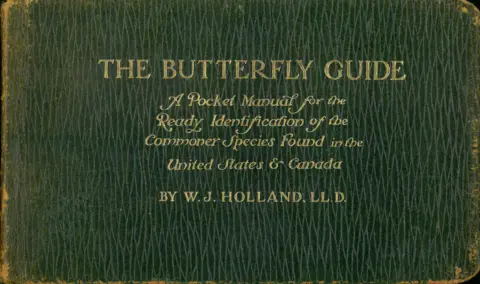
The butterfly guide
W. J. (William Jacob) Holland
THE CLASSIC COLLECTION · 1898
"The Butterfly Book" by W. J. Holland is a scientific publication written in the late 19th century. This work serves as a popular guide aimed at educating readers on the butterflies of North America, providing insight into their life cycles, capture, and preservation. The book promises to appeal to both amateur collectors and scholars, featuring detailed illustrations and information on the various species found on the continent. The opening of this guide introduces readers to the concept of collecting, particularly among young naturalists, and emphasizes the beauty and fascination of butterflies as collectible insects. Holland addresses the gap in accessible literature by noting that while European collectors benefit from well-illustrated manuals, North American enthusiasts have lacked similar resources. He outlines the purpose of the book: to fill this void, offering practical guidance not only on butterfly identification but also on preservation techniques, aiming to inspire a greater appreciation for the insect world while diverting attention from the more threatened bird species.
Introduction adapted from the source catalogue; source summaries may be automatically generated.
Free to read · English · 134,103 words · No account needed
MAKE TIME FOR A GOOD BOOK
On by default. Untick to stop anonymous reading totals. Each page counts after 10 seconds in view. How this works.
Anonymous counting is on unless you have switched it off.
The metropolis of this species seems to be the wooded forests of the Appalachian ranges at comparatively low levels. It abounds in southwestern Pennsylvania, the Virginias, the Carolinas, Kentucky, and Tennessee. I have often found as many as a dozen of these magnificent butterflies congregated on a moist spot on the banks of the Monongahela. At Berkeley Springs, in West Virginia, I counted, one summer day, forty specimens hovering over the weeds and flowers in a small deserted field. The movements of the butterfly on the wing are bold and rapid. Its flight is dashing. Now aloft to the tops of the highest trees, now down in the shadows of the undergrowth, hither and thither it goes, often settling for a moment on some attractive flower, or staying its flight to quench its thirst on the sandy edge of a brook, and then away again over the fields and into the forests. In New England it is not very abundant, and in the Gulf States, while numerous, is still less common than about the head waters of the Ohio.
(5) =Papilio daunus=, Boisduval, Plate XXXVIII, Fig. 2, ♂ (Daunus).
Butterfly.--This magnificent species, which is even larger than turnus (the figures in the plate are greatly reduced), resembles the preceding species in color and markings, but may at once be distinguished by the two tails on the hind wing and the projection of the lobe at the anal angle of this wing. It is found among the eastern valleys of the Rocky Mountain ranges, and descends into Mexico. In Arizona it is quite common. Expanse, 4.00-5.25 inches.
Early Stages.--These have not yet been thoroughly studied, but what we know of them shows that the species is allied very closely to its immediate congeners, and the caterpillar feeds upon the same plants, principally Rosaceæ.
(6) =Papilio pilumnus=, Boisduval, Plate XXXVIII, Fig. 3, ♂ (Pilumnus).
Butterfly.--Resembling the preceding species, but smaller, having the bands and black margins of the wings decidedly broader, and the lobe of the anal angle of the hind wing so much lengthened as to give the wing the appearance of being furnished with three tails. Expanse, 3.80-4.30 inches.
+--------------------------------------------------------------+ | | | EXPLANATION OF PLATE XL | | | | 1. Papilio asterias, Cramer, ♂. | | 2. Papilio bairdi, Edwards, ♂. | | 3. Papilio hollandi, Edwards, ♂. | | 4. Papilio brucei, Edwards, ♂. | | 5. Papilio brevicauda, Saunders, ♀. | | | | [Illustration PLATE XL.] | +--------------------------------------------------------------+
Early Stages.--All we know of these is derived from the brief account given by Schaus in "Papilio," vol. iv, p. 100. Mr. Schaus says that the larva "feeds on laurel."
The insect is Mexican, and only occasionally occurs in Arizona.
(7) =Papilio thoas=, Linnæus, Plate XLII, Fig. 4, ♂ (Thoas).
Your reading position is saved on this browser. Take it to another device with a library code. Reading pages adapt to text, rather than matching a printed edition.
W. J. (William Jacob) Holland
W. J. (William Jacob) Holland
William T. (William Temple) Hornaday & W. J. (William Jacob) Holland
BEHIND THE BOOK
This eBook is for the use of anyone anywhere in the United States and most other parts of the world at no cost and with almost no restrictions whatsoever. You may copy it, give it away or re-use it under the terms of the Project Gutenberg License included with this eBook or online at www.gutenberg.org. If you are not located in the United States, you will have to check the laws of the country where you are located before using this eBook. Read the source licence.
The original source file, including credits and licence, is retained by this library. Request an original-format copy at no charge. Please include the book title and Project Gutenberg identifier #41279.
KEEP YOUR CURIOSITY GOING

John Muir

Asa Gray
Asa Gray

Florence Nightingale
Elizabeth Robins Pennell
Denison Olmsted