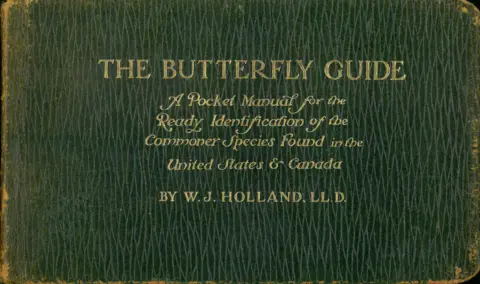
The butterfly guide
W. J. (William Jacob) Holland
THE CLASSIC COLLECTION · 1898
"The Butterfly Book" by W. J. Holland is a scientific publication written in the late 19th century. This work serves as a popular guide aimed at educating readers on the butterflies of North America, providing insight into their life cycles, capture, and preservation. The book promises to appeal to both amateur collectors and scholars, featuring detailed illustrations and information on the various species found on the continent. The opening of this guide introduces readers to the concept of collecting, particularly among young naturalists, and emphasizes the beauty and fascination of butterflies as collectible insects. Holland addresses the gap in accessible literature by noting that while European collectors benefit from well-illustrated manuals, North American enthusiasts have lacked similar resources. He outlines the purpose of the book: to fill this void, offering practical guidance not only on butterfly identification but also on preservation techniques, aiming to inspire a greater appreciation for the insect world while diverting attention from the more threatened bird species.
Introduction adapted from the source catalogue; source summaries may be automatically generated.
Free to read · English · 134,103 words · No account needed
MAKE TIME FOR A GOOD BOOK
On by default. Untick to stop anonymous reading totals. Each page counts after 10 seconds in view. How this works.
Anonymous counting is on unless you have switched it off.
+--------------------------------------------------------------+ | | | EXPLANATION OF PLATE XXXVII | | | | 1. Terias gundlachia, Poey, ♂. | | 2. Terias proterpia, Fabricius, ♂. | | 3. Terias nicippe, Cramer, ♂. | | 4. Terias nicippe, Cramer, ♀. | | 5. Terias nicippe, Cramer, var. flava, | | Strecker, ♂. | | 6. Terias nicippe, Cramer, ♀, | | under side. | | 7. Terias mexicana, Boisduval, ♂. | | 8. Terias mexicana, Boisduval, ♂, | | under side. | | 9. Terias damaris, Felder, ♂. | | 10. Terias damaris, Felder, ♂, | | under side. | | 11. Terias westwoodi, Boisduval, ♂. | | 12. Terias elathea, Cramer, ♂. | | 13. Terias lisa, Boisd.-Lec., ♂. | | 14. Terias delia, Cramer, ♂. | | 15. Terias jucunda, Boisd.-Lec., ♂. | | 16. Terias jucunda, Boisd.-Lec., ♂, | | under side. | | 17. Dismorphia melite, Linnæus, ♂. | | 18. Dismorphia melite, Linnæus, ♀. | | | | [Illustration PLATE XXXVII.] | +--------------------------------------------------------------+
"The lepidopterous insects in general, soon after they emerge from the pupa state, and commonly during their first flight, discharge some drops of a red-colored fluid, more or less intense in different species, which, in some instances, where their numbers have been considerable, have produced the appearance of a 'shower of blood,' as this natural phenomenon is sometimes called.
"Showers of blood have been recorded by historians and poets as preternatural--have been considered in the light of prodigies, and regarded, where they have happened, as fearful prognostics of impending evil.
"There are two passages in Homer, which, however poetical, are applicable to a rain of this kind; and among the prodigies which took place after the death of the great dictator, Ovid particularly mentions a shower of blood:
"'Sæpe faces visæ mediis ardere sub astris,
Sæpe inter nimbos guttæ cecidere cruentæ.'
"('With threatening signs the lowering skies were fill'd, And sanguine drops from murky clouds distilled.')
"Among the numerous prodigies reported by Livy to have happened in the year 214 B.C., it is instanced that at Mantua a stagnating piece of water, caused by the overflowing of the river Mincius, appeared as of blood; and in the cattle-market at Rome a shower of blood fell in the Istrian Street. After mentioning several other remarkable phenomena that happened during that year, Livy concludes by saying that these prodigies were expiated, conformably to the answers of the aruspices, by victims of the greater kinds, and supplication was ordered to be performed to all the deities who had shrines at Rome. Again, it is stated by Livy that many alarming prodigies were seen at Rome in the year 181 B.C., and others reported from abroad; among which was a shower of blood which fell in the courts of the temples of Vulcan and Concord. After mentioning that the image of Juno Sospita shed tears, and that a pestilence broke out in the country, this writer adds that these prodigies, and the mortality which prevailed, alarmed the Senate so much that they ordered the consuls to sacrifice to such gods as their judgment should direct victims of the larger kinds, and that the decemvirs should consult their books. Pursuant to their direction, a supplication for one day was proclaimed to be performed at every shrine in Rome; and they advised, besides, and the Senate voted, and the consul proclaimed, that there should be a supplication and public worship for three days throughout all Italy. In the year 169 B.C., Livy also mentions that a shower of blood fell in the middle of the day. The decemvirs were again called upon to consult their books, and again were sacrifices offered to the deities. The account, also, of Livy, of the bloody sweat on some of the statues of the gods, must be referred to the same phenomenon, as the predilection of those ages to marvel, says Thomas Browne, and the want of accurate investigation in the cases recorded, as well as the rare occurrence of these atmospherical depositions in our own times, inclines us to include them among the blood-red drops deposited by insects.
Your reading position is saved on this browser. Take it to another device with a library code. Reading pages adapt to text, rather than matching a printed edition.
W. J. (William Jacob) Holland
W. J. (William Jacob) Holland
William T. (William Temple) Hornaday & W. J. (William Jacob) Holland
BEHIND THE BOOK
This eBook is for the use of anyone anywhere in the United States and most other parts of the world at no cost and with almost no restrictions whatsoever. You may copy it, give it away or re-use it under the terms of the Project Gutenberg License included with this eBook or online at www.gutenberg.org. If you are not located in the United States, you will have to check the laws of the country where you are located before using this eBook. Read the source licence.
The original source file, including credits and licence, is retained by this library. Request an original-format copy at no charge. Please include the book title and Project Gutenberg identifier #41279.
KEEP YOUR CURIOSITY GOING

John Muir

Asa Gray
Asa Gray

Florence Nightingale
Elizabeth Robins Pennell
Denison Olmsted