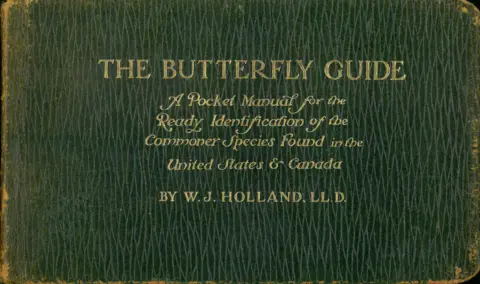
The butterfly guide
W. J. (William Jacob) Holland
THE CLASSIC COLLECTION · 1898
"The Butterfly Book" by W. J. Holland is a scientific publication written in the late 19th century. This work serves as a popular guide aimed at educating readers on the butterflies of North America, providing insight into their life cycles, capture, and preservation. The book promises to appeal to both amateur collectors and scholars, featuring detailed illustrations and information on the various species found on the continent. The opening of this guide introduces readers to the concept of collecting, particularly among young naturalists, and emphasizes the beauty and fascination of butterflies as collectible insects. Holland addresses the gap in accessible literature by noting that while European collectors benefit from well-illustrated manuals, North American enthusiasts have lacked similar resources. He outlines the purpose of the book: to fill this void, offering practical guidance not only on butterfly identification but also on preservation techniques, aiming to inspire a greater appreciation for the insect world while diverting attention from the more threatened bird species.
Introduction adapted from the source catalogue; source summaries may be automatically generated.
Free to read · English · 134,103 words · No account needed
MAKE TIME FOR A GOOD BOOK
On by default. Untick to stop anonymous reading totals. Each page counts after 10 seconds in view. How this works.
Anonymous counting is on unless you have switched it off.
Butterfly.--Easily distinguished from all other species in our fauna by the pointed hind wings, margined on the outer border with black, and by the heavy black border of the fore wings, deeply excised inwardly, recalling the fore wing of the species of the genus Meganostoma. Expanse, ♂, 1.75 inch; ♀, 1.85 inch.
Early Stages.--We do not, as yet, know much about these.
T. mexicana is very common in Arizona, and occurs also in Texas. It is
abundant in Mexico.
(5) =Terias damaris=, Felder, Plate XXXVII, Fig. 9, ♂; Fig. 10, ♂,
under side (Damaris).
Butterfly.--Allied to the preceding species, but readily distinguished from it by the less deeply excised outer border of the fore wing, by the fact that the black outer margin of the secondaries extends inwardly beyond the angulated point of the wing, and by the different color and style of the markings of the lower side. Expanse, 1.35-1.65 inch.
Early Stages.--Unknown.
Damaris occurs in Arizona, and thence ranges south into Venezuela.
(6) =Terias westwoodi.= Boisduval, Plate XXXVII, Fig. 11, ♂ (Westwood's
Yellow).
Butterfly.--Pale yellow or orange-yellow, with a narrow black border on the fore wings, beginning on the costa beyond the middle, and not quite reaching the inner angle. On the under side the wings are pale yellow, immaculate, or at the apex of the fore wing and the outer angle of the hind wing broadly marked with very pale reddish-brown. Expanse, 1.75-2.00 inches.
Early Stages.--Unknown.
Westwood's Yellow occurs in Texas and Arizona, but is not common. It is
abundant farther south.
(7) =Terias lisa=, Boisduval and Leconte, Plate XXXVII, Fig. 13, ♂; Plate II, Fig. 3, larva; Plate V, Fig. 56, chrysalis (The Little Sulphur).
Butterfly.--Allied to the three following species, from which it may at once be distinguished by the absence of the black bar on the inner margin of the fore wings and by the profusely mottled surface of the under side of the hind wings. It is subject to considerable variation, albino females and melanic males being sometimes found, as well as dwarfed specimens of very small size. Expanse, 1.25-1.60 inch.
Early Stages.--These have not been thoroughly studied and described, in spite of the fact that the insect is very common in many easily accessible localities. The caterpillar feeds on Cassia and on clover.
T. lisa ranges from New England south and west as far as the foot-hills of the Rocky Mountains, and into Mexico and Honduras. It is found in the Antilles and Bermuda. An interesting account of the appearance of a vast swarm of these butterflies in the Bermudas is given by Jones in "Psyche," vol. i, p. 121:
Your reading position is saved on this browser. Take it to another device with a library code. Reading pages adapt to text, rather than matching a printed edition.
W. J. (William Jacob) Holland
W. J. (William Jacob) Holland
William T. (William Temple) Hornaday & W. J. (William Jacob) Holland
BEHIND THE BOOK
This eBook is for the use of anyone anywhere in the United States and most other parts of the world at no cost and with almost no restrictions whatsoever. You may copy it, give it away or re-use it under the terms of the Project Gutenberg License included with this eBook or online at www.gutenberg.org. If you are not located in the United States, you will have to check the laws of the country where you are located before using this eBook. Read the source licence.
The original source file, including credits and licence, is retained by this library. Request an original-format copy at no charge. Please include the book title and Project Gutenberg identifier #41279.
KEEP YOUR CURIOSITY GOING

John Muir

Asa Gray
Asa Gray

Florence Nightingale
Elizabeth Robins Pennell
Denison Olmsted