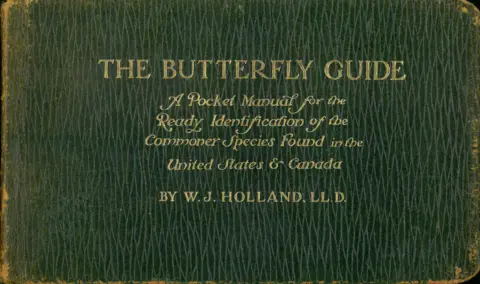
The butterfly guide
W. J. (William Jacob) Holland
THE CLASSIC COLLECTION · 1898
"The Butterfly Book" by W. J. Holland is a scientific publication written in the late 19th century. This work serves as a popular guide aimed at educating readers on the butterflies of North America, providing insight into their life cycles, capture, and preservation. The book promises to appeal to both amateur collectors and scholars, featuring detailed illustrations and information on the various species found on the continent. The opening of this guide introduces readers to the concept of collecting, particularly among young naturalists, and emphasizes the beauty and fascination of butterflies as collectible insects. Holland addresses the gap in accessible literature by noting that while European collectors benefit from well-illustrated manuals, North American enthusiasts have lacked similar resources. He outlines the purpose of the book: to fill this void, offering practical guidance not only on butterfly identification but also on preservation techniques, aiming to inspire a greater appreciation for the insect world while diverting attention from the more threatened bird species.
Introduction adapted from the source catalogue; source summaries may be automatically generated.
Free to read · English · 134,103 words · No account needed
MAKE TIME FOR A GOOD BOOK
On by default. Untick to stop anonymous reading totals. Each page counts after 10 seconds in view. How this works.
Anonymous counting is on unless you have switched it off.
Early Stages.--These have often been described. The caterpillar, which is small and slug-shaped, feeds upon the common sorrel (Rumex acetosella).
(11) =Chrysophanus snowi=, Edwards, Plate XXIX, Fig. 7, ♂; Fig. 8, ♀
(Snow's Copper).
Butterfly.--This is a medium-sized species, easily recognized by the even, rather wide black border on both wings on the upper side, and the dirty-gray color of the hind wings on the under side. Expanse, 1.15-1.25 inch.
Early Stages.--Unknown.
Snow's Copper, which is named in honor of the amiable Chancellor of the University of Kansas, occurs in Colorado at high elevations, and is reported from Alberta and British Columbia.
(12) =Chrysophanus rubidus=, Behr, Plate XXIX, Fig. 5, ♂; Fig. 6, ♀
(The Ruddy Copper).
Butterfly.--This is a rather large species. The male on the upper side is prevalently pale, lustrous red, with a narrow black marginal band and uniformly conspicuous white fringes. The upper side of the female is accurately depicted in the plate. On the under side the wings are shining white, the secondaries immaculate. Expanse, 1.30-1.50 inch.
Early Stages.--These are altogether unknown.
This exceedingly beautiful species is found in Oregon, Nevada, and
Montana.
(13) =Chrysophanus sirius=, Edwards, Plate XXIX, Fig. 3, ♂; Fig. 4, ♀
(Sirius).
Butterfly.--The male closely resembles the preceding species on the upper side, but is brighter red, especially along the nervules of the fore wings. The female on the upper side is dusky. On the under side the wings are whitish or pale gray, but the hind wings are not without spots, as in the preceding species, and carry the characteristic markings of the genus. Expanse, 1.20-1.30 inch.
Early Stages.--Unknown.
The species has been found from Fort McCleod, in British America, as far south as Arizona, among the North American Cordilleras.
All the forces of nature are interdependent. Many plants would not bear seeds or fruit were it not for the activity of insects, which cause the pollen to be deposited upon the pistil and the seed-vessel to be fertilized. Attempts were made many years ago to grow clover in Australia, but the clover did not make seed. All the seed required for planting had to be imported at much expense from Europe. It was finally ascertained that the reason why the clover failed to make seed was because throughout Australia there were no bumblebees. Bumblebees were introduced, and now clover grows luxuriantly in Australia, making seed abundantly; and Australian meats, carried in the cold-storage rooms of great ocean steamers, are used to feed the people of Manila, Hong-Kong, Yokohama, and even London.
Your reading position is saved on this browser. Take it to another device with a library code. Reading pages adapt to text, rather than matching a printed edition.
W. J. (William Jacob) Holland
W. J. (William Jacob) Holland
William T. (William Temple) Hornaday & W. J. (William Jacob) Holland
BEHIND THE BOOK
This eBook is for the use of anyone anywhere in the United States and most other parts of the world at no cost and with almost no restrictions whatsoever. You may copy it, give it away or re-use it under the terms of the Project Gutenberg License included with this eBook or online at www.gutenberg.org. If you are not located in the United States, you will have to check the laws of the country where you are located before using this eBook. Read the source licence.
The original source file, including credits and licence, is retained by this library. Request an original-format copy at no charge. Please include the book title and Project Gutenberg identifier #41279.
KEEP YOUR CURIOSITY GOING

John Muir

Asa Gray
Asa Gray

Florence Nightingale
Elizabeth Robins Pennell
Denison Olmsted