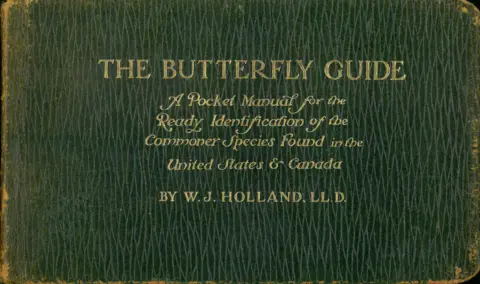
The butterfly guide
W. J. (William Jacob) Holland
THE CLASSIC COLLECTION · 1898
"The Butterfly Book" by W. J. Holland is a scientific publication written in the late 19th century. This work serves as a popular guide aimed at educating readers on the butterflies of North America, providing insight into their life cycles, capture, and preservation. The book promises to appeal to both amateur collectors and scholars, featuring detailed illustrations and information on the various species found on the continent. The opening of this guide introduces readers to the concept of collecting, particularly among young naturalists, and emphasizes the beauty and fascination of butterflies as collectible insects. Holland addresses the gap in accessible literature by noting that while European collectors benefit from well-illustrated manuals, North American enthusiasts have lacked similar resources. He outlines the purpose of the book: to fill this void, offering practical guidance not only on butterfly identification but also on preservation techniques, aiming to inspire a greater appreciation for the insect world while diverting attention from the more threatened bird species.
Introduction adapted from the source catalogue; source summaries may be automatically generated.
Free to read · English · 134,103 words · No account needed
MAKE TIME FOR A GOOD BOOK
On by default. Untick to stop anonymous reading totals. Each page counts after 10 seconds in view. How this works.
Anonymous counting is on unless you have switched it off.
This insect has a wide range, being found from the province of Quebec to Texas and Colorado. It is common in western Pennsylvania.
(15) =Thecla liparops=, Boisduval and Leconte, Plate XXIX, Fig. 28, ♀, under side; Plate V, Fig. 28, chrysalis (The Striped Hair-streak).
Butterfly.--Dark brown on the upper side, grayish below. The lines are arranged much as in T. edwardsi, but are farther apart, often very narrow, scarcely defining the dark bands between them. The spots at the anal angle are obscure and blackish. Expanse, 1.15 inch.
Early Stages.--Much like those of the allied species. Scudder, in "The Butterflies of New England," gives a full account of them. The caterpillar feeds on a variety of plants--oaks, willows, the wild plum, and other rosaceous plants, as well as on the Ericaceæ.
It ranges through the northern Atlantic States and Quebec to Colorado and Montana, but is local in its habits, and nowhere common.
(16) =Thecla chalcis=, Behr, Plate XXIX, Fig. 36, ♂; Fig. 37, ♀, under side (The Bronzed Hair-streak).
Butterfly.--On the upper side uniformly brown. On the under side dark, with a narrow submarginal and an irregular median transverse band, and a pale short bar closing the cell on both wings; a black spot at the anal angle of the secondaries, preceded by a few bluish-green scales. Expanse, 1.00-1.10 inch.
Early Stages.--Unknown.
Habitat, California and Utah.
(17) =Thecla sæpium=, Boisduval, Plate XXIX, Fig. 33, ♂; Fig. 34, ♀ (The Hedge-row Hair-streak).
Butterfly.--Almost identically like the preceding species, except that the wings on the upper side are a trifle redder, on the under side paler; the lines on the under side of the wings are narrowly defined externally by white, and the anal spots are better developed and defined on the hind wings. Expanse, 1.20 inch.
Early Stages.--Unknown.
This species is found throughout the Pacific States, and I am inclined to believe it identical with chalcis. If this should be proved to be true the latter name will sink as a synonym.
(18) =Thecla adenostomatis=, Henry Edwards, Plate XXIX, Fig. 25, ♂ (The
Gray Hair-streak).
Butterfly.--Mouse-gray on the upper side, with a few white lines on the outer margin near the anal angle; hoary-gray on the under side, darker on the median and basal areas. The limbal area is defined inwardly by a fine white line, is paler than the rest of the wing, and on the secondaries is marked by a full, regularly curved submarginal series of small dark lunules. Expanse, 1.30 inch.
Early Stages.--Undescribed.
Habitat, California.
(19) =Thecla spinetorum=, Boisduval, Plate XXIX, Fig. 21, ♀ (The Thicket
Hair-streak).
Your reading position is saved on this browser. Take it to another device with a library code. Reading pages adapt to text, rather than matching a printed edition.
W. J. (William Jacob) Holland
W. J. (William Jacob) Holland
William T. (William Temple) Hornaday & W. J. (William Jacob) Holland
BEHIND THE BOOK
This eBook is for the use of anyone anywhere in the United States and most other parts of the world at no cost and with almost no restrictions whatsoever. You may copy it, give it away or re-use it under the terms of the Project Gutenberg License included with this eBook or online at www.gutenberg.org. If you are not located in the United States, you will have to check the laws of the country where you are located before using this eBook. Read the source licence.
The original source file, including credits and licence, is retained by this library. Request an original-format copy at no charge. Please include the book title and Project Gutenberg identifier #41279.
KEEP YOUR CURIOSITY GOING

John Muir

Asa Gray
Asa Gray

Florence Nightingale
Elizabeth Robins Pennell
Denison Olmsted