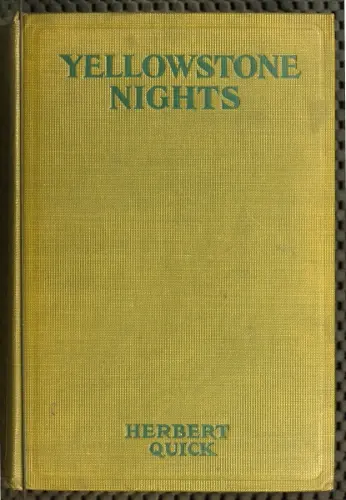
Yellowstone Nights
Herbert Quick
THE CLASSIC COLLECTION · 1915
"The Brown Mouse" by Herbert Quick is a novel written in the early 20th century. The story centers on Jim Irwin, a farmhand struggling with his identity and aspirations, as he unexpectedly finds himself appointed as a schoolteacher. The narrative explores themes of class, ambition, and the pursuit of a meaningful life against the backdrop of rural America. At the start of the novel, we are introduced to Jim Irwin and Jennie Woodruff, a farmer's daughter. Their interaction begins with a simple yet pivotal moment when Jennie dismisses the idea of Jim marrying her with a derisive "Humph!" This offhand comment triggers a chain of events that lead Jim to reflect on his stagnant life, prompting his decision to pursue a teaching position. The opening establishes Jim's internal conflict between his duties, his unfulfilled dreams, and his feelings for Jennie, while also hinting at the broader societal expectations and limitations placed on individuals in rural settings. The narrative teases the promise of transformation for both Jim and the community as they navigate the complexities of their relationships and aspirations.
Introduction adapted from the source catalogue; source summaries may be automatically generated.
Free to read · English · 53,726 words · No account needed
MAKE TIME FOR A GOOD BOOK
On by default. Untick to stop anonymous reading totals. Each page counts after 10 seconds in view. How this works.
Anonymous counting is on unless you have switched it off.
And they were off on the trail that leads back to childhood. They had talked long, and intimately, when the shadows of the early evening crept into the corners of the room. He had carried her across the flooded slew again after the big rain. They had relived a dozen moving incidents by flood and field. Jennie recalled the time when the tornado narrowly missed the schoolhouse, and frightened everybody in school nearly to death.
"Everybody but you, Jim," Jennie remembered. "You looked out of the window and told the teacher that the twister was going north of us, and would kill somebody else."
"Did I?" asked Jim.
"Yes," said Jennie, "and when the teacher asked us to kneel and thank God, you said, 'Why should we thank God that somebody else is blowed away?' She was greatly shocked."
"I don't see to this day," Jim asserted, "what answer there was to my
question."
In the gathering darkness Jim again took Jennie's hand, but this time she
deprived him of it.
He was trembling like a leaf. Let it be remembered in his favor that this was the only girl's hand he had ever held.
"You can't find any more scars on it," she said soberly.
"Let me see how much it has changed since I stuck the knife in it," begged
Jim.
Jennie held it up for inspection.
"It's longer, and slenderer, and whiter, and even more beautiful," said he, "than the little hand I cut; but it was then the most beautiful hand in the world to me--and still is."
"I must light the lamps," said the county superintendent-elect, rather flustered, it must be confessed. "Mama! Where are all the matches?"
Mrs. Woodruff and Mrs. Irwin came in, and the lamplight reminded Jim's mother that the cow was still to milk, and that the chickens might need attention. The Woodruff sleigh came to the door to carry them home; but Jim desired to breast the storm. He felt that he needed the conflict. Mrs. Irwin scolded him for his foolishness, but he strode off into the whirling drift, throwing back a good-by for general consumption, and a pathetic smile to Jennie.
"He's as odd as Dick's hatband," said Mrs. Woodruff, "tramping off in a
storm like this."
"Did you line him up?" asked the colonel of Jennie.
The young lady started and blushed. She had forgotten all about the
politics of the situation.
"I--I'm afraid I didn't, papa," she confessed.
"Those brown mice of Professor Darbishire's," said the colonel, "were the devil and all to control."
Jennie was thinking of this as she dropped asleep.
Your reading position is saved on this browser. Take it to another device with a library code. Reading pages adapt to text, rather than matching a printed edition.
BEHIND THE BOOK
This eBook is for the use of anyone anywhere in the United States and most other parts of the world at no cost and with almost no restrictions whatsoever. You may copy it, give it away or re-use it under the terms of the Project Gutenberg License included with this eBook or online at www.gutenberg.org. If you are not located in the United States, you will have to check the laws of the country where you are located before using this eBook. Read the source licence.
The original source file, including credits and licence, is retained by this library. Request an original-format copy at no charge. Please include the book title and Project Gutenberg identifier #26987.
KEEP YOUR CURIOSITY GOING
Coulson Kernahan

Maurice Baring
Frances Wright
Cécile Tormay

Frederic Jesup Stimson

W. H. P. (William Henry Pope) Jarvis