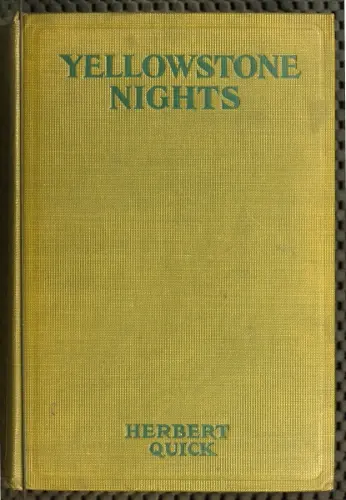
Yellowstone Nights
Herbert Quick
THE CLASSIC COLLECTION · 1915
"The Brown Mouse" by Herbert Quick is a novel written in the early 20th century. The story centers on Jim Irwin, a farmhand struggling with his identity and aspirations, as he unexpectedly finds himself appointed as a schoolteacher. The narrative explores themes of class, ambition, and the pursuit of a meaningful life against the backdrop of rural America. At the start of the novel, we are introduced to Jim Irwin and Jennie Woodruff, a farmer's daughter. Their interaction begins with a simple yet pivotal moment when Jennie dismisses the idea of Jim marrying her with a derisive "Humph!" This offhand comment triggers a chain of events that lead Jim to reflect on his stagnant life, prompting his decision to pursue a teaching position. The opening establishes Jim's internal conflict between his duties, his unfulfilled dreams, and his feelings for Jennie, while also hinting at the broader societal expectations and limitations placed on individuals in rural settings. The narrative teases the promise of transformation for both Jim and the community as they navigate the complexities of their relationships and aspirations.
Introduction adapted from the source catalogue; source summaries may be automatically generated.
Free to read · English · 53,726 words · No account needed
MAKE TIME FOR A GOOD BOOK
On by default. Untick to stop anonymous reading totals. Each page counts after 10 seconds in view. How this works.
Anonymous counting is on unless you have switched it off.
Now, however, he arose as from some inner compulsion, and went to her side. He wished that he knew enough of music to turn her sheets for her, but, alas! the notes were meaningless to him. Still scanning him by means of her back hair, Jennie knew that in another moment Jim would lay his hand on her shoulder, or otherwise advance to personal nearness, as he had done the night of his ill-starred speech at the schoolhouse--and she rose in self-defense. Self-defense, however, did not seem to require that he be kept at too great a distance; so she maneuvered him to the sofa, and seated him beside her. Now was the time to line him up.
"It seems good to have you with us to-day," said she. "We're such old, old
friends."
"Yes," repeated Jim, "old friends .... We are, aren't we, Jennie?"
"And I feel sure," Jennie went on, "that this marks a new era in our
friendship."
"Why?" asked Jim, after considering the matter.
"Oh! everything is different, now--and getting more different all the time. My new work, and your new work, you know."
"I should like to think," said Jim, "that we are beginning over again."
"Oh, we are, we are, indeed! I am quite sure of it."
"And yet," said Jim, "there is no such thing as a new beginning.
Everything joins itself to something which went before. There isn't any
seam."
"No?" said Jennie interrogatively.
"Our regard for each other," Jennie noted most pointedly his word "regard"--"must be the continuation of the old regard."
"I hardly know what you mean," said Jennie.
Jim reached over and possessed himself of her hand. She pulled it from him gently, but he paid no attention to the little muscular protest, and examined the hand critically. On the back of the middle finger he pointed out a scar--a very tiny scar.
"Do you remember how you got that?" he asked.
Because Jim clung to the hand, their heads were very close together as she joined in the examination.
"Why, I don't believe I do," said she.
"I do," he replied. "We--you and I and Mary Forsythe were playing mumble-peg, and you put your hand on the grass just as I threw the knife--it cut you, and left that scar."
"I remember, now!" said she. "How such things come back over the memory. And did it leave a scar when I pushed you toward the red-hot stove in the schoolhouse one blizzardy day, like this, and you peeled the skin off your wrist where it struck the stove?"
"Look at it," said he, baring his long and bony wrist. "Right there!"
Your reading position is saved on this browser. Take it to another device with a library code. Reading pages adapt to text, rather than matching a printed edition.
BEHIND THE BOOK
This eBook is for the use of anyone anywhere in the United States and most other parts of the world at no cost and with almost no restrictions whatsoever. You may copy it, give it away or re-use it under the terms of the Project Gutenberg License included with this eBook or online at www.gutenberg.org. If you are not located in the United States, you will have to check the laws of the country where you are located before using this eBook. Read the source licence.
The original source file, including credits and licence, is retained by this library. Request an original-format copy at no charge. Please include the book title and Project Gutenberg identifier #26987.
KEEP YOUR CURIOSITY GOING
Coulson Kernahan

Maurice Baring
Frances Wright
Cécile Tormay

Frederic Jesup Stimson

W. H. P. (William Henry Pope) Jarvis