THE CLASSIC COLLECTION✦Pan’s gardenCLASSIC FREE BOOKS
Pan’s garden
Algernon Blackwood
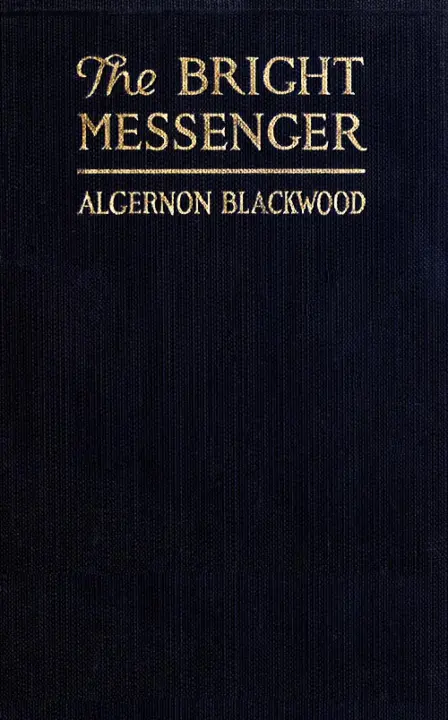
THE CLASSIC COLLECTION · 1922
"The Bright Messenger" by Algernon Blackwood is a novel written in the early 20th century. The story centers on Edward Fillery, a detached yet deeply sympathetic psychologist and doctor, who grapples with his identity shaped by his unconventional birth and upbringing. The book explores themes of human nature, consciousness, and the search for deeper understanding, particularly as it relates to a mysterious young man named LeVallon, who embodies both extraordinary abilities and a primordial connection to nature. At the start of the narrative, we are introduced to Edward Fillery, who reflects on his unique perspective on life stemming from the complex circumstances of his birth. The opening chapters delve into his upbringing, his father's passion for a foreign woman, and the psychological burdens that shaped him into a compassionate observer of humanity. As Fillery embarks on a journey to discover the potential of human consciousness, he receives a letter about LeVallon, a young man with unusual traits and a deep spiritual connection to nature. This letter hints at LeVallon being a unique case filled with potential for insight into the reality beyond ordinary human existence. The initial dynamics between Fillery, LeVallon, and the influences of their respective pasts set the stage for a deeper exploration of what it means to be human.
Introduction adapted from the source catalogue; source summaries may be automatically generated.
Free to read · English · 119,592 words · No account needed
MAKE TIME FOR A GOOD BOOK
On by default. Untick to stop anonymous reading totals. Each page counts after 10 seconds in view. How this works.
Anonymous counting is on unless you have switched it off.
"One thing is certain: only human knowledge, expressed in human terms, can come through a human brain. No mind, no intellect, can convey a message that transcends human experience and reason. Art, however, can. It can supply the vehicle, the body. But, even here, the great artist cannot communicate the secret of his Vision; he cannot talk about it, tell it to others. He can only show the result."
"Results," interrupted Dr. Fillery in a curious tone; "what results, exactly, would you look for?" There was a burning in his eyes. His skin was tingling.
"What else but a widening, deepening, heightening of our present consciousness," came the instant reply. "An extension of faculty, of course, making entirely new knowledge available. A group of great artists, each contributing his special vision, respectively, of form, colour, words, proportion, could together create a 'body' to express a Power transcending the accumulated wisdom of the world. The race could be uplifted, taught, redeemed."
"You have already given some attention to this strange idea?" suggested his listener, watching closely the working of the other's face. "You have perhaps even experimented---- A ceremonial of some sort, you mean? A performance, a ritual--or what?"
Father Collins lowered his voice, becoming more earnest, more
impressive:
"Beauty, the arts," he whispered, "can alone provide a vehicle for the expression of those Intelligences which are the cosmic powers. A performance of some sort--possibly--since there must be sound and movement. A bridge between us, between our evolution and their own, might, I believe, be thus constructed. Art is only great when it provides a true form for the expression of an eternal cosmic power. By combining--we might provide a means for their manifestation----"
"A body of thought, as it were, through which our 'N. H.' might become articulate? Is that your idea?"
Behind the question lay something new, it seemed, as though, while listening to the exposition of an odd mystical conception, his mind had been busy with a preoccupation, privately but simultaneously, of his own. "In what way precisely do you suggest the arts might combine to provide this 'body'?" he asked, a faint tremor noticeable in the lowered voice.
"That," replied Father Collins promptly, never at a loss, "we should have to think about. Inspiration will come to us--probably through him. Ceremonial, of course, has always been an attempt in this direction, only it has left the world so long that people no longer know how to construct a real one. The ceremonials of to-day are ugly, vulgar, false. The words, music, colour, gestures--everything must combine in perfect harmony and proportion to be efficacious. It is a forgotten method."
"And results--how would they come?"
Your reading position is saved on this browser. Take it to another device with a library code. Reading pages adapt to text, rather than matching a printed edition.
Algernon Blackwood
Algernon Blackwood
Algernon Blackwood
Algernon Blackwood
BEHIND THE BOOK
This eBook is for the use of anyone anywhere in the United States and most other parts of the world at no cost and with almost no restrictions whatsoever. You may copy it, give it away or re-use it under the terms of the Project Gutenberg License included with this eBook or online at www.gutenberg.org. If you are not located in the United States, you will have to check the laws of the country where you are located before using this eBook. Read the source licence.
The original source file, including credits and licence, is retained by this library. Request an original-format copy at no charge. Please include the book title and Project Gutenberg identifier #43594.
KEEP YOUR CURIOSITY GOING
Coulson Kernahan

Maurice Baring
Frances Wright
Cécile Tormay
Francis Greenleaf Allinson & Anne C. E. (Anne Crosby Emery) Allinson

Frederic Jesup Stimson