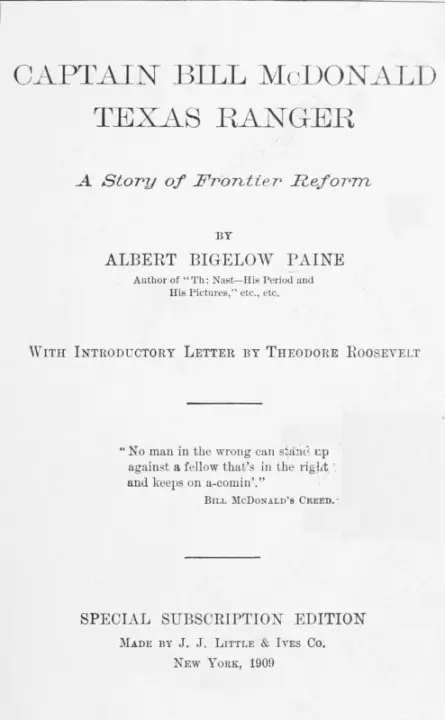
Captain Bill McDonald, Texas Ranger: A Story of Frontier Reform
Albert Bigelow Paine
THE CLASSIC COLLECTION · 1899
"The Bread Line: A Story of a Paper" by Albert Bigelow Paine is a novel written in the late 19th century. The story centers around a group of four friends—two artists and two writers—who embark on an ambitious endeavor to start a publication called the "Whole Family." It explores themes of aspiration, collaboration, and the contrasts between artistic dreams and harsh realities, offering insights into the struggles of bohemian life during a time of economic prosperity. At the start of the book, the narrative unfolds on New Year’s Eve, capturing the optimism and camaraderie among the four protagonists as they indulge in a lavish dinner at a café. As they discuss their dreams and frustrations with the publishing industry, one of the friends, Barrifield, proposes the idea of launching their own paper at a low subscription price, drawing inspiration from an existing successful model. The camaraderie comes to life through their banter and shared ambitions, and as events progress, they find themselves humbled by the social realities around them, exemplified by their encounter with those waiting in the bread line for assistance. This opening chapter establishes the characters' motivations while hinting at the challenges they will face in their entrepreneurial journey.
Introduction adapted from the source catalogue; source summaries may be automatically generated.
Free to read · English · 37,232 words · No account needed
MAKE TIME FOR A GOOD BOOK
On by default. Untick to stop anonymous reading totals. Each page counts after 10 seconds in view. How this works.
Anonymous counting is on unless you have switched it off.
Van Dorn and Perner stared at him a moment to make sure that he was in earnest. There was consent in the laugh that followed. The proposition appealed to their sense of artistic fitness. There was a picturesque completeness in thus rounding out the year. Besides, as Livingstone had said, they were hungry.
They set forth somewhat later. There was a strong wind, and the sleet bit into their flesh keenly. It got into their eyes and, when they spoke, into their mouths.
"I don't know about this," shouted Van Dorn, presently. "I think it's undertaking a good deal for the sake of art."
"Oh, pshaw, Van, this is bully!" Livingstone called back. He was well in advance, and did not seem to mind the storm.
Perner, who was tall, was shrunken and bent by the cold and storm. His voice, however, he lifted above it.
"Art!" he yelled. "I'm going for the sake of the coffee!"
The line that began on Tenth Street had made the turn on Broadway and reached almost to Grace Church when they arrived. The men stood motionless, huddled back into their scanty collars, their heads bent forward to shield their faces from the sharp, flying ice. Strong electric light shone on them. The driving sleet grew on their hats and shoulders. Those who had just arrived found it even colder standing still. Van Dorn's teeth were rattling.
"Do you suppose there's always enough to go round?" he asked of Perner,
who stood ahead of him.
Talking was not pleasant, but the waif behind him answered:
"Wasn't last night. I was on the end of the line and didn't git no
coffee. Guess there'll be enough to-night, though, 'cause it's New
Year."
"If they don't have coffee to-night I'll die," shivered Perner.
Livingstone stood ahead of Perner in the line.
"If it stops with me I'll give you mine," he said. "I'm not hungry, nor
cold, either."
The waif in front of him and the waif behind Van Dorn both made an
effort to see Livingstone.
"What are you doing here, then?" growled the man behind. He saw that the three ahead of him were better dressed than the others and regarded them suspiciously. "What did you fellers come here for, anyway?"
There was a chance for a final joke. It fell to Perner:
"We've been keeping up a whole family," he chattered,--"several whole families. Now we're broke."
"You can have my place in the line," added Livingstone, and they
changed.
The incident attracted little attention. Storm, cold, and hunger had deadened the instinct of curiosity natural to every human bosom. Presently Livingstone leaned forward and murmured to Van Dorn:
Your reading position is saved on this browser. Take it to another device with a library code. Reading pages adapt to text, rather than matching a printed edition.
Albert Bigelow Paine
Albert Bigelow Paine
Albert Bigelow Paine
Albert Bigelow Paine
BEHIND THE BOOK
This eBook is for the use of anyone anywhere in the United States and most other parts of the world at no cost and with almost no restrictions whatsoever. You may copy it, give it away or re-use it under the terms of the Project Gutenberg License included with this eBook or online at www.gutenberg.org. If you are not located in the United States, you will have to check the laws of the country where you are located before using this eBook. Read the source licence.
The original source file, including credits and licence, is retained by this library. Request an original-format copy at no charge. Please include the book title and Project Gutenberg identifier #34023.
KEEP YOUR CURIOSITY GOING
Coulson Kernahan

Maurice Baring
Frances Wright
Cécile Tormay

Frederic Jesup Stimson

W. H. P. (William Henry Pope) Jarvis