THE CLASSIC COLLECTION✦The Broken CupCLASSIC FREE BOOKS
The Broken Cup
Heinrich Zschokke
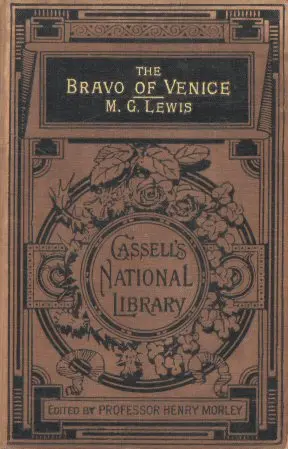
THE CLASSIC COLLECTION · 1805
"The Bravo of Venice: A Romance" by Heinrich Zschokke is a novel written during the early 19th century. The story unfolds against the backdrop of Venice and follows the tragic character Abellino, a beggar who possesses a noble past but now teeters on the edge of desperation, navigating the treacherous world of bandits and moral dilemmas. As he grapples with his fate, he must confront themes of honor, loss, and the possibility of redemption amidst the chaos of his surroundings. At the start of the novel, readers are introduced to Abellino, who reflects on his miserable situation while sitting alone near the canal in Venice on a moonlit night. Struggling with hunger and despair, he vows to take action and ends up intervening to save a stranger from an assassin, unveiling his potential for bravery. The narrative quickly shifts to depict Abellino aligning with bandits after finding himself in dire straits. As he grapples with the implications of his actions, the decision to embrace the life of a "bravo" intertwines with his past and hopes for future greatness, setting the stage for a complex exploration of identity and morality in a world rife with danger and temptation.
Introduction adapted from the source catalogue; source summaries may be automatically generated.
Free to read · English · 34,801 words · No account needed
MAKE TIME FOR A GOOD BOOK
On by default. Untick to stop anonymous reading totals. Each page counts after 10 seconds in view. How this works.
Anonymous counting is on unless you have switched it off.
The doors were thrown open. Contarino entered hastily, enveloped in his
cloak.
“Good evening, sweet gentlemen,” said he, and threw his mantle aside. And Memmo, Parozzi, and Falieri started back in horror.
“Good God!” they exclaimed, “what has happened? You are covered with
blood?”
“A trifle!” cried Contarino; “is that wine? quick, give me a goblet of it, I expire with thirst.”
Falieri (while he gives him a cup).—But, Contarino, you bleed?
Contarino.—You need not tell me that. I did not do it myself, I
promise you.
Parozzi.—First let us bind up your wounds, and then tell us what has happened to you. It is as well that the servants should remain ignorant of your adventure; I will be your surgeon myself.
Contarino.—What has happened to me, say you? Oh! a joke, gentlemen, a mere joke. Here, Falieri, fill the bowl again.
Memmo.—I can scarcely breathe for terror.
Contarino.—Very possibly; neither should I, were I Memmo instead of being Contarino. The wound bleeds plenteously it’s true, but it’s by no means dangerous (he tore open his doublet, and uncovered his bosom). There, look, comrades; you see it’s only a cut of not more than two inches deep.
Memmo (shuddering).—Mercy on me! the very sight of it makes my blood
run cold.
Parozzi brought ointments and linen, and bound up the wound of his
associate.
Contarino.—Old Horace is in the right. A philosopher can be anything he pleases, a cobbler, a king, or a physician. Only observe with what dignified address the philosopher Parozzi spreads that plaster for me. I thank you, friend; that’s enough: and now, comrades, place yourselves in a circle round me, and listen to the wonders which I am going to relate.
Falieri.—Proceed.
Contarino.—As soon as it was twilight, I stole out, wrapped in my cloak, determined if possible to discover some of the banditti. I knew not their persons, neither were they acquainted with mine. An extravagant undertaking, perhaps, you will tell me; but I was resolved to convince you that everything which a man determines to do, may be done. I had some information respecting the rascals, though it was but slight, and on these grounds I proceeded. I happened by mere accident to stumble upon a gondolier, whose appearance excited my curiosity. I fell into discourse with him. I was soon convinced that he was not ignorant of the lurking-place of the bravoes, and by means of some gold and many fair speeches, I at length brought him to confess that though not regularly belonging to the band, he had occasionally been employed by them. I immediately made a bargain with him; he conducted me in his gondola through the greatest part of Venice, sometimes right, sometimes left, till I lost every idea as to the quarter of the town in which I found myself. At length he insisted on binding my eyes with his handkerchief, and I was compelled to submit. Half an hour elapsed before the gondola stopped. He told me to descend, conducted me through a couple of streets, and at length knocked at a door, where he left me still blindfolded. The door was opened; my business was inquired with great caution, and after some demur I was at length admitted. The handkerchief was now withdrawn from my eyes, and I found myself in a small chamber, surrounded by four men of not the most creditable appearance, and a young woman, who (it seems) had opened the door for me.
Your reading position is saved on this browser. Take it to another device with a library code. Reading pages adapt to text, rather than matching a printed edition.
BEHIND THE BOOK
This eBook is for the use of anyone anywhere in the United States and most other parts of the world at no cost and with almost no restrictions whatsoever. You may copy it, give it away or re-use it under the terms of the Project Gutenberg License included with this eBook or online at www.gutenberg.org. If you are not located in the United States, you will have to check the laws of the country where you are located before using this eBook. Read the source licence.
The original source file, including credits and licence, is retained by this library. Request an original-format copy at no charge. Please include the book title and Project Gutenberg identifier #2706.
KEEP YOUR CURIOSITY GOING
Cécile Tormay

Moritz Busch
Coulson Kernahan
John L. Ransom

Maurice Baring
Frances Wright