
Arthur
Eugène Sue
THE CLASSIC COLLECTION · 1908
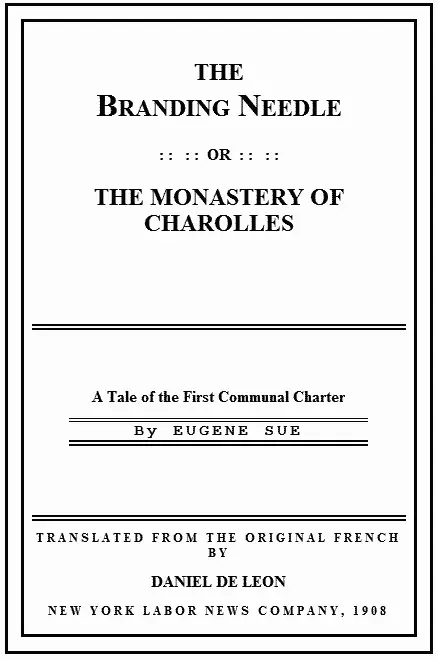
"The Branding Needle; or, The Monastery of Charolles" by Eugène Sue is a historical novel written in the late 19th century. This tale is part of a series titled "The Mysteries of the People" and centers around the Valley of Charolles, a community that stands independent against the political turbulence of its time, particularly against the backdrop of Frankish rule. The narrative includes significant characters such as Loysik, the wise leader of the monastery, and highlights themes of social justice, the struggle for autonomy, and the dynamics of power within the feudal system. The opening of the novel introduces the serene setting of the Valley of Charolles, where the local inhabitants are preparing for a celebratory event marking their settlement's anniversary. As we meet the cheerful characters, notably Fulvia and the old dame Odille, a sense of joy permeates the atmosphere, filled with laughter and camaraderie. However, this tranquility is juxtaposed with the ominous shadow of political strife looming from the outside, as hinted by the arrival of powerful adversaries, including Queen Brunhild and her agents. The chapter sets the stage for an unfolding conflict as Loysik prepares to uphold the community’s rights against the encroaching authority of the church and state, foreshadowing the dramatic events yet to come.
Introduction adapted from the source catalogue; source summaries may be automatically generated.
Free to read · English · 36,666 words · No account needed
MAKE TIME FOR A GOOD BOOK
On by default. Untick to stop anonymous reading totals. Each page counts after 10 seconds in view. How this works.
Anonymous counting is on unless you have switched it off.
"Madam," said Chrotechilde to Brunhild, "for whom do you intend the one of the two female slaves whom you expect to buy?"
"You really ask me?"
"Yes, madam--"
"Chrotechilde, age seems to dull your powers of penetration--perhaps I may have to look for some other confidante."
"Madam, please explain yourself--"
"I mean to test how far the present dullness that seems to have come
over you may go."
"Truly, madam, I am at a loss to understand you--"
"Tell me, Chrotechilde, did not my son Childebert, when he died assassinated by Fredegonde, leave me the guardianship of his two sons, my grandchildren, Thierry and Theudebert?"
"Yes--madam--but I was speaking of the two female slaves--and not of
your children."
"At what age was my grandson Theudebert a father?"
"At thirteen--at that age he had a son from Bilichilde, the dark-complexioned slave with green eyes, for whom you paid a big price. I still see her wild looks, as uncommon as her style of beauty. For the rest, she had a nymph's waist, and wavy and jet-black hair that reached the floor. I never in my life saw such hair. But why do you look so somber?"
"The vile slave! Did not that miserable Bilichilde gain a fatal ascendency over my grandson Theudebert, despite the many other concubines that we furnished him?"
"Indeed, madam! So fatal was the ascendency that she gained over him, that she caused us to be driven out of Metz, both you and me, and led prisoners as far as Arcis-on-the-Aube, the boundary of Burgundy, the kingdom of your other grandson, Thierry. But all that is an old story, madam, that is dead and should be forgotten, together with the principal actors in it. Bilichilde is no more; she was last year strangled to death by your grandson, the savage idiot Theudebert himself, who passed from love to hatred; afterwards, beaten at the battle of Tolbiac by his brother, whom you hurled at his head, he was himself shorn of his hair and stabbed to death; finally, his five-year-old son had his skull broken against a stone. Accordingly, that score was thoroughly settled. Were you not amply revenged?"
"No; with me, hatred survives vengeance, it survives death itself, as the dagger survives the murder. No; my vengeance is not yet complete."
"You are not reasonable. To hate beyond the grave is childish at your
age."
"And is your mind not yet enlightened by what we have just said?"
"With regard to the two handsome slaves?"
"Yes, with regard to the two pretty girls."
"No, madam, I cannot yet fathom your thoughts."
Your reading position is saved on this browser. Take it to another device with a library code. Reading pages adapt to text, rather than matching a printed edition.
Eugène Sue
Eugène Sue
Eugène Sue

Eugène Sue
BEHIND THE BOOK
This eBook is for the use of anyone anywhere in the United States and most other parts of the world at no cost and with almost no restrictions whatsoever. You may copy it, give it away or re-use it under the terms of the Project Gutenberg License included with this eBook or online at www.gutenberg.org. If you are not located in the United States, you will have to check the laws of the country where you are located before using this eBook. Read the source licence.
The original source file, including credits and licence, is retained by this library. Request an original-format copy at no charge. Please include the book title and Project Gutenberg identifier #33618.
KEEP YOUR CURIOSITY GOING
Cécile Tormay

Moritz Busch
Coulson Kernahan
John L. Ransom

Maurice Baring
Frances Wright