The Young Wild-Fowlers
Harry Castlemon
THE CLASSIC COLLECTION · 1877
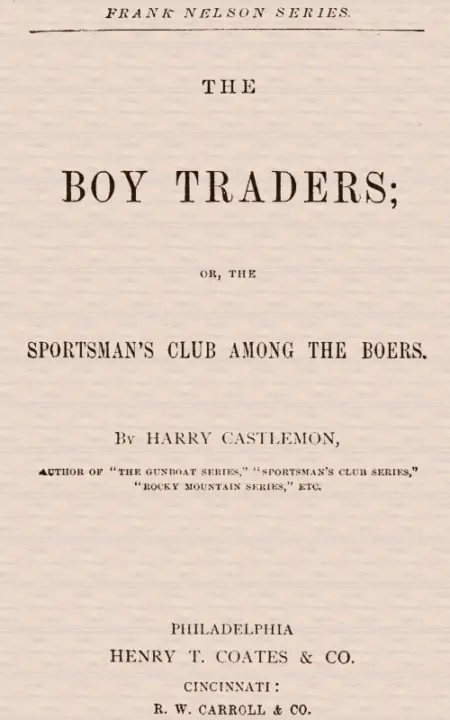
"The Boy Traders; Or, The Sportsman's Club Among the Boers" by Harry Castlemon is a novel written in the late 19th century. The narrative follows a group of young adventurers known as the Sportsman's Club, led by Frank Nelson, as they navigate the perils and excitement of maritime life, including several intense encounters at sea and with the inhabitants of various islands. At the start of the story, the Club members find themselves aboard the schooner named Stranger, aiming to escape an approaching cyclone. As they prepare for the storm, the characters engage in nautical discussions that reflect their experiences and fears. In the aftermath of the cyclone, the crew faces new challenges, including the capture of a rival ship's crew and the arrival of dangerous figures among the rescued from a shipwreck. The opening chapters set the stage for adventure and conflict, introducing themes of bravery and camaraderie among the young adventurers as they encounter both natural and human threats during their journey.
Introduction adapted from the source catalogue; source summaries may be automatically generated.
Free to read · English · 64,485 words · No account needed
MAKE TIME FOR A GOOD BOOK
On by default. Untick to stop anonymous reading totals. Each page counts after 10 seconds in view. How this works.
Anonymous counting is on unless you have switched it off.
“There’s no danger that you will be overburdened with company if you intend to pass the night at that shooting-hole,” said Bob, with a laugh. “I know who won’t go. Here’s one.”
“Here’s another,” said George.
“Here’s one who will go,” cried Archie.
“You don’t mean it,” exclaimed George.
“I mean just this: if Eugene is brave enough to stay beside that spring to-night, I am,” returned Archie.
“So am I,” said Fred.
“Oh, of course,” laughed George. “If one of you three go, you’ll all go. Well, I shall stay contentedly by the fire, and about the time you hear the roar of the first lion that is coming to the spring to drink, you’ll wish yourselves safe beside the fire, too.”
“Do you really mean to go, Eugene?” asked Archie, in a low tone.
“Yes, I do, if you two fellows will go with me. We don’t expect to kill a lion or even shoot at one, but we’ll have something to brag of. When we get home we can say we performed a feat that none of the others dared attempt.”
“How big is one of them critters, anyhow?” asked Dick Lewis. “Is he much bigger’n a painter?”
“Why a panther wouldn’t make an ear for a lion,” replied Eugene. “Well, yes, perhaps he would, too,” he added, seeing that the trapper’s eyes were fastened searchingly upon him; “but he wouldn’t make more than a half a dozen good mouthfuls. Will you go with us, Dick?”
“Nary time,” exclaimed the trapper, quickly. “A critter that can make such a bellerin’ as that one did that stormy night a few weeks back, is something I don’t want to see.”
Our three friends, Archie, Fred, and Eugene, had something to talk about now—something in which they alone were interested; so they fell back behind the others, and during the rest of the forenoon were left almost entirely to themselves. Whether or not they expected to derive any pleasure from their projected enterprise, other than to be found in talking about it after it was all over, it is hard to tell. They tried their best to make themselves and one another believe that they did, and repeatedly expressed the hope that Uncle Dick would not interpose his authority, and spoil all their sport by ordering them to stay in the camp. They expected that he would have something to say about it during the noon halt, and so he did, but he did not put his veto on the project. He had done such a thing more than once during his young and foolish days, he said, and although he could not be easily induced to do it again, he would not like to sell his experience at any price. It was going to be a beautiful night for sport. It would be as dark as pitch, and that was just what they wanted. He hoped that they would bag lions enough so that each one of the party could have a skin to remind him of his sojourn in Africa, and of that night in particular. Frank talked much in the same strain, and added that he thought he had enough arsenical soap left to preserve a few of the heads of the lions, if the hunters would cut them off and bring them to the camp. The three friends were not prepared for this, and they did not know what to make of it. They had looked for opposition, and instead of that received encouragement and offers of assistance. They said nothing until the journey was resumed, and then they fell behind to compare notes.
Your reading position is saved on this browser. Take it to another device with a library code. Reading pages adapt to text, rather than matching a printed edition.
Harry Castlemon
Harry Castlemon
Harry Castlemon
Harry Castlemon
BEHIND THE BOOK
This eBook is for the use of anyone anywhere in the United States and most other parts of the world at no cost and with almost no restrictions whatsoever. You may copy it, give it away or re-use it under the terms of the Project Gutenberg License included with this eBook or online at www.gutenberg.org. If you are not located in the United States, you will have to check the laws of the country where you are located before using this eBook. Read the source licence.
The original source file, including credits and licence, is retained by this library. Request an original-format copy at no charge. Please include the book title and Project Gutenberg identifier #56868.
KEEP YOUR CURIOSITY GOING
Wilfrid Scawen Blunt
Wilfrid Scawen Blunt

E. W. (Edgar Watson) Howe
Coulson Kernahan

Maurice Baring
Frances Wright