THE CLASSIC COLLECTION✦The ocean wireless boys of the iceberg patrolCLASSIC FREE BOOKS
The ocean wireless boys of the iceberg patrol
John Henry Goldfrap
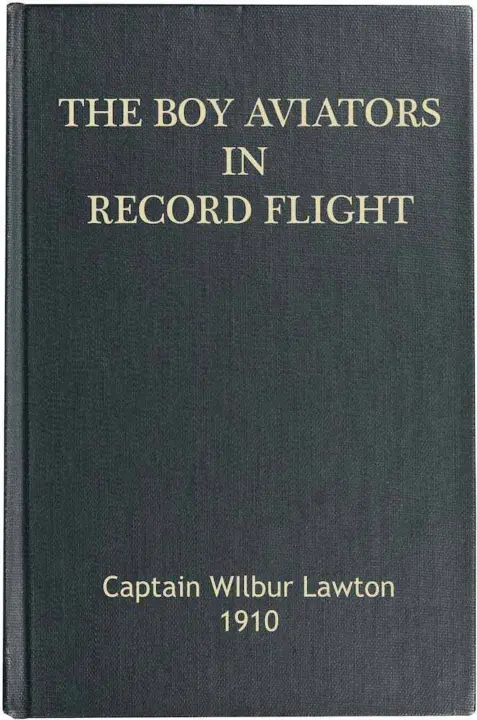
THE CLASSIC COLLECTION · 1910
"The Boy Aviators in Record Flight; Or, The Rival Aeroplane" by Captain Wilbur Lawton is a young adult adventure novel written in the early 20th century. The story centers around two young aviators, Frank and Harry Chester, who, along with their friend Billy Barnes, take on a formidable challenge: a cross-country flight from New York to San Francisco for a $50,000 prize. In addition to the thrill of aviation, the narrative explores themes of rivalry, clever problem-solving, and the adventures of youth. The opening of the tale introduces Billy Barnes, a reporter for the New York "Planet", who is tasked with covering a major aviation event. After discussing the competitive landscape with his editor, he learns that their rival newspaper, the "Despatch", is also entering the fray with an identical prize for the same flight, which adds tension and urgency to the plot. The discussion leads to Billy's desire to involve the Chester brothers in the competition, but they are initially hesitant. As the story progresses, readers witness the development of friendships and rivalries, the planning for a record-setting flight, and the mounting excitement as the characters prepare for their daring undertaking. The stage is set for thrilling aerial adventures and unexpected challenges as they embark on their journey.
Introduction adapted from the source catalogue; source summaries may be automatically generated.
Free to read · English · 48,212 words · No account needed
MAKE TIME FOR A GOOD BOOK
On by default. Untick to stop anonymous reading totals. Each page counts after 10 seconds in view. How this works.
Anonymous counting is on unless you have switched it off.
What was to be done?
The bridge across the canyon was impassable for an auto—that seemed certain. While the open space caused by the removal of the two planks or rough trunks was not more than four feet, still it was a distance sufficient to make anyone despair of ever getting a vehicle across it.
“We can cut some trees and split off planks?” suggested Mr. Joyce.
“That would take too long,” declared the boys. “Frank and Harry need us in a hurry or they would not have sent such an imperative message. We have got to cross the canyon.”
Suddenly Lathrop, who had been studying the situation, the steep-sided canyon, the roaring river on its rocky bed below the structure of the bridge itself, uttered an exclamation.
“I think I can see a way to get across that gap,” he cried.
“Climb across on the stringpiece, I suppose?” replied Bart sarcastically. “I thought of that some time ago; we can easily do that, but we’ve got to have the auto. It’s got all the supplies in it.”
“No, my plan is to go across, auto and all,” rejoined Lathrop.
“What! Take the auto across that gap?”
“Yes.”
“Say, this is no time for fooling, Lathrop,” remonstrated Billy Barnes.
“I’m not fooling. I mean it. Did you ever go to the circus?”
“Well, of all the fool questions. Yes, I’ve been to the circus, but what has that got to do with this situation?”
“A whole lot.”
“For instance?”
“Well, you’ve seen an act there called ‘leaping the gap’ or some such
name?”
“Yes, where a woman in an auto comes down a steep incline and jumps a big gap at the bottom?”
“That’s it.”
“But, in the circus the auto is given an upward impetus by the fact that the incline down which it runs down is curved upward at the end,” objected Billy.
“So it is in this case,” was the calm reply. “I’ve been looking it over, and it seems to me that conditions are about the same.”
“As how?”
“Well, here we have a steep incline—the hill yonder,” Billy Barnes nodded, “and there yonder is the gap where Luther Barr and his gang took out the boards.”
“But you haven’t got the upward curve at the end of your incline to throw the auto into the air and carry it safely across the gap,” objected Billy.
“Oh, yes, that’s there, too,” was the calm reply; “do you notice that the bridge sags in the centre?”
“Yes, it does, that’s true,” pronounced Billy, after a prolonged
scrutiny.
Your reading position is saved on this browser. Take it to another device with a library code. Reading pages adapt to text, rather than matching a printed edition.
John Henry Goldfrap
John Henry Goldfrap
John Henry Goldfrap

John Henry Goldfrap
BEHIND THE BOOK
This eBook is for the use of anyone anywhere in the United States and most other parts of the world at no cost and with almost no restrictions whatsoever. You may copy it, give it away or re-use it under the terms of the Project Gutenberg License included with this eBook or online at www.gutenberg.org. If you are not located in the United States, you will have to check the laws of the country where you are located before using this eBook. Read the source licence.
The original source file, including credits and licence, is retained by this library. Request an original-format copy at no charge. Please include the book title and Project Gutenberg identifier #45182.
KEEP YOUR CURIOSITY GOING
Coulson Kernahan

Maurice Baring
Frances Wright
Cécile Tormay

Frederic Jesup Stimson

W. H. P. (William Henry Pope) Jarvis