THE CLASSIC COLLECTION✦The ocean wireless boys of the iceberg patrolCLASSIC FREE BOOKS
The ocean wireless boys of the iceberg patrol
John Henry Goldfrap
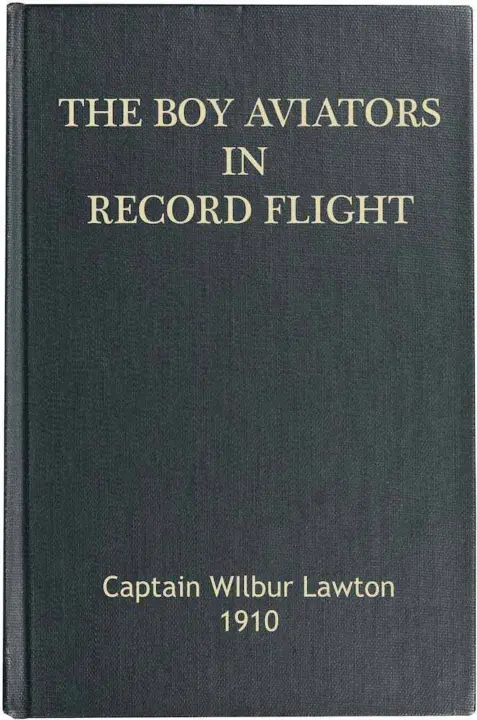
THE CLASSIC COLLECTION · 1910
"The Boy Aviators in Record Flight; Or, The Rival Aeroplane" by Captain Wilbur Lawton is a young adult adventure novel written in the early 20th century. The story centers around two young aviators, Frank and Harry Chester, who, along with their friend Billy Barnes, take on a formidable challenge: a cross-country flight from New York to San Francisco for a $50,000 prize. In addition to the thrill of aviation, the narrative explores themes of rivalry, clever problem-solving, and the adventures of youth. The opening of the tale introduces Billy Barnes, a reporter for the New York "Planet", who is tasked with covering a major aviation event. After discussing the competitive landscape with his editor, he learns that their rival newspaper, the "Despatch", is also entering the fray with an identical prize for the same flight, which adds tension and urgency to the plot. The discussion leads to Billy's desire to involve the Chester brothers in the competition, but they are initially hesitant. As the story progresses, readers witness the development of friendships and rivalries, the planning for a record-setting flight, and the mounting excitement as the characters prepare for their daring undertaking. The stage is set for thrilling aerial adventures and unexpected challenges as they embark on their journey.
Introduction adapted from the source catalogue; source summaries may be automatically generated.
Free to read · English · 48,212 words · No account needed
MAKE TIME FOR A GOOD BOOK
On by default. Untick to stop anonymous reading totals. Each page counts after 10 seconds in view. How this works.
Anonymous counting is on unless you have switched it off.
Harry tinkered with the engine, and it began to run a little better for a short time, but soon began to gasp and cough, as if in mortal distress.
“What can be the matter with it?” puzzled Harry. “Everything, ignition, lubrication and all seems to be all right.”
“I have it,” suddenly cried Frank.
“What is it?”
“The gasolene is running out!”
Sure enough there was hardly more than a few spoonfuls of the fuel left.
“There’s some alcohol in the locker. We had it for the stove. Let’s try that,” suggested Harry.
The alcohol was dumped into the tank and gave them a little more fuel, but the shore still looked far away.
Lower and lower sagged the aeroplane under her decreased speed, till as they reached the shore it seemed that she was hardly skimming the waves, but she bravely struggled on, and as the engine gave a final gasp and came to an abrupt stop, the Golden Eagle settled down on a sandy beach.
“Well, here we are,” said Frank, “and none too soon.”
“Now, let’s go and see what sort of folks they are in that village,” said Harry. “I’m famished, and my mouth is as parched as a bit of dried orange peel.”
“Same here,” said Frank, as the boys set out for the interior which was hidden from them by sand dunes, topped with a sort of sharp bladed grass that cut like a knife.
The village they found to be a mere collection of shacks, with pigs roaming about its streets, and skinny cattle poking their noses into the house doors. They were received hospitably enough, however, and although they could not talk Spanish, managed to make their wants understood, more especially when they showed some gold.
The wonder of the villagers knew no bounds when, after they had refreshed themselves, the boys showed them the aeroplane and pointed to the sky. The Mexicans were too polite to say so, but it was clear that they thought the boys were fabricators, though how they imagined they had landed in their village was a matter of speculation.
That night they managed to secure a cart and, having packed the Golden Eagle, set out for the railroad, which the Mexicans assured them was “far, far away,” as a matter of fact, it was not more than sixty miles, and the next day, late in the evening, two very dusty, very ragged, very tired boys got out of the plodding ox cart at Torres, a small town on the Sonora Railroad, and almost frightened the native operator to death by their vehement demands to file messages.
Your reading position is saved on this browser. Take it to another device with a library code. Reading pages adapt to text, rather than matching a printed edition.
John Henry Goldfrap
John Henry Goldfrap
John Henry Goldfrap
John Henry Goldfrap
BEHIND THE BOOK
This eBook is for the use of anyone anywhere in the United States and most other parts of the world at no cost and with almost no restrictions whatsoever. You may copy it, give it away or re-use it under the terms of the Project Gutenberg License included with this eBook or online at www.gutenberg.org. If you are not located in the United States, you will have to check the laws of the country where you are located before using this eBook. Read the source licence.
The original source file, including credits and licence, is retained by this library. Request an original-format copy at no charge. Please include the book title and Project Gutenberg identifier #45182.
KEEP YOUR CURIOSITY GOING
Coulson Kernahan

Maurice Baring
Frances Wright
Cécile Tormay

Frederic Jesup Stimson

W. H. P. (William Henry Pope) Jarvis