THE CLASSIC COLLECTION✦The ocean wireless boys of the iceberg patrolCLASSIC FREE BOOKS
The ocean wireless boys of the iceberg patrol
John Henry Goldfrap
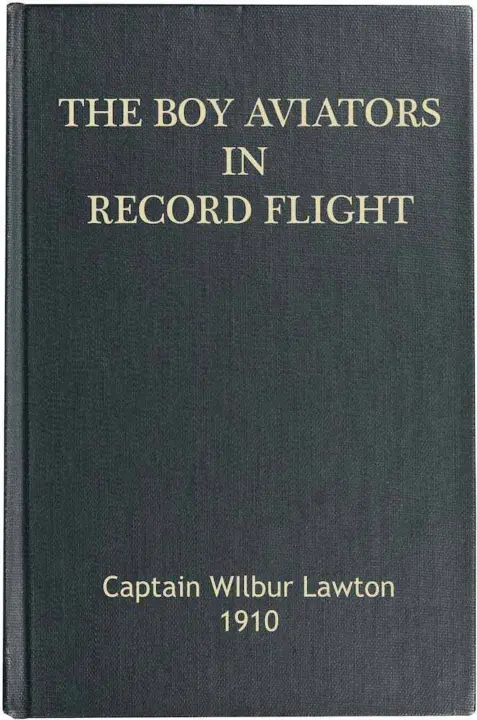
THE CLASSIC COLLECTION · 1910
"The Boy Aviators in Record Flight; Or, The Rival Aeroplane" by Captain Wilbur Lawton is a young adult adventure novel written in the early 20th century. The story centers around two young aviators, Frank and Harry Chester, who, along with their friend Billy Barnes, take on a formidable challenge: a cross-country flight from New York to San Francisco for a $50,000 prize. In addition to the thrill of aviation, the narrative explores themes of rivalry, clever problem-solving, and the adventures of youth. The opening of the tale introduces Billy Barnes, a reporter for the New York "Planet", who is tasked with covering a major aviation event. After discussing the competitive landscape with his editor, he learns that their rival newspaper, the "Despatch", is also entering the fray with an identical prize for the same flight, which adds tension and urgency to the plot. The discussion leads to Billy's desire to involve the Chester brothers in the competition, but they are initially hesitant. As the story progresses, readers witness the development of friendships and rivalries, the planning for a record-setting flight, and the mounting excitement as the characters prepare for their daring undertaking. The stage is set for thrilling aerial adventures and unexpected challenges as they embark on their journey.
Introduction adapted from the source catalogue; source summaries may be automatically generated.
Free to read · English · 48,212 words · No account needed
MAKE TIME FOR A GOOD BOOK
On by default. Untick to stop anonymous reading totals. Each page counts after 10 seconds in view. How this works.
Anonymous counting is on unless you have switched it off.
All that afternoon the two ships sailed along in company, the boys’ aeroplane slightly in the lead. As the sun sank lower a big bank of clouds arose toward the north and the sun glowed with a peculiar red light.
A light breeze also sprang up, but instead of being cooling it was as hot as if it had blown from an oven door.
“We’re in for a storm,” remarked Frank, “or I’m very much mistaken.”
“What, a regular rain and wind storm?” asked Harry. “I thought they only had those in the hills in this part of the country.”
“They have a worse thing than that,” said Frank apprehensively, “a sand storm, and that’s what may be coming.”
“McArthur doesn’t seem to be worrying,” remarked Harry, glancing up at the dirigible, which was sailing slightly above them.
“No,” said Frank, “that’s a fact. Maybe I am mistaken, after all. Anyhow, we’ll keep on as long as he does.”
But half an hour later the boys wished they had alighted. The wind came in sharp, hot puffs from the north, and had it not been for the Joyce gyroscopic balancer they carried, the ship would have been in hard straits. As it was, when Frank wished to make a landing he dared not risk it. The air, too, grew so thick that he could not see the earth beneath them.
Stinging particles of sand drove into their eyes, blinding them and gritting between their teeth. The wind grew stronger, and as it did so the air grew black as night with the sand with which it was impregnated.
So dark was it, in fact, that when night came and found them still in the air, unable to make a landing, there did not seem to be any perceptible difference.
The aeroplane drove rigidly before the howling wind. Her speed was terrific. Neither boy spoke after their first expressions of alarm, but devoted their entire attentions to keeping the aeroplane from capsizing.
“Keep cool, Harry,” said Frank at length. “We may come out of it all
right.”
“Where are we being driven?” asked the other lad.
“To the south at a terrific pace, too. If the gasolene holds out we may manage to live out the storm, but I don’t know where we will be driven to.”
“What lies to the south of us?” asked Harry, after another long pause, during which the storm-stressed aeroplane made several sickening lurches, always recovering herself in time, however, thanks to the gyroscope.
“Why, about as desolate a country as can be imagined. Nothing but arid
wastes and cactus.”
Your reading position is saved on this browser. Take it to another device with a library code. Reading pages adapt to text, rather than matching a printed edition.
John Henry Goldfrap
John Henry Goldfrap
John Henry Goldfrap
John Henry Goldfrap
BEHIND THE BOOK
This eBook is for the use of anyone anywhere in the United States and most other parts of the world at no cost and with almost no restrictions whatsoever. You may copy it, give it away or re-use it under the terms of the Project Gutenberg License included with this eBook or online at www.gutenberg.org. If you are not located in the United States, you will have to check the laws of the country where you are located before using this eBook. Read the source licence.
The original source file, including credits and licence, is retained by this library. Request an original-format copy at no charge. Please include the book title and Project Gutenberg identifier #45182.
KEEP YOUR CURIOSITY GOING
Coulson Kernahan

Maurice Baring
Frances Wright
Cécile Tormay

Frederic Jesup Stimson

W. H. P. (William Henry Pope) Jarvis