Lives of Fair and Gallant Ladies. Vol 2.
Pierre de Bourdeille Brantôme
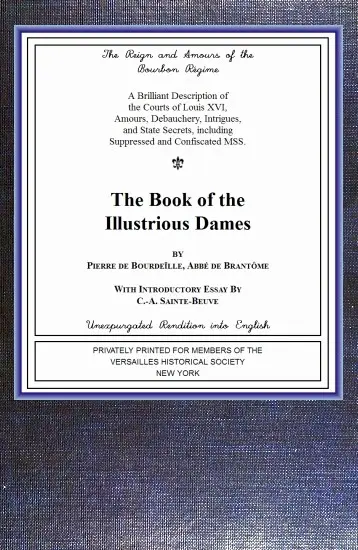
THE CLASSIC COLLECTION · 1899
"The Book of the Ladies" by Pierre de Bourdeille Brantôme is a historical account written in the late 16th century. The text explores the lives and virtues of various notable women of the French court, particularly focusing on significant queens such as Anne de Bretagne and Catherine de' Medici. Through detailed accounts and engaging anecdotes, Brantôme provides insight into their personalities, challenges, and the roles they played in history, portraying them as influential figures shaping the social and political fabric of their time. At the start of the book, the author introduces his own perspective and background, establishing his credibility as someone who has witnessed the courts of France and interacted with its key figures. He emphasizes the importance of honoring the contributions of women in history, beginning with a detailed examination of Anne de Bretagne's life. Brantôme describes her marriage to King Charles VIII, her influence on French politics, and her notable personal attributes, such as beauty and intelligence, while also touching upon her complexities, including her sense of vengeance when wronged. The opening portion sets a tone of admiration and respect for these illustrious dames, positioning Brantôme not only as a storyteller but also as a defender of their legacies against historical neglect.
Introduction adapted from the source catalogue; source summaries may be automatically generated.
Free to read · English · 101,730 words · No account needed
MAKE TIME FOR A GOOD BOOK
On by default. Untick to stop anonymous reading totals. Each page counts after 10 seconds in view. How this works.
Anonymous counting is on unless you have switched it off.
MARGUERITE, Queen of France and of Navarre, daughter of Henri II. and Catherine de’ Medici, wife of Henri
IV., Brantôme visits her at the Castle of Usson and dedicates his work to her, 19;
mention of her in his will, 22;
his discourse, 152-193;
her beauty and style of dress, 153-163;
her mind and education, 164-166;
marriage to Henri IV., 167;
Brantôme’s argument in favour of the Salic law, 168-175;
difficulty of religion between herself and her husband, 176;
her dignity and sense of honour, 178-180;
retirement in the Castle of Usson, 183;
on ill terms with her brother Henri III., 184;
her beautiful dancing, 185;
her liberality and generosity, 186-190;
love of reading, 191;
corresponds with Brantôme, 191;
Sainte-Beuve’s essay on her, 193;
reasons why she began her Memoirs, 195;
faithfulness to the Catholic religion, 195;
intimacy with her brother d’Anjou, Henri III., 196, 197;
her love for Henri Duc de Guise, le Balafré, her marriage to Henri IV., 198;
the Saint-Bartholomew, 201;
her Memoirs, 202, etc.;
anecdote of a Princesse de Ligne, 205;
friendship with her brother, Duc d’Alençon, 206;
her letters, 208;
her life at Usson, 209;
divorce from Henri IV., 209, 210;
return to Paris, eccentricities, appearance at the coronation of Marie de’ Medici, 210-212;
comparison with Marie Stuart, 213;
her real merit, 213, 231.
MARGUERITE DE LORRAINE, wife of the Duc de Joyeuse, 282, 283.
MARIE D’AUTRICHE, wife of the Emperor Maximilian II., 291-293.
MARIE D’AUTRICHE, sister of the Emperor Charles V. and wife of Louis, King of Hungary, 273-280.
MARIE STUART, Queen of France and Scotland, her parentage, 89;
youthful accomplishments and beauty, 90-93;
marriage to François II., and widowhood, 93, 94;
her poem on her widowhood, 94-96, 294;
Charles IX.’s love for her, 96;
returns to Scotland,
Brantôme accompanies her, 97-101,
marriage to Darnley, 101;
Brantôme’s defence of her, 102;
her disasters, 103;
her imprisonment in England, 104;
her death, as related to Brantôme by one of her ladies there present, 105-115;
Sainte-Beuve’s essay on Marie Stuart and summing up of her life, 121-136, 289;
her poem on her widowhood, translation, 301.
MÉZERAY (François Eudes de), his History of France, his picture of Catherine de’ Medici, 85.
MIGNET (François Auguste), his invaluable History of Marie Stuart, 121, 122, 136.
MOLAND (M. Henri), his essay on Brantôme used in the introduction to this volume, 1.
NIEL (M.), librarian to Ministry of the Interior, his collection of original portraits and crayons of celebrated persons of the 16th century, 86, 87.
PATIN (Gui), his feelings in Saint-Denis before the tomb of Louis XII. and Anne de Bretagne, 40, 41.
PHILIP II. of Spain, 138, 139, 142.
RENÉE DE FRANCE (Madame), daughter of Louis XII. and Anne de Bretagne, wife of the Duke of Ferrara, 220-223.
RŒDERER (Comte), his Memoirs on Polite Society, study of Louis XII. and Anne de Bretagne, 41-43.
RONSARD (Pierre de), 91, 124, 156, 157, 160, 185, 224.
Your reading position is saved on this browser. Take it to another device with a library code. Reading pages adapt to text, rather than matching a printed edition.
Pierre de Bourdeille Brantôme
Pierre de Bourdeille Brantôme
BEHIND THE BOOK
This eBook is for the use of anyone anywhere in the United States and most other parts of the world at no cost and with almost no restrictions whatsoever. You may copy it, give it away or re-use it under the terms of the Project Gutenberg License included with this eBook or online at www.gutenberg.org. If you are not located in the United States, you will have to check the laws of the country where you are located before using this eBook. Read the source licence.
The original source file, including credits and licence, is retained by this library. Request an original-format copy at no charge. Please include the book title and Project Gutenberg identifier #42515.
KEEP YOUR CURIOSITY GOING
Cécile Tormay

Moritz Busch
John L. Ransom
Frances Wright
Cécile Tormay

Mabel Potter Daggett