Lives of Fair and Gallant Ladies. Vol 2.
Pierre de Bourdeille Brantôme
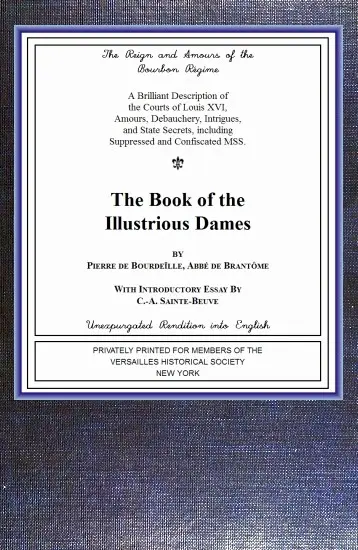
THE CLASSIC COLLECTION · 1899
"The Book of the Ladies" by Pierre de Bourdeille Brantôme is a historical account written in the late 16th century. The text explores the lives and virtues of various notable women of the French court, particularly focusing on significant queens such as Anne de Bretagne and Catherine de' Medici. Through detailed accounts and engaging anecdotes, Brantôme provides insight into their personalities, challenges, and the roles they played in history, portraying them as influential figures shaping the social and political fabric of their time. At the start of the book, the author introduces his own perspective and background, establishing his credibility as someone who has witnessed the courts of France and interacted with its key figures. He emphasizes the importance of honoring the contributions of women in history, beginning with a detailed examination of Anne de Bretagne's life. Brantôme describes her marriage to King Charles VIII, her influence on French politics, and her notable personal attributes, such as beauty and intelligence, while also touching upon her complexities, including her sense of vengeance when wronged. The opening portion sets a tone of admiration and respect for these illustrious dames, positioning Brantôme not only as a storyteller but also as a defender of their legacies against historical neglect.
Introduction adapted from the source catalogue; source summaries may be automatically generated.
Free to read · English · 101,730 words · No account needed
MAKE TIME FOR A GOOD BOOK
On by default. Untick to stop anonymous reading totals. Each page counts after 10 seconds in view. How this works.
Anonymous counting is on unless you have switched it off.
DIANE DE FRANCE (Madame), Duchesse d’Angoulême, illegitimate daughter of Henri II., 231-234.
ÉLISABETH DE FRANCE, Queen of Spain, daughter of Henri II. and Catherine de’ Medici, second wife of Philip II. of Spain, 137-151, 229, 230, 270, 271.
ÉLISABETH DE FRANCE, Queen of Spain, daughter of Henri IV. and Marie de’ Medici, her portraits by Rubens, 212.
FLEUR-DE-LIS, how connected with the Florentine lily, 45.
FRANÇOIS I., King of France, 219, 220, 236, 237, 238, 241, 245-249, 254.
GERMAINE DE FOIX, wife of King Ferdinand of Spain, 142, 143.
GUISE (Henri I., Duc de), le Balafré, 117, 198, 199, 273, 283, 288.
GUISE (Catherine de Clèves, Duchesse de), 283, 289.
HENRI II., King of France, 231, 232.
HENRI III., King of France, 177, 178, 180, 184, 196-198, 234, 267, 280, 283, 285, 286, 292.
HENRI IV., King of France, opinion of Catherine de’ Medici, 83, 87, 88; 176, 180, 181, 201, 209; remark at the coronation of Marie de’ Medici, 210; 234.
ISABELLE D’AUTRICHE, Queen of France, daughter of Maximilian II., wife of Charles IX. of France, 262-270.
ISABELLA OF BAVARIA, wife of Charles VI. of France, first brought the pomps and fashions of dress to France, 157.
JEANNE D’AUTRICHE, wife of Jean, Infante of Portugal, 270-273.
JEANNE DE FRANCE (Madame), daughter of Louis XI., married to and divorced by Louis XII., 215, 216.
LABANOFF (Prince Alexander), his careful research into the history of Marie Stuart, 121.
L’HÔPITAL (Michel de), chancellor of France, epithalamium on the marriage of Marie Stuart and François II., 124; his changed feeling, 131, 132.
LOUIS XII., King of France, 25, 29, 30, 31, 32, 39, 41-43.
LOUISE DE FRANCE (Madame), daughter of François I. and Queen Claude, died young, 223.
LOUISE DE LORRAINE, Queen of France, wife of Henri III., 280-282, 283.
MAGDELAINE DE FRANCE (Madame), daughter of François I. and Queen Claude, wife of James V. of Scotland, 223, 224.
MAINTENON (Madame de), a pendant to Anne de Bretagne, 43.
MAISON-FLEUR (M. de), 91, 97, 300.
MARGUERITE DE VALOIS, Queen of Navarre, sister of François I., wife of Henri d’Albret, King of Navarre, grandmother of Henri IV., 234;
her poems, 235;
her devotion to her brother, 237-240, 245, 249;
interest in the phenomenon of death, 242;
her “Nouvelles,” 242, 243, 244;
Sainte-Beuve’s essay on her, 243-261;
her learning and comprehension of the Renaissance, 244, 245;
her letters, 249;
Erasmus’ opinion of her, 250, 251;
favours, but does not belong
to, the Religion, 251-255;
her writings, the Heptameron, 255-260;
the patron of the Renaissance, 261;
her works, 303.
MARGUERITE DE FRANCE (Madame), daughter of François I. and Queen Claude, wife of the Duc de Savoie, 224-229.
Your reading position is saved on this browser. Take it to another device with a library code. Reading pages adapt to text, rather than matching a printed edition.
Pierre de Bourdeille Brantôme
Pierre de Bourdeille Brantôme
BEHIND THE BOOK
This eBook is for the use of anyone anywhere in the United States and most other parts of the world at no cost and with almost no restrictions whatsoever. You may copy it, give it away or re-use it under the terms of the Project Gutenberg License included with this eBook or online at www.gutenberg.org. If you are not located in the United States, you will have to check the laws of the country where you are located before using this eBook. Read the source licence.
The original source file, including credits and licence, is retained by this library. Request an original-format copy at no charge. Please include the book title and Project Gutenberg identifier #42515.
KEEP YOUR CURIOSITY GOING
Cécile Tormay

Moritz Busch
John L. Ransom
Frances Wright
Cécile Tormay

Mabel Potter Daggett