
Letters to a Friend, Written to Mrs. Ezra S. Carr, 1866-1879
John Muir
THE CLASSIC COLLECTION · 1908
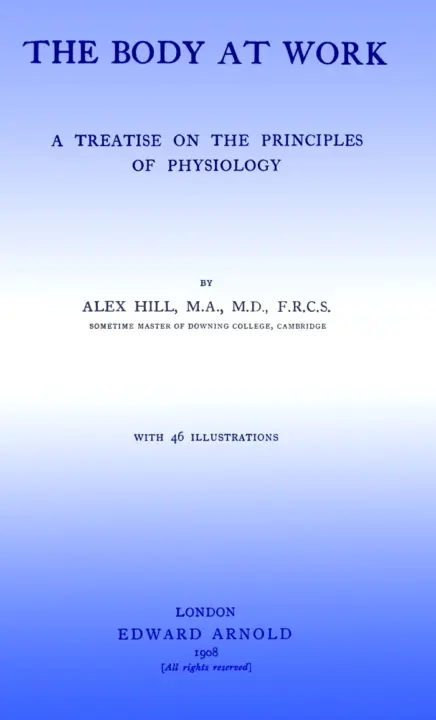
"The Body at Work: A Treatise on the Principles of Physiology" by Alex Hill is a scientific publication written in the early 20th century. The work discusses the various functions and interdependencies of physiological processes in living organisms, emphasizing the study of life and its manifestations rather than just anatomical structures. Hill aims to address the complexities of physiology in an accessible manner for readers unfamiliar with the foundational sciences. The opening of the treatise introduces the field of physiology, establishing it as the science concerned with the activities and functions of living beings. Hill contrasts physiology with anatomy, emphasizing that the former focuses on understanding how the body operates and responds to stimuli as opposed to merely detailing its structural components. He argues that the physiologist's role evolves through observational experimentation, leading to inferences about bodily functions, a process that historically highlights the interplay between living systems and their underlying structures. This section sets the stage for an exploration of life forms and their complex functionalities throughout the text.
Introduction adapted from the source catalogue; source summaries may be automatically generated.
Free to read · English · 172,268 words · No account needed
MAKE TIME FOR A GOOD BOOK
On by default. Untick to stop anonymous reading totals. Each page counts after 10 seconds in view. How this works.
Anonymous counting is on unless you have switched it off.
The difficulty in the way of establishing a complete theory of the coagulation of blood increases when the phenomena of incoagulability are considered. Blood may be rendered incapable of clotting in a variety of ways. Leeches and other animals which suck blood have the capacity of rendering it incoagulable. If the heads are removed from a score of leeches, thrown into absolute alcohol, dried, ground in a pepper mill, extracted with normal saline solution, a dark turbid liquor is obtained. This liquor, after filtration and sterilization at a temperature of 120° C., injected into the veins of an animal, renders its blood incoagulable.
The preparation sold by druggists under the name “peptone,” when injected into the veins of a dog, renders its blood incoagulable. Commercial “peptone” is a mixture of many substances. Its anticoagulation-effect is not due to the peptone which it contains. It has been supposed to be due to imperfectly digested albumin and gelatin (proteoses), but products of bacteric fermentation (toxins and ptomaines) are more probably the active bodies. Not only is the peptonized blood of a dog incoagulable, but if this blood be injected into the veins of a rabbit (an animal upon which the direct injection of peptone has no effect), it diminishes the coagulability of the rabbit’s blood. If peptonized blood be mixed in a beaker with non-peptonized blood, it prevents the coagulation of the latter. There is little doubt but that the poison, whatever it may be, acts upon the leucocytes; and there are some reasons for thinking that the poison is not contained in the “peptone,” but is secreted by the liver of the animal into which the “peptone” has been injected.
A still more remarkable property in relation to coagulation must be assigned to leucocytes. The blood of a dog which has been rendered incoagulable by injection of peptone recovers its coagulability after a time. If a further injection of “peptone” be made, the animal is found to be immune. Injection of “peptone” no longer renders its blood incoagulable. In a similar manner the blood develops a power of resisting the action of agents which induce its coagulation whilst circulating in the vascular system. Nucleo-proteins contained in extracts of lymphatic glands and other organs when injected into the veins of living animals cause their blood to clot, provided they are injected in sufficient quantity. If they are injected in quantity less than sufficient to induce coagulation, they render the animal immune to their influence. A larger quantity given to an animal thus prepared fails to take effect. This brings the phenomena of coagulation and resistance to coagulation to the verge of chemistry. They extend into the domain in which pathology reigns. Tempting though it be to record other facts with regard to these phenomena which recent investigation has brought to light, it is probably judicious to leave the problem at the frontier. Across the frontier lies a fascinating land, rich with unimaginable possibilities for the human race. Settlement is rapidly proceeding in this country, which is charted, like other border-lands, with barbarous names: “antibodies,” “haptors,” “amboceptors,” “toxins,” “antitoxins,” and the like—finger-posts to hypotheses which show every sign of hasty and provisional construction. But certain facts stand out, in whatever way theory may, in the future, link them up. The virus of hydrophobia, modified by passing through a rabbit, develops in human beings, even when injected after they have been infected, the power of resisting hydrophobia. The serum of a horse which has acquired immunity to diphtheria aids the blood of a child, which has not had time to become immune, in destroying the germs of this disease. It is a contest between the blood and offensive bodies of all kinds which find entrance to it, whether living germs or poisons in solution; with victory always, in the long-run, on the side of the blood, provided its owner does not die in the meantime. And not only is the blood victorious in the struggle with any given invader, but having repulsed him, it retains for a long while a property which neutralizes all further attempts at aggression on his part. In the past, physicians have fought disease with such clumsy weapons as mercury, arsenic, and quinine. Now they anticipate disease. In mimic warfare with an attenuated virus the blood is trained to combat. Smallpox which has been passed through the body of a cow is suppressed by the blood’s native strength. The exercise develops skill to deal with the most virulent germs of the same kind. In cases in which physicians cannot anticipate disease in human beings, they train the blood of animals to meet it; and, keeping their serum in stock, they can, when the critical moment arrives, reinforce the fighting strength of the patient with this mercenary aid.
Your reading position is saved on this browser. Take it to another device with a library code. Reading pages adapt to text, rather than matching a printed edition.
BEHIND THE BOOK
This eBook is for the use of anyone anywhere in the United States and most other parts of the world at no cost and with almost no restrictions whatsoever. You may copy it, give it away or re-use it under the terms of the Project Gutenberg License included with this eBook or online at www.gutenberg.org. If you are not located in the United States, you will have to check the laws of the country where you are located before using this eBook. Read the source licence.
The original source file, including credits and licence, is retained by this library. Request an original-format copy at no charge. Please include the book title and Project Gutenberg identifier #63089.
KEEP YOUR CURIOSITY GOING
John Muir

Asa Gray
Asa Gray

Florence Nightingale
Elizabeth Robins Pennell
Denison Olmsted