
Letters to a Friend, Written to Mrs. Ezra S. Carr, 1866-1879
John Muir
THE CLASSIC COLLECTION · 1908
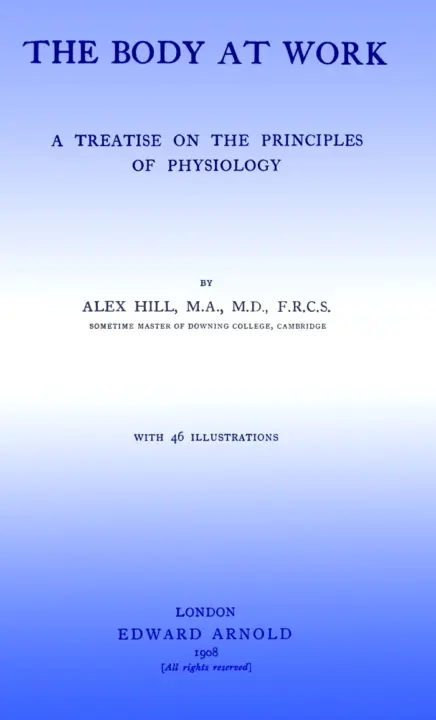
"The Body at Work: A Treatise on the Principles of Physiology" by Alex Hill is a scientific publication written in the early 20th century. The work discusses the various functions and interdependencies of physiological processes in living organisms, emphasizing the study of life and its manifestations rather than just anatomical structures. Hill aims to address the complexities of physiology in an accessible manner for readers unfamiliar with the foundational sciences. The opening of the treatise introduces the field of physiology, establishing it as the science concerned with the activities and functions of living beings. Hill contrasts physiology with anatomy, emphasizing that the former focuses on understanding how the body operates and responds to stimuli as opposed to merely detailing its structural components. He argues that the physiologist's role evolves through observational experimentation, leading to inferences about bodily functions, a process that historically highlights the interplay between living systems and their underlying structures. This section sets the stage for an exploration of life forms and their complex functionalities throughout the text.
Introduction adapted from the source catalogue; source summaries may be automatically generated.
Free to read · English · 172,268 words · No account needed
MAKE TIME FOR A GOOD BOOK
On by default. Untick to stop anonymous reading totals. Each page counts after 10 seconds in view. How this works.
Anonymous counting is on unless you have switched it off.
When large vessels have been severed, the copious hæmorrhage which follows induces fainting. For a short time the heart stops, or beats very feebly. The blood-pressure falls. The bloodvessels contract. A clot has time to form. An emotional tendency to faint at the sight of blood is a provision for giving the various causes which stop bleeding an opportunity of coming into play. It is a useful reflex action, always supposing that the person who is liable to it faints at the sight of his own blood. Amongst other reasons for the greater fortitude of women—they are far less subject to this emotional reflex than men—might be alleged the circumstances of life of primitive people. It was the part of their women-folk to dress wounds, not to receive them.
The phenomenon of coagulation has attracted attention from the earliest times. It was a phenomenon that needed explanation, and culinary experience suggested analogies close at hand. Hippocrates attributed the clotting of blood to its coming to rest and growing cold. The blood which gushed from a warrior’s wound formed a still pool by his side. It set into a jelly as it cooled. Until the second quarter of the nineteenth century this theory was deemed sufficient. It then occurred to two men of inquiring mind to institute control experiments. John Davy placed a dish of blood upon the hob. William Hunter kept one shaking. In both experiments the blood clotted more quickly than it did in vessels of the same size, containing the same amount of the same blood, left upon the table.
Even before this date an observation had been made regarding the circumstances in which clotting occurs, which has thrown much light upon the causes of the phenomenon. In 1772 Hewson gently tied a vein in two places. At the end of a couple of hours he opened the vein. The blood was still liquid, but clotted in a normal manner after it was shed. Scudamore showed that blood clots more slowly in a closed than in an open flask. A new theory, as little trustworthy as Hippocrates’, was based upon these observations. Blood clotted because it was exposed to air. A record of all observations of the circumstances of coagulation, and of all the theories to which they have given rise, would make an exceptionally interesting chapter in the history of human thought. It would bring into singular prominence stages in the development of what is now known as the “scientific method.” Not that Science has a method of her own. Philosophers of all classes would follow the same method if their data allowed of its application. The peculiarity of the data with which Science deals is that they can be brought to a test of which the data of historical, or political, or economic theory are not susceptible. They can be confronted with control experiments. The control experiment is the alphabet and the syntax of the scientific method. No hypothesis is admissible into the pyramid of theory until it has passed this test. A natural phenomenon is observed. Every measurement which is applicable is taken and recorded—time, weight, temperature, colour. Scientific observation implies the tabulation of all particulars which are capable of statistical expression. Reflecting upon the relation of the phenomenon to other phenomena of a like nature, the philosopher—it is the philosophy of physiologists which interests us—formulates an hypothesis as to its cause. At this point the real difficulty of applying the scientific method begins. It is easy to formulate hypotheses. It is very difficult to devise control experiments. An experiment must be arranged which will provide that, while all other conditions in which the phenomenon has been observed to occur are reproduced, the condition which was ex hypothesi its cause shall be omitted. This digression into the philosophy of science may seem to be somewhat remote from our line of march, but it may perhaps hasten our progress in the comprehension of the story of physiology. There is no other science in which the control experiment plays an equally important part. Unless this is realized, the whole trend of experimental work will be misunderstood. Scudamore explained coagulation as due to contact with air. Based on the observations we have cited, no hypothesis could have seemed more reasonable. With a view to checking this hypothesis, blood was received into a tube of mercury. It coagulated in the Torricellian vacuum. Scudamore’s hypothesis, like many earlier and later, when confronted with a control experiment, was turned away, ashamed.
Your reading position is saved on this browser. Take it to another device with a library code. Reading pages adapt to text, rather than matching a printed edition.
BEHIND THE BOOK
This eBook is for the use of anyone anywhere in the United States and most other parts of the world at no cost and with almost no restrictions whatsoever. You may copy it, give it away or re-use it under the terms of the Project Gutenberg License included with this eBook or online at www.gutenberg.org. If you are not located in the United States, you will have to check the laws of the country where you are located before using this eBook. Read the source licence.
The original source file, including credits and licence, is retained by this library. Request an original-format copy at no charge. Please include the book title and Project Gutenberg identifier #63089.
KEEP YOUR CURIOSITY GOING
John Muir

Asa Gray
Asa Gray

Florence Nightingale
Elizabeth Robins Pennell
Denison Olmsted